New research highlights the importance of Roberts Bank for young Chinook salmon
Wild Chinook are better foragers, but all young salmon depend on healthy eelgrass habitat.
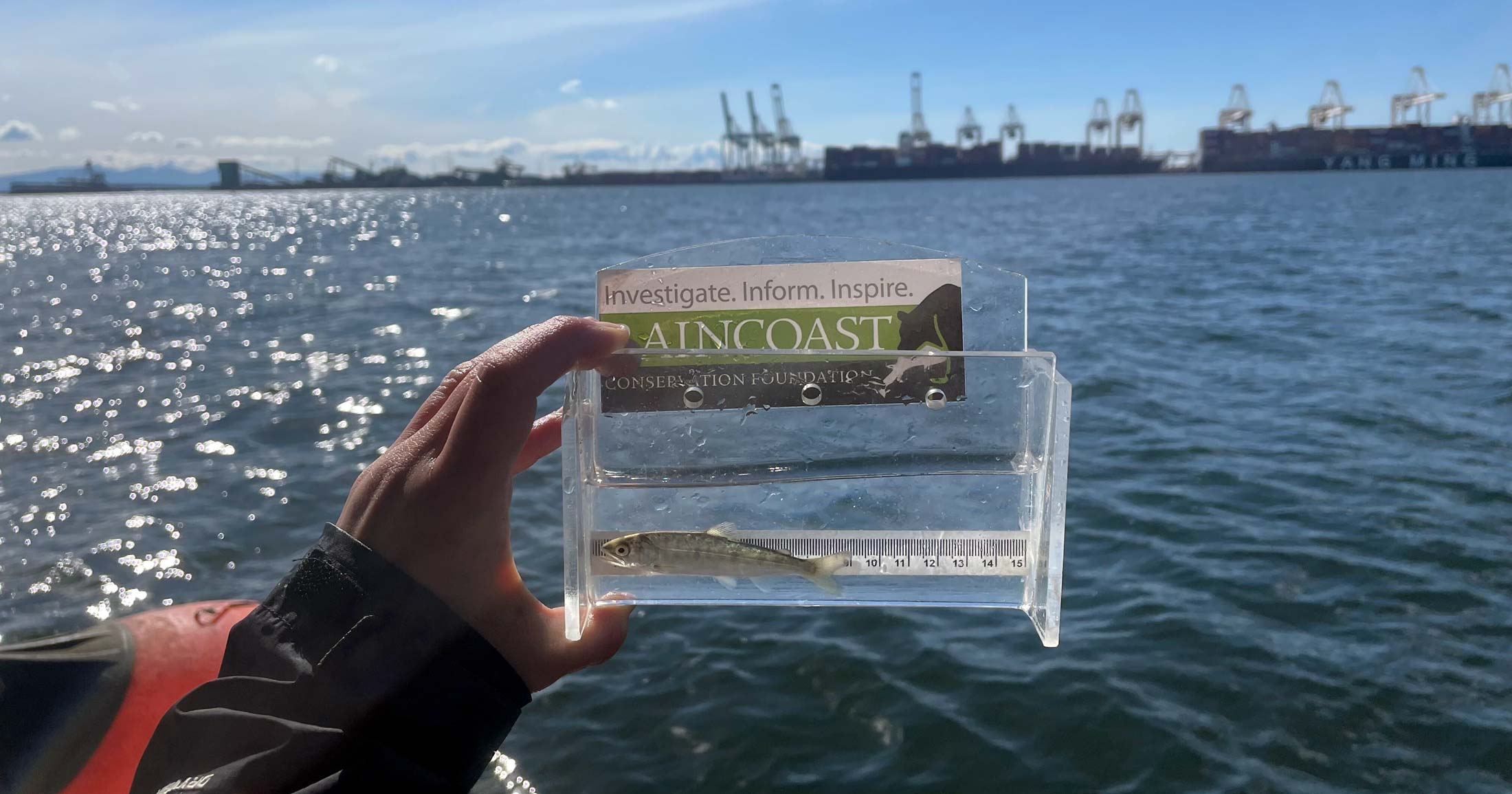
What are young Chinook salmon eating as they pass through the Fraser River Estuary? A new Raincoast report finds that the answer depends on whether they’re of wild or hatchery origin, and that both rely heavily on the eelgrass habitat of Roberts Bank.
Wild juvenile Chinook had fuller stomachs, ate a more varied diet, and began feeding on fish earlier than their hatchery counterparts. But despite these differences, both groups depended on Roberts Bank eelgrass beds as a key source of fish prey.
The findings carry weight for how hatcheries are managed, and for the future of Roberts Bank, where critical habitat is currently at risk from development.
Citation
Roper PET, Scott DC, Hunt BPV, MacDuffee M, Rhodes S, Hinch SG. 2026. Dietary analysis of wild and hatchery juvenile chinook salmon (oncorhynchus tshawytscha) in the Fraser river estuary reveals ontogenetic and foraging differences. Canadian Journal of Fisheries and Aquatic Sciences. 83:1–17. doi:10.1139/cjfas-2026-0044.
Abstract
Estuaries provide critical rearing areas for both wild and hatchery juvenile Chinook Salmon (Oncorhynchus tshawytscha) but there has been limited examination of differences in diets between these two groups of fish, and how diets change during the months long estuarine rearing period. In 2021 and 2022, we examined size, stomach contents, and stomach fullness of 142 juveniles of wild and hatchery origin from eelgrass habitat in the Fraser River estuary. An additional 37 wild origin fish from marsh and sandflat habitats were obtained—hatchery origin fish were rarely found in those habitats. In eelgrass habitat, stomach fullness increased with fish size and was ~51% higher in wild fish compared to hatchery fish, despite hatchery fish being ~3.5% longer on average than wild fish. Size and time of year were indicators of juvenile’s transition to a primarily piscivorous diet, which was observed earlier and at smaller sizes in wild fish than hatchery fish.