The wild diet of sea wolves
Camera-trap footage offers a rare glimpse into the unique ecology of coastal wolves scavenging on a Pacific sleeper shark.
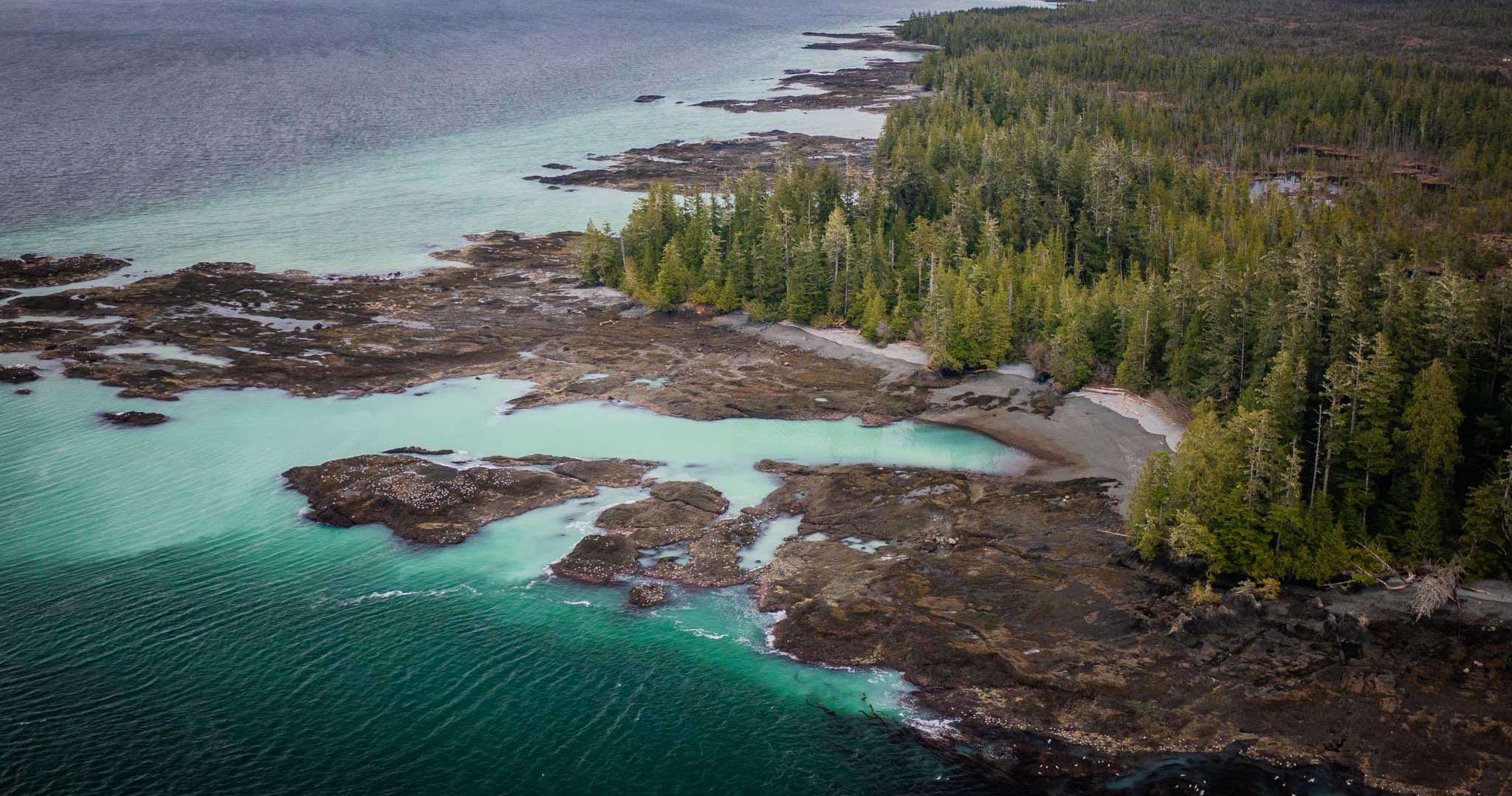
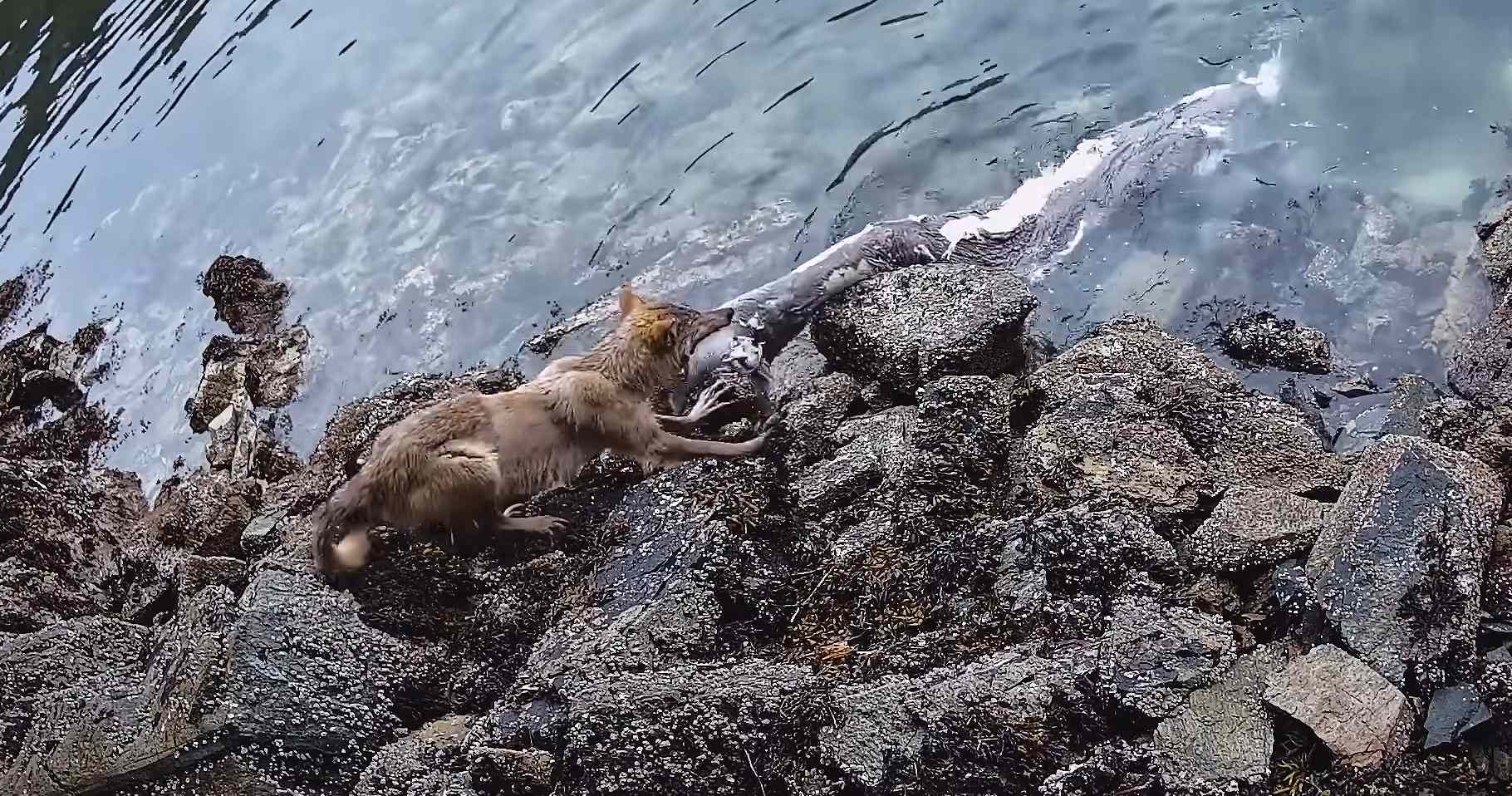
Earlier this spring, local guides made a remarkable discovery when a rare Pacific sleeper shark (Somniosus pacificus) washed ashore in Kitasoo Xai’xais Territory. After setting up a camera trap, the team captured unprecedented footage of coastal wolves scavenging on the deep-sea shark, revealing a striking connection between ocean depths and life along the coast.
Featured in a new short documentary by CBC British Columbia, The Wild Diet of Sea Wolves brings together community observations and marine science to explore these ecological relationships and highlight the enduring role of Indigenous stewardship in safeguarding the region’s interconnected ecosystems.
The documentary features Sierra Hall, Wildlife Coexistence Coordinator, and Jasspreet Sahib, Marine Ecologist, with the Kitasoo Xai’xais Stewardship Authority, alongside Aaron Bechard, bear guide at Spirit Bear Lodge. Raincoast’s Science Director, Dr. Chris Darimont, also shares his insights on the elusive coastal wolves and what this remarkable footage reveals about their ecology.
CD: Wolves of the rainforest on the coast are very different genetically, ecologically, morphologically, in how they look, and certainly behaviourally.
CD: You can think of them as an animal that’s terrestrial in origin, but that has been shaped over millennia by the ocean and its resources. What has evolved is this highly adapted organism to the marine environment, which is a really different way to think about wolves. Most people, when they think about wolves, think about a wolf pursuing something like a deer or a moose or an elk or a caribou. Not on the coast. Although they do eat deer, many of them eat much more from the ocean: salmon, some of the smaller marine-oriented mammals like mink and river otter, some of larger ones like sea lion or sea otter, even some whales, and as we’re learning, sleeper sharks.
CD: This is a really cool sequence of videos that showed wolves problem-solving. One of them pushed a big piece of driftwood out of the way to get at the carcass. Another one tugged it out of the water. You see some really cool social interactions where likely family members – because that’s what a pack is, a family – were kind of arguing with one another over access to this bounty from the ocean.
CD: What we watched in the video is also a really good reminder that healthy wolf populations, and in fact all coastal wildlife populations, depend on a healthy ocean. An ocean that provides abundant resources. These wildlife species are really coupled or connected to the ocean. So, a healthy ocean will continue to give us healthy wildlife populations.
CD: What the video also reminded me of is that First Nations people, Indigenous people like the Kitasoo Xai’xais, are out there. They’re the eyes of the coast, and they saw this not far from the village, and immediately set up this beautiful piece of modern technology to give us all a really beautiful glimpse into the ecology of the coast, into the ecology of their neighbours, of their relatives, the wolves. And the story that we all get to see from this video is really beautiful.