
No buffer left: Southern Residents face too many threats
The jeopardy test is a legal line: a project cannot be authorized if it threatens the survival or recovery of a species.

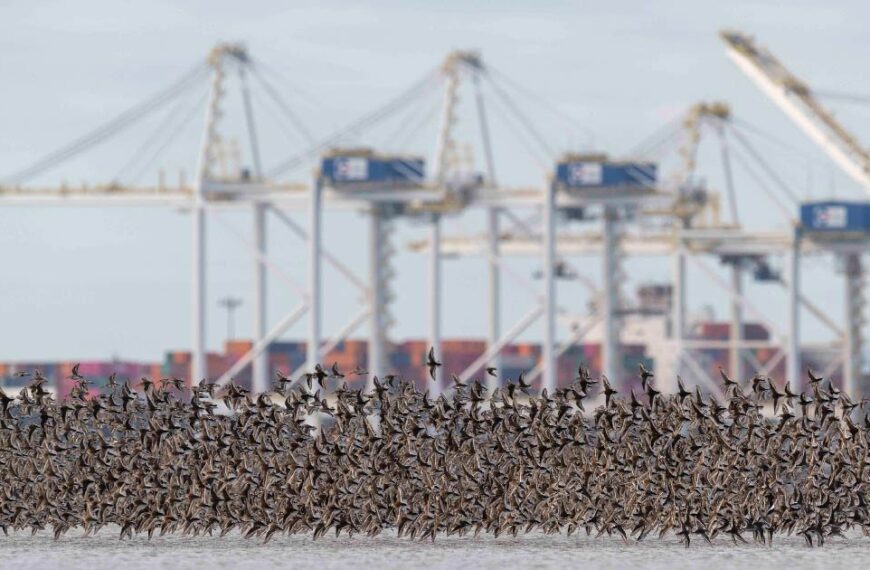
Southern Resident killer whales struggle with too little food, too much noise and too many toxic contaminants.12 A federal review found that the Roberts Bank port expansion (RBT2) near Vancouver would add to these pressures through more underwater noise, ship strike risk and impacts to Fraser River salmon.3 Now, an oil tanker terminal is also proposed at Roberts Bank.4 For these endangered whales, every added pressure makes recovery harder.5
Declining at an average of -1% per year
| Southern Resident killer whales are projected to decline at an average of 1% per year under existing levels of underwater noise, salmon and pollution.6 Reducing these threats can support their recovery; adding new ports and tankers could put it further out of reach. |
Fewer salmon. Less food.
- Chinook salmon are the whales’ main prey, but they have declined in size and numbers.7
- Recovery depends on whales finding enough salmon throughout the year.8
- The federal review panel expects RBT2 to harm Chinook salmon, adding to the cumulative stress on Southern Residents.9
Ship noise makes finding food harder
- Southern Residents need to hear the sound of their echolocation clicks to hunt for prey.10
- Underwater noise can drown out their clicks and calls. This makes it harder for whales to catch the prey they need.11
- As ship noise gets louder, Southern Residents are more likely to stop feeding.12
- Quiet time for the whales is important, and it is declining. From 2017 to 2025, summer vessel noise in Boundary Pass reduced their listening space by more than 80%.13
Pollution, spills & ship strikes can kill
- Southern Residents are already among the world’s most contaminated whales.14
- Long-lasting pollutants build up in milk and fat.15
- Oil spills harm whales when they inhale fumes or eat contaminated prey.16
- 22 killer whales died after exposure to the 1989 Exxon Valdez oil spill.17
- Ship strikes can be lethal. Southern Residents Sooke (L112), Luna (L98) and Doublestuff (J34) all died from ‘blunt force trauma’ collisions.1819
RBT2’s review panel was blunt
- More ships and loss of salmon habitat in the Fraser River Estuary would cause “significant adverse cumulative effects” to these whales.20
- With so few Southern Residents left, every whale matters. Even one fatal ship strike could have consequences for survival and recovery.21
Too little food. Too much noise. Too much pollution. Ship strikes. This is how extinction happens – one added pressure at a time.
Notes and references
- Fisheries and Oceans Canada. 2018. Recovery strategy for the northern and southern resident killer whales (Orcinus orca) in Canada [Proposed]. Species at Risk Act Recovery Strategy Series. Ottawa (ON): Fisheries and Oceans Canada. x + 84 p. https://wildlife-species.canada.ca/species-risk-registry/virtual_sara/files/plans/Rs-ResidentKillerWhale-v00-2018Aug-Eng.pdf
- Independent Science Panel on SRKW Recovery. 2025. Strengthening recovery actions for Southern Resident killer whales. Raincoast Conservation Foundation. 67 p. https://doi.org/10.70766/32.7300.
- Review Panel for the Roberts Bank Terminal 2 Project. 2020. Federal review panel report for the Roberts Bank Terminal 2 Project. Ottawa (ON): Impact Assessment Agency of Canada. 627 PDF pages. https://iaac-aeic.gc.ca/050/documents/p80054/134506E.pdf
- Government of Alberta. 2026. West coast oil pipeline project: submission by the Government of Alberta to the Major Projects Office for listing under the Building Canada Act. Edmonton (AB): Government of Alberta. 89 PDF pages. https://open.alberta.ca/dataset/a529e3da-6368-43d7-af43-74b1773be517/resource/6e43e4b4-3dfe-4c28-b723-116b6cab19ea/download/west-coast-oil-pipeline-project-submission-to-mpo.pdf
- Williams R, Lacy RC, Ashe E, Barrett-Lennard L, Brown TM, Gaydos JK, Gulland F, MacDuffee M, Nelson BW, Nielsen KA, Nollens H, Raverty S, Reiss S, Ross PS, Salerno Collins M, Stimmelmayr R, Paquet P. 2024. Warning sign of an accelerating decline in critically endangered killer whales (Orcinus orca). Commun Earth Environ. 5:173. https://doi.org/10.1038/s43247-024-01327-5.
- Williams et al. 2024.
- Fisheries and Oceans Canada 2018.
- Fisheries and Oceans Canada 2018.
- Review Panel for the Roberts Bank Terminal 2 Project 2020.
- Tennessen JB, Holt MM, Wright BM, Hanson MB, Emmons CK, Giles DA, Hogan JT, Thornton SJ, Deecke VB. 2024. Males miss and females forgo: auditory masking from vessel noise impairs foraging efficiency and success in killer whales. Glob Chang Biol. 30(9):e17490. https://doi.org/10.1111/gcb.17490.
- Tennessen et al. 2024.
- Williams R, Ashe E, Yruretagoyena L, Mastick N, Siple M, Wood J, Joy R, Langrock R, Mews S, Finne E. 2021. Reducing vessel noise increases foraging in endangered killer whales. Mar Pollut Bull. 173(Pt A):112976. https://doi.org/10.1016/j.marpolbul.2021.112976
- McNeilly J, Hendricks B, Vergara V. 2026. NoiseTracker: Tracking vessel noise and its implications for Southern Resident killer whales in the Salish Sea. Raincoast Conservation Foundation. 69 p. https://doi.org/10.70766/8.76355.
- Ross PS, Ellis GM, Ikonomou MG, Barrett-Lennard LG, Addison RF. 2000. High PCB concentrations in free-ranging Pacific killer whales, Orcinus orca: effects of age, sex and dietary preference. Marine Pollution Bulletin. 40(6):504–515. https://doi.org/10.1016/S0025-326X(99)00233-7
- Fisheries and Oceans Canada 2018.
- Jarvela Rosenberger AL, MacDuffee M, Rosenberger AGJ, Ross PS. 2017. Oil spills and marine mammals in British Columbia, Canada: development and application of a risk-based conceptual framework. Archives of Environmental Contamination and Toxicology. 73(1):131–153. https://doi.org/10.1007/s00244-017-0408-7
- Exxon Valdez Oil Spill Trustee Council. n.d. Killer whales [Internet]. [accessed 2026 Sep 06]. https://evostc.state.ak.us/status-of-restoration/killer-whales/
- Raverty S, St Leger J, Noren DP, Burek Huntington K, Rotstein DS, Gulland FMD, et al. 2020. Pathology findings and correlation with body condition index in stranded killer whales (Orcinus orca) in the northeastern Pacific and Hawaii from 2004 to 2013. PLoS One. 15(12):e0242505. https://doi.org/10.1371/journal.pone.0242505
- Carretta JV, Oleson EM, Forney KA, Bradford AL, Yano K, Weller DW, Lang AR, Baker J, Orr AJ, Hanson B, Moore JE, Wallen M, Brownell RL Jr. 2024. Killer whale (Orcinus orca): Eastern North Pacific Southern Resident Stock. In: U.S. Pacific marine mammal stock assessments: 2023. U.S. Department of Commerce, NOAA Technical Memorandum NMFS-SWFSC-704. p. 122–129. https://doi.org/10.25923/aqdn-f357
- Review Panel for the Roberts Bank Terminal 2 Project 2020.
- Review Panel for the Roberts Bank Terminal 2 Project 2020.