Why Canada needs SARA’s jeopardy test
The jeopardy test is a legal line: a project cannot be authorized if it threatens the survival or recovery of a species.
Canada’s Species at Risk Act (SARA) is the federal law enacted in 2002 to protect and recover endangered wildlife in Canada.1 In 2026, Ottawa proposed an unprecedented change that would allow Cabinet to exempt major projects from Section 73 of SARA, one of Canada’s most important safeguards for endangered wildlife.2
The jeopardy test
Known as the jeopardy clause, Section 73 of SARA has a strict legal requirement that a project must not jeopardize the survival or recovery of a species.3 This is the jeopardy test.
What are at-risk species?
- Under SARA, species at-risk refers to extirpated, endangered, or threatened species, or those of special concern.4
- SARA requires recovery plans and protection for the Critical Habitat of threatened and endangered species.5
What is the jeopardy clause?
- The SARA jeopardy clause is designed to prevent species extinction as a result of a project undertaken in Critical Habitat.6
Why would a project need a SARA permit?
Under SARA Section 73, Ottawa may permit activities in Critical Habitat of an endangered species.7 A permit can be granted if these three conditions are met:8
- Alternatives were considered and the best reasonable option is selected;
- all feasible measures will minimize harm; and
- there is no threat (jeopardy) to survival or recovery.
The legal backstop for SARA
The jeopardy test looks at harm remaining after considering alternatives,
offsetting, and mitigation. If remaining harm from a proposed project still threatens a SARA-listed species, a section 73 permit cannot be issued.9
Is Ottawa putting SARA at risk?
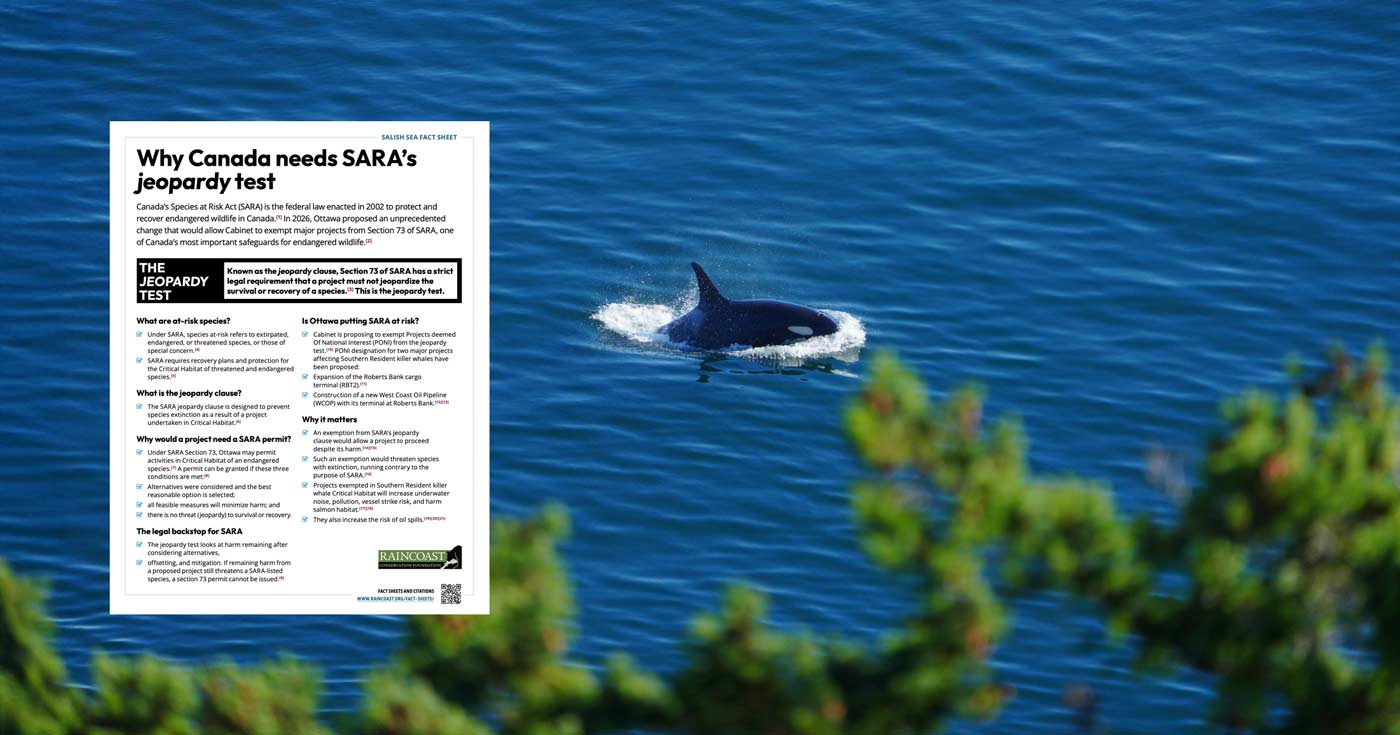
Cabinet is proposing to exempt Projects deemed Of National Interest (PONI) from the jeopardy test.10 PONI designation for two major projects affecting Southern Resident killer whales have been proposed:
- Expansion of the Roberts Bank cargo terminal (RBT2).11 12
- Construction of a new West Coast Oil Pipeline (WCOP) with its terminal at Roberts Bank.13 14
Why it matters
- An exemption from SARA’s jeopardy clause would allow a project to proceed despite its harm.15 16
- Such an exemption would threaten species with extinction, running contrary to the purpose of SARA.17
- Projects exempted in Southern Resident killer whale Critical Habitat will increase underwater noise, pollution, vessel strike risk, and harm salmon habitat.18 19
- They also increase the risk of oil spills.20 21 22
The jeopardy test is a legal line: a project cannot be authorized if it threatens the survival or recovery of a species.23
Notes and references
- Government of Canada. 2002. Species at Risk Act, S.C. 2002, c. 29 [Internet]. Ottawa (ON): Department of Justice Canada; [accessed 2026 Sep 4]. Cited s. 2, 6, 37, 56–58, 73. https://laws-lois.justice.gc.ca/eng/acts/s-15.3/
- Government of Canada. 2026a. Getting major projects built in Canada: discussion paper on proposed legislative, regulatory, and policy reforms [Internet]. Ottawa (ON): Government of Canada; [accessed 2026 Sep 4]. Cited proposal 6, item 8; Next steps. https://www.canada.ca/en/one-canadian-economy/services/simplifying-canada-process/engagement-supporting-timely-decision-making/getting-major-projects-built-canada-discussion-paper-proposed-legislative-regulatory-policy-reforms.html
- Government of Canada 2002.
- Government of Canada 2002.
- Government of Canada 2002.
- Government of Canada 2002.
- Government of Canada 2002.
- Government of Canada 2002.
- Government of Canada 2002.
- Government of Canada 2002.
- Government of Canada. 2026b. Notice—Roberts Bank Terminal 2 [Internet]. Canada Gazette Part I. 160(35); [accessed 2026 Sep 4]. Cited section Notice—Roberts Bank Terminal 2. https://gazette.gc.ca/rp-pr/p1/2026/2026-08-29/html/notice-avis-eng.html#nb3
- Government of Canada. 2026c. Notice—West Coast Oil Pipeline [Internet]. Canada Gazette Part I. 160(31), Supplement; [accessed 2026 Sep 4]. Cited section Notice—West Coast Oil Pipeline. https://gazette.gc.ca/rp-pr/p1/2026/2026-08-01/html/sup1-eng.html
- Government of Alberta. 2026. West Coast Oil Pipeline project: submission to the Major Projects Office [Internet]. Edmonton (AB): Government of Alberta. Cited PDF pp. 5–9, 50, 57–61, 85–88. https://open.alberta.ca/dataset/a529e3da-6368-43d7-af43-74b1773be517/resource/6e43e4b4-3dfe-4c28-b723-116b6cab19ea/download/west-coast-oil-pipeline-project-submission-to-mpo.pdf
- Government of Canada 2002.
- Government of Canada 2026a.
- Raincoast Conservation Foundation. 2026. Raincoast feedback on Getting Major Projects Built in Canada [Internet]. [accessed 2026 Sep 4]. Cited sections Raincoast’s submission; Implications for Southern Resident killer whales; Removal of the Jeopardy Test may be counterproductive. https://www.raincoast.org/2026/06/feedback-on-getting-major-projects-built-in-canada/
- Review Panel for the Roberts Bank Terminal 2 Project. 2020. Federal review panel report for the Roberts Bank Terminal 2 Project. Ottawa (ON): Impact Assessment Agency of Canada. 627 p. Cited PDF pp. 16–17, 229–232, 606–608. https://iaac-aeic.gc.ca/050/documents/p80054/134506E.pdf
- Fisheries and Oceans Canada. 2018. Recovery strategy for the northern and southern resident killer whales (Orcinus orca) in Canada [proposed]. Ottawa (ON): Fisheries and Oceans Canada. x + 84 p. Cited PDF pp. 27–30, 44–46. https://wildlife-species.canada.ca/species-risk-registry/virtual_sara/files/plans/Rs-ResidentKillerWhale-v00-2018Aug-Eng.pdf
- Review Panel for the Roberts Bank Terminal 2 Project 2020. https://iaac-aeic.gc.ca/050/documents/p80054/134506E.pdf
- Government of Alberta 2026.
- Fisheries and Oceans Canada 2018.
- Government of Canada 2002.