Listing Roberts Bank Terminal 2 as a Project of National Interest
The evidence does not support treating this project as being in the national interest.
Submitted by: Raincoast Conservation Foundation
To: Major Projects Office and the Honourable Dominic LeBlanc, Minister responsible for the Building Canada Act
Re: Canada Gazette notice concerning Roberts Bank Terminal 2
Submission email: RBT2Comment-CommentaireT2RB [at] mpo-bgp [dot] gc [dot] ca
Comment deadline: October 1, 2026
Date: October 1, 2026
Read our submission as a PDF
Recommendation
Raincoast Conservation Foundation asks the Governor in Council not to add RBT2 to Schedule 1 of the Building Canada Act.[2] The evidence does not support treating this project as being in the national interest. We remain concerned that there is no benefit from listing the project as a PONI this late in the review process and conversely, that it will bring significant consequences for Fraser River Chinook salmon and endangered Southern Resident killer whales (SRKW). RBT2’s Fisheries Act /Species at Risk Act permitting process was almost complete. Listing RBT2 as a PONI could fundamentally change the way the project proceeds.
The physical footprint of RBT2 would permanently alter 177 hectares of intertidal and subtidal habitat in the Fraser River estuary, Canada’s largest salmon producing watershed. It would affect the function of the estuary and further restrict access to juvenile salmon trying to reach eelgrass beds on Roberts Bank. Currently, no adequate mitigation to this problem is being advanced. The federal Review Panel also found significant adverse and cumulative effects on Southern Resident killer whales, Lower Fraser and South Thompson Chinook salmon, other species and habitats. They also concluded there was no adequate proposal to mitigate increased underwater noise and its effects on Southern Resident killer whales. [1]
Designation as a PONI is not an appropriate use of the Building Canada Act. Raincoast is concerned that the national interest cannot be reduced to container capacity, trade volume and construction speed when the proposal is in the Fraser River Estuary. Promises and investments announced by the federal government on Sept 29 to ensure prosperity by combining regulatory certainty with environmental protection are an insufficient guarantee given the level of harm identified from this project.
Summary of reasons
| Reason | Why it matters |
|---|---|
| Listing is unnecessary to avoid delay. | The SARA permitting process was reportedly 92 percent complete as of August 31, 2026, with a target completion date of October 28, 2026. The government should explain what delay a PONI listing is intended to cure and why the process cannot be completed under the existing timeframe. |
| Listing risks overriding the safeguards in the Species at Risk Act | Because SARA is included in Schedule 2 of the Building Canada Act, listing RBT2 as a PONI allows federal decision makers to favour approval without assessing the projects level of harm against the jeopardy test.[2] Since RBT2 requires a SARA permit, the no-jeopardy analysis should be completed as intended and not overtaken by an exceptional approval mechanism. |
| The federal assessment found serious and cumulative harm. | The Review Panel found significant adverse and cumulative effects on Southern Resident killer whales and Chinook salmon, as well as significant adverse and cumulative effects on wetlands and marshes. It also found that the proposed 29-hectare aquatic offsetting plan was insufficient to compensate for productivity losses associated with 177 hectares of habitat conversion. |
| Conditions cannot make an unmitigable effect disappear. | The Panel found that the Port’s (VFPA) voluntary vessel slowdowns initiatives are not mitigation for underwater noise. Information available to Raincoast indicates that DFO has not endorsed a workable method to offset underwater shipping noise. Conditions imposed after listing do not guarantee the project will not jeopardize SRKW survival or recovery. |
| The claimed national benefits have not been presented as a transparent net-benefit case. | Government emphasizes trade, GDP and employment, but there is no public record on the assumptions, distribution of benefits, public and environmental costs, liabilities, or a comparison with lower-impact alternatives (like DP4) that are needed to evaluate the national interest. Estuaries in the Salish Sea provide over $5B worth of environmental services and benefits every year.[4] |
The Building Canada Act requires a genuine national interest determination
The Canada Gazette notice asks for views on considerations that should guide the listing decision and identifies five factors:[3]
- the extent to which RBT2 can strengthen Canada’s autonomy, resilience and security;
- provide economic or other benefits;
- have a high likelihood of successful execution;
- advance the interests of Indigenous peoples; and
- contribute to clean growth and Canada’s climate objectives
The government must consider the whole project—not just its economic promises. Requests to the VFPA during the RBT2 hearing process to account for ecosystem services and the true economic cost associated with impacts to the estuary’s habitat and function, were rejected. These costs don’t vanish; they are absorbed by other people and governments. Yet still, only the terminal construction comes with a price tag.
Permanent habitat loss, harm to endangered species, impacts on pollution, climate costs and impacts to First Nations cannot be dealt with later. Even the Building Canada Act calls for environmental protection and respect for Indigenous rights.
Listing RBT2 would also change the approval process. Because the Species at Risk Act and Fisheries Act are covered by the Building Canada Act, decisions are designed to favour approval. So the question would shift from whether RBT2 should proceed, to what are the conditions that should apply.
Listing would provide little legitimate scheduling benefit
RBT2 is not an early-stage proposal stalled among duplicative preliminary reviews. It underwent a multi-year assessment by an independent Review Panel, received a federal decision statement in 2023 and entered the remaining permitting stage to review the SARA. The federal government itself describes the project as having completed the impact assessment and pending final permits.
Raincoast understands that the Fisheries Act permitting process, including the Species at Risk Act requirements needed for permitting the destruction of SRKW critical habitat, began following the VFPA’s application in October 2024. As of August 31, 2026, the federal project page reportedly showed a target completion date of October 28, 2026, and stated that the process was 92 percent complete.
Against that timeline, listing cannot reasonably be justified merely by invoking the need for a faster timeline. The government should identify each remaining authorization, its current stage, the information still required, and the time that listing is expected to save. It should also disclose whether ECCC or DFO has advised that the project can or cannot satisfy the jeopardy test. Without that information, the public cannot determine whether listing is being used to coordinate an approval or to avoid a lawful refusal.
Bypassing SARA’s no-jeopardy test
Southern Resident killer whales are endangered under SARA Schedule 1. They face interacting, additive and likely synergistic threats [8] from insufficient Chinook salmon prey, underwater noise, contaminants and vessel strikes. Their Canadian critical habitat includes the waters at Roberts Bank and other parts of the Fraser River estuary. It also includes many parts of the southern Salish Sea that are overlapped by the shipping routes of vessels headed to the Port of Vancouver. The federal Recovery Strategy identifies the need to increase prey availability, reduce acoustic and physical disturbance, and reduce contaminants [7]. The federal government has also made two imminent threat decisions, finding in 2018 and again in 2024 that SRKW face imminent threats to their survival and that intervention is required to allow for survival and eventual recovery.
Section 73 of SARA ensures a check before an activity affecting endangered wildlife or their critical habitat may be authorized. Reasonable alternatives must be considered, all measures feasible must be taken to minimize impacts, and the activity must not jeopardize the survival or recovery of the species or population. This no-jeopardy requirement is a backstop: where harm cannot be avoided, mitigated or offset sufficiently, a permit cannot be issued.
The federal Review Panel found that RBT2 would reduce Chinook prey availability, increase underwater noise and vessel-strike risk, and destroy part of Southern Resident killer whale critical habitat. It found these pathways could act synergistically and concluded that the project and associated vessel traffic would cause significant adverse cumulative effects on the population.[1]
The federal Review Panel also found regional noise-reduction initiatives were voluntary and could not be relied upon as project mitigation. Raincoast gathers from information reviewed during the SARA permitting process, that DFO scientists found unresolved methodological and practical obstacles to offsetting underwater shipping noise through vessel slowdowns. As such, they did not endorse the proposed framework.[6] If there is no reliable means to offset the project’s projected increases in noise, this information is central to the no-jeopardy analysis.
Listing RBT2 before DFO completes and publishes the no jeopardy analysis creates a reasonable assumption that the Building Canada Act is being used to avoid that determination. The Governor in Council should not sanction that approach. At minimum, no listing decision should be made until the responsible ministers publish the completed scientific and legal advice on section 73, including the proposed mitigation and offsetting measures and the basis for concluding whether those measures are feasible and effective.
The environmental record weighs against national interest listing
Southern Resident killer whales
The Panel’s findings were not limited to a small, isolated project effect. It found a permanent and irreversible adverse effect on prey availability; increased behavioural disturbance and acoustic masking from marine shipping; a low-probability vessel strike capable of population-level consequences; and interactions among these effects that could be greater than each effect alone. It concluded that both the project-specific effect and the cumulative effect would be significant.[1]
More recent scientific synthesis reinforces the need to reduce, not add to, these threats. Recovery requires adequate Chinook prey and measurable reductions in vessel noise and disturbance. A 2023 letter in Science warned that RBT2 would add habitat destruction, pollution and noise in critical habitat while the population remains at high risk of extinction under existing conditions.[9] New spending on whale protection does not neutralize a decision to authorize a project that increases the same threats. Recovery programs and project mitigation must be additional, effective and enforceable.
Fraser River Chinook salmon and estuary habitat
The Fraser River estuary is a nursery and migration corridor for salmon from throughout the watershed. Juvenile salmon use its marshes, mudflats and eelgrass meadows to feed, grow, avoid predators and transition from freshwater to marine conditions. Most (85%) of the estuary’s former floodplain habitat has already been lost or disconnected, increasing the importance of what remains.[10]
The Review Panel concluded that RBT2 would cause significant adverse and cumulative effects on ocean-type juvenile Chinook salmon from the Lower Fraser and South Thompson rivers. These fish would face migration disruption from the terminal footprint, preventing them from reaching the eelgrass beds on the south side of the terminal. They would also face changes to underwater light and sound. These same Chinook populations are important prey for Southern Resident killer whales, linking these direct effects on Chinook habitat to the whales’ recovery.[1]
The proposed offsetting does not resolve these findings. The Panel found the 29-hectare aquatic offsetting plan insufficient to compensate for productivity losses associated with 177 hectares of habitat conversion. It also found significant adverse and cumulative effects on marsh and wetland function, including permanent and irreversible residual effects. Habitat created elsewhere in the Fraser River cannot replace the location, connectivity, ecological timing and functions of the habitat lost at Roberts Bank.[1]
The Fraser estuary as an irreplaceable system
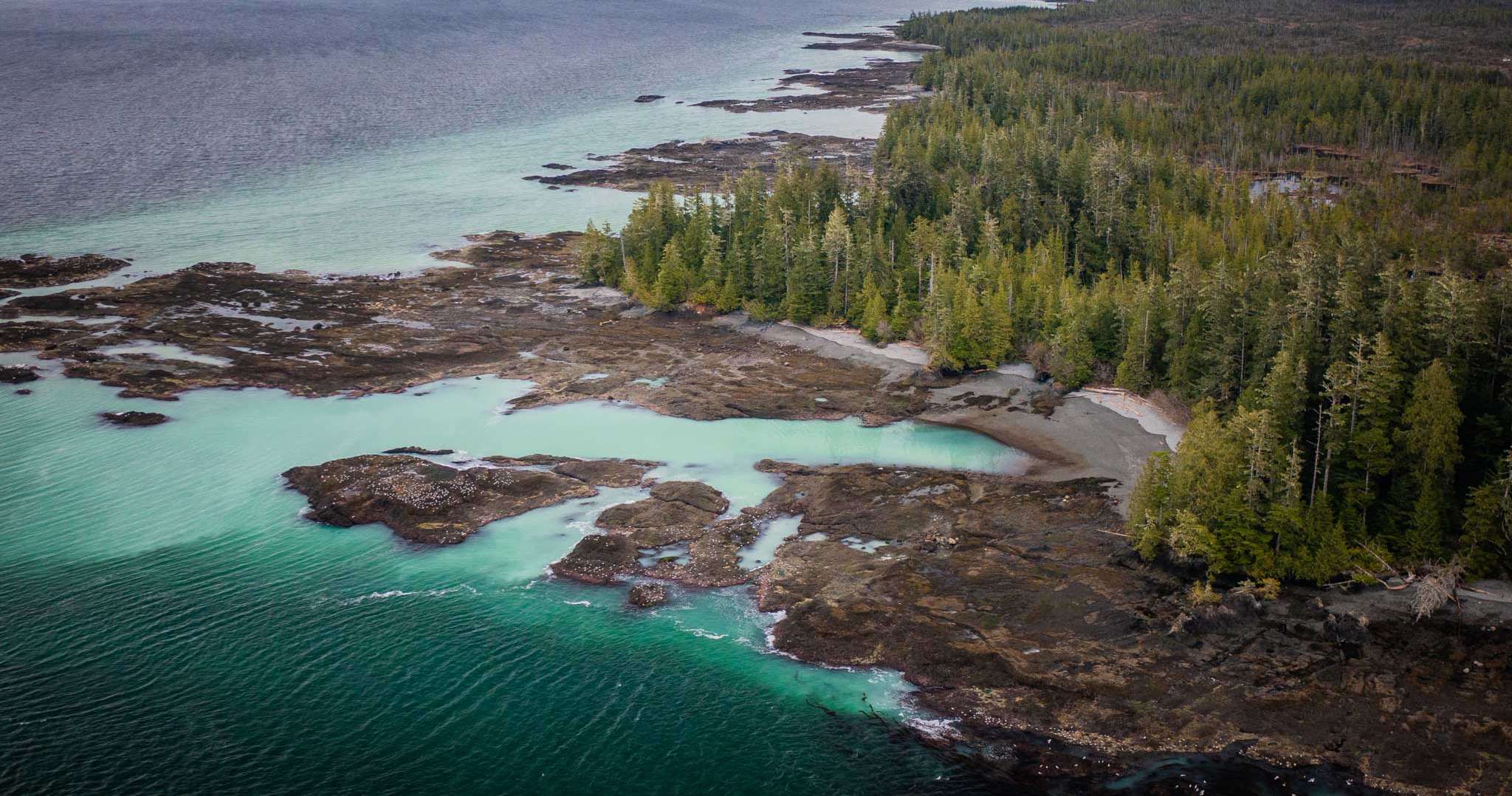
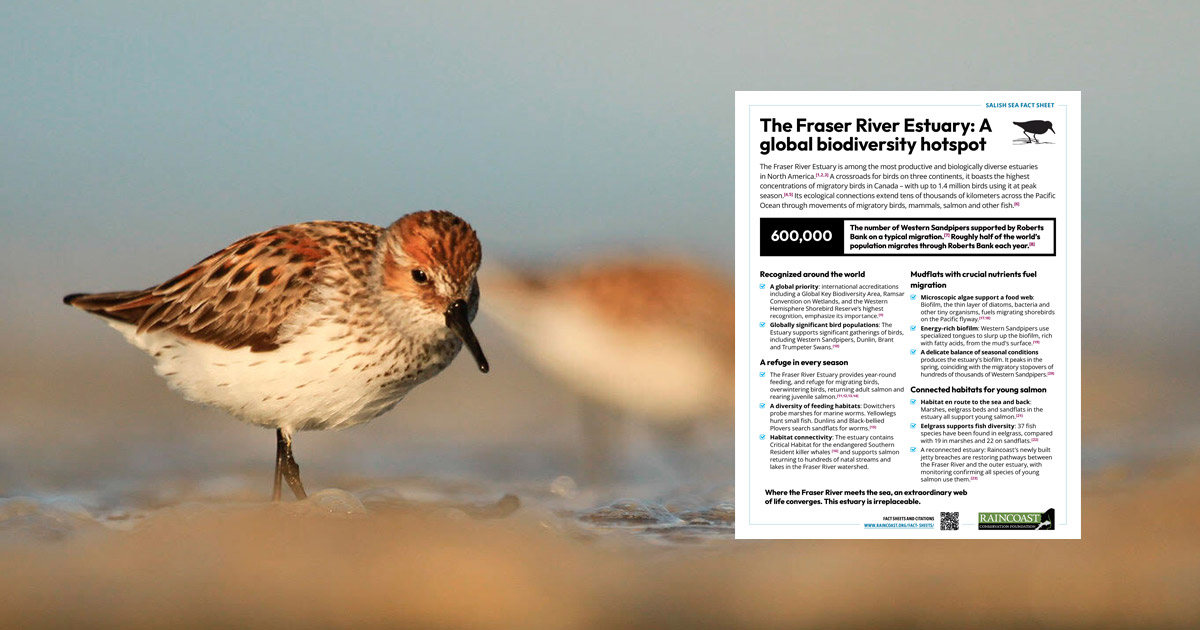
Roberts Bank forms part of a globally significant estuary supporting salmon, forage fish, migratory birds and marine mammals. Its mudflats and biofilm support major concentrations of migratory shorebirds; its eelgrass and shallow waters support diverse fish communities; and its ecological connections extend across the North Pacific through the pathways of salmon, birds and marine mammals.[11]
While the Panel could not reach a confident conclusion about the project’s effect on the production of polyunsaturated fatty acids in biofilm, a potentially critical food resource for Western Sandpipers, as the science was still emerging. Research since the Review Panels work has added to the understanding of biofilm processes, fatty acids and the importance of Roberts Bank. During the review, Environment and Climate Change Canada (ECCC) warned that disrupting the salinity regime at Roberts Bank could pose a species-level risk to Western sandpipers and other shorebirds, and that high-quality biofilm habitat could not be recreated. ECCC also noted that because shorebird use of Roberts Bank is so high, even low-probability effects carry a high risk. The Panel agreed with ECCC that creating mudflats is unproven as mitigation for biofilm.[1] When considering irreversible development in an already degraded internationally recognized estuary, uncertainty supports precaution and retention of remaining habitat. Because of the global significance of this habitat, the implications of disrupting these processes have global consequences.
Cumulative effects must be addressed now, not left for some future time
The listing decision must reflect existing and reasonably foreseeable pressures, not assess RBT2 in isolation. The Salish Sea already has a high vessel traffic volume and underwater noise. Southern Resident killer whales are already nutritionally stressed and exposed to contaminants. The Fraser estuary has already lost extensive habitat. The Panel expressly found that RBT2 would add to significant cumulative effects.[1]
The federal government is also advancing a West Coast oil pipeline with a marine terminal at Roberts Bank. Even if that proposal remains at an early stage, the government cannot credibly promote multiple nation-building projects in the same endangered killer whale critical habitat while postponing their combined effects to separate, later processes. The potential overlap in underwater noise, vessel traffic, habitat alteration, pollution and spill risk must inform whether RBT2 should receive exceptional treatment now.
A condition-setting process after listing is not an adequate substitute. Once RBT2 is listed, the central decision becomes how the project will proceed. Conditions can regulate effects, but they cannot restore the independent option of refusing an authorization when a statutory threshold is not met, nor can they manufacture a proven offset where none exists.
The asserted economic case requires independent scrutiny
The government states that RBT2 would increase Port of Vancouver container capacity by approximately 50 percent, unlock roughly $100 billion in annual trade capacity, contribute more than $3 billion to GDP each year and support more than 17,000 ongoing supply-chain jobs.[5] These are substantial claims, but gross capacity is not the same as net national benefit.
Before relying on those figures, the Governor in Council should disclose the underlying studies, definitions and assumptions, including projected utilization, commodity and container flows, treatment of transshipment, displacement from other Canadian terminals, automation, public infrastructure costs, climate costs, habitat and fisheries losses, mitigation and offsetting costs, and sensitivity to trade and shipping trends. It should also provide an independent comparison with lower-impact alternatives, including optimization of existing terminals and distribution of capacity across Canadian gateways.
The Review Panel recognized that RBT2 could provide employment, business opportunities and additional west-coast container capacity. It did not conclude that those benefits erased the significant adverse effects it identified.[1] The listing decision is a new and more consequential decision under a statute that front-loads federal approval. It therefore requires an updated, transparent net-benefit analysis—not repetition of the proponent’s headline numbers.
Resilience also requires scrutiny. Concentrating additional trade infrastructure in a single ecologically sensitive gateway may increase throughput, but diversification and resilience are not synonyms. The government should assess physical climate risks, supply-chain concentration, rail constraints, seismic and flood exposure, and the opportunity cost of committing scarce industrial and ecological space to this project.
The project has not been shown to advance clean growth or climate objectives
The public rationale for listing emphasizes trade growth but does not demonstrate how the project contributes to clean growth or Canada’s climate objectives. Construction of a 120-hectare marine terminal landmass, a widened causeway and an expanded tug basin entails substantial material and construction emissions. Operations would add terminal energy demand and associated rail, truck, tug and marine activity.
The Governor in Council should require a current lifecycle greenhouse-gas assessment that distinguishes direct, upstream, downstream and induced emissions; tests realistic throughput scenarios; identifies binding measures rather than aspirations; and evaluates consistency with Canada’s legislated targets. Funding separate whale, salmon or marine-safety programs does not establish that RBT2 itself is clean growth.
Indigenous rights and interests require more than counting agreements
The government’s public materials rely heavily on the statement that the Vancouver Fraser Port Authority has mutual benefit agreements with 27 Indigenous groups.[5] Those agreements may be important to the parties, but their existence does not establish that RBT2 advances the interests of Indigenous peoples as a whole, that every potentially affected rights-holder supports listing, or that Canada has fulfilled its constitutional and statutory duties.
The Review Panel found that RBT2 would likely cause significant adverse and cumulative effects on current use by Tsawwassen First Nation and Musqueam Indian Band in the project area, and significant cumulative effects from project-related shipping on current use by Pacheedaht First Nation and Ditidaht First Nation. It also found significant adverse effects on cultural heritage for Tsawwassen First Nation and Tsleil-Waututh Nation in the project area.[1]
Canada must assess rights, effects, benefits and positions Nation by Nation. It should disclose which Nations may be adversely affected, the issues they raised, how those issues influence the listing decision, and any accommodation proposed. Private benefit agreements must not be characterized as consent unless the Nation itself has expressly authorized that characterization.
Requested decision and safeguards
Raincoast requests that the Governor in Council decline to list RBT2 in Schedule 1 of the Building Canada Act.
If the government is not prepared to decline listing on the present record, it should defer any decision until it has:
- allowed Fisheries and Oceans Canada to complete the existing Fisheries Act and Species at Risk Act review without direction or presumptions arising from a national interest listing;
- published the scientific and legal basis for determining whether RBT2 can satisfy the Species at Risk Act no-jeopardy requirement, including the feasibility and effectiveness of every proposed mitigation and offset;
- identified every remaining federal authorization and explained precisely what delay listing would prevent;
- released an independent net-benefit analysis and the evidence supporting the government’s capacity, GDP, employment, resilience and trade-diversification claims;
- completed and published a current lifecycle climate analysis;
- assessed cumulative effects with other proposed development at Roberts Bank, including the West Coast oil pipeline concept;
- completed meaningful, Nation-specific consultation and accommodation and accurately represented the positions of affected Indigenous rights-holders; and
- provided the public a meaningful opportunity to comment on that information before the listing decision is made.
Conclusion
RBT2 is not a project whose risks are unknown because assessment has not occurred. It is a project whose serious risks are known because a lengthy federal assessment documented them. The Review Panel found permanent habitat loss, significant adverse and cumulative effects on endangered Southern Resident killer whales and Chinook salmon, significant wetland effects, and significant impacts on Indigenous current use and cultural heritage. The remaining species-at-risk permit is not procedural debris; it is the legal mechanism intended to prevent a project from jeopardizing survival or recovery.
Using the Building Canada Act at the end of that process would save little time but could remove the possibility of the outcome the Species at Risk Act requires when jeopardy cannot be avoided. That is not regulatory coordination. It is a substantive change with potentially irreversible consequences. Canada should complete the lawful permitting process and decline to list Roberts Bank Terminal 2 as a project of national interest.
Sources
[1] Federal Review Panel Report on Roberts Bank Terminal 2. 2020, March. See summary of key findings at 1–3; Wetlands at 162–163; Southern Resident killer whale at 214–217.
[2] Building Canada Act, S.C. 2025, c. 2, s. 4, ss. 4, 5–7, 23.1–24 and Schedule 2. Current consolidated text: https://laws-lois.justice.gc.ca/eng/acts/B-9.89/FullText.html
[3] Major Projects Office, Notice — Roberts Bank Terminal 2, Canada Gazette, Part I, Vol. 160, No. 35 (August 29, 2026): https://gazette.gc.ca/rp-pr/p1/2026/2026-08-29/html/notice-avis-eng.html
[4] Mackey E, Fletcher A, Cousins K. 2022. Nature’s value in the Salish Sea: non-market benefits and human wellbeing. Tacoma (WA): Earth Economics. https://pspwa.box.com/s/7bzycsghlbeyi5um0kboebevyywese2g/file/1548344085559
[5] Government of Canada, Roberts Bank Terminal 2 — Major Projects Office (updated August 28, 2026), and Backgrounder: Port of Vancouver Gateway Strategy (July 2026): https://www.canada.ca/en/privy-council/major-projects-office/projects/national/roberts-bank.html and https://www.canada.ca/en/one-canadian-economy/news/2026/07/port-of-vancouver-gateway-strategy.html
[6] Government of Canada. Access to Information. Discussions regarding the VFPA and Fisheries and Oceans Canada permitting review for Roberts Bank Terminal 2 project.
[7] Fisheries and Oceans Canada, Recovery Strategy for the Northern and Southern Resident Killer Whales (Orcinus orca) in Canada (2018).
[8] National Marine Fisheries Service. 2021. Southern Resident killer whales (Orcinus Orca) 5-Year Review: Summary and Evaluation. NOAA. https://www.fisheries.noaa.gov/s3//2022-01/srkw-5-year-review-2021.pdf
[9] MacDuffee M, Barrett-Lennard L, Chhor A, Dennert AM, Ross PS, Scott DC, Vergara V and Walters K. 2023. Will Canada permit killer whale extinction? Science 380.2023, DOI: 10.1126/science.adi5984.
[10] Finn RJ, Chalifour L, Gergel SE, Hinch SG, Scott DC, Martin TG. Quantifying lost and inaccessible habitat for Pacific salmon in Canada’s Lower Fraser River. Ecosphere. 2021 Jul;12(7):e03646.
[11] Kehoe LJ et al. 2021. Conservation in heavily urbanized biodiverse regions requires urgent management action and attention to governance. Conservation Science and Practice. 3(2):e310. Conservation Science and Practice 3: e310.