What is conservation finance?
A brief introduction to the field of conservation finance, and how Raincoast will incorporate it into our work to advance a conservation economy pilot.
Conservation finance is an evolving field with the objective of investing financial capital in ways that benefit biodiversity and ecosystems. Key to achieving this is recognizing that ecological processes and biodiversity support human wellbeing – such as providing clean water, reducing flood risk, and pollinating crops, for example. Conservation finance captures these processes in economic terms as ‘goods and services’ that businesses and governments can then invest in (London School of Economics, 2023). To mobilize capital, a variety of investment tools are used, including: building markets for nature (e.g., trading carbon or biodiversity credits) and developing new financial vehicles (e.g., green bonds, debt-for-nature swaps). While funding for conservation has historically come from governments and philanthropic organizations, conservation finance represents an opportunity to scale the funding required to meet international biodiversity targets – estimated at $1 trillion annually before 2030 and $4.1 trillion by 2050 (Smart Prosperity Institute, 2021).
Investments in natural capital are growing world wide: more than $60 billion was mobilized over the last decade, and annual flows have increased five-fold since 2016 (The Nature Conservancy, 2026). This investment has been concentrated mostly in the Americas, while Asia and Africa continue to remain underfunded. Interestingly, return-first investors (i.e., those who prioritize financial profit) are increasingly viewing nature investments as a strategic and competitive financial opportunity. A recent report by The Nature Conservancy surveyed investors and found that 88% identified a positive relationship between investment and impact. This marks a shift from earlier trends in investing, which relied on Environmental, Social, and Governance (ESG) goals and reputational signaling to drive investment into the environment. Now, there is a genuine business case for investing in the natural world that underpins food production, water security, and that helps regulate the risk of wildfires and floods.
While assigning economic value to natural ecological processes or species can seem to denote their inherent worth or value, conservation finance can instead be viewed as another way to attract the needed funding to support on-the-ground and policy work dedicated to protecting and restoring habitat, and recovering endangered species.
Conservation finance in Canada
There is tangible momentum in conservation finance in Canada, spanning the federal government, investors, research groups, and NGOs. The federal government’s A Force of Nature: Canada’s Strategy to Protect Nature supported the creation of the Expert Taskforce on Natural Capital Accounting and Nature Financing, which will explore how to better account for the value of nature and recommend new policies, incentives, and financing tools to encourage businesses and investors to support conservation. This Task Force brings together Indigenous and non-Indigenous conservation leaders from across Canada who will develop recommendations to increase the mobilization of private investment in nature-positive economies, and help shape government policies and financial instruments in support of these goals. Among thought leaders, groups such as the Nature Investment Hub and the Smart Prosperity Institute are leading efforts to accelerate public and private investment to halt and reverse biodiversity loss while advancing climate resilience.

Key examples of conservation finance in Canada have emerged over the last decade that have drawn on a range of investment tools. One notable model is Project Finance for Permanence (PFP), which secures partners, governance agreements, and long-term, large-scale investments from multiple revenue sources. Importantly, this model finalizes and executes funding and agreements simultaneously, eliminating the piecemeal approach of traditional conservation, which typically relies on short-term grants.
A key example of this model is the Great Bear Sea PFP, which secured $335 million in funding, with contributions from the Government of Canada ($200 million), the Province of British Columbia ($60 million) and philanthropic funders ($75 million). The initiative supports Indigenous-led conservation by 17 First Nations, in partnership with the federal and provincial governments. The Great Bear Sea is one of the most productive cold-water environments in the world, covering two-thirds of the coast of British Columbia. However, cumulative effects from increased shipping traffic, overfishing, habitat loss, and climate change are driving declines in a suite of shellfish, bird, and fish populations. The Great Bear Sea PFP aims to address these challenges by centring Indigenous leadership and empowering communities to manage land and water in ways that support job creation and economic development. Forecasted benefits from the PFP include: 3,000 new jobs, recovery of fish populations, 32,000 days of skills training, and progress toward 30×30 conservation goals through Marine Protected Areas.
Beyond the Central Coast, a recent report – Exploring Conservation Finance: Insights and Opportunities for BC Watersheds by the Action on Climate Team (ACT) at Simon Fraser University, in partnership with the Fraser Basin Council and Watersheds BC – identifies opportunities for conservation finance tools to support watershed-based work across the province. The report highlights growing momentum around ecosystem service payments, impact bonds, and carbon markets, and examines case studies of conservation finance vehicles that have been successfully implemented, including: the Forest Resilience Bond, Tlaoquiaht Tribal Parks Allies, and the Darkwoods Forest Carbon Project. Importantly, the report focuses on the applicability to BC watersheds and identifies the enabling factors that contribute to the success or limitations of each approach.
While conservation finance is still a developing field, there is significant opportunity to advance investment tools within Canada and British Columbia to help close the funding gap needed to recover biodiversity, support job creation, increase climate change adaptation, and foster nature-positive communities in a changing world.
How Raincoast is incorporating conservation finance into our work
The Living Economies Program builds on the success of Raincoast’s decade-long habitat restoration and conservation work in the Lower Fraser River. Over the past 10 years, our projects have removed barriers to fish passage, controlled invasive species, and restored critical habitat for wild Pacific salmon.
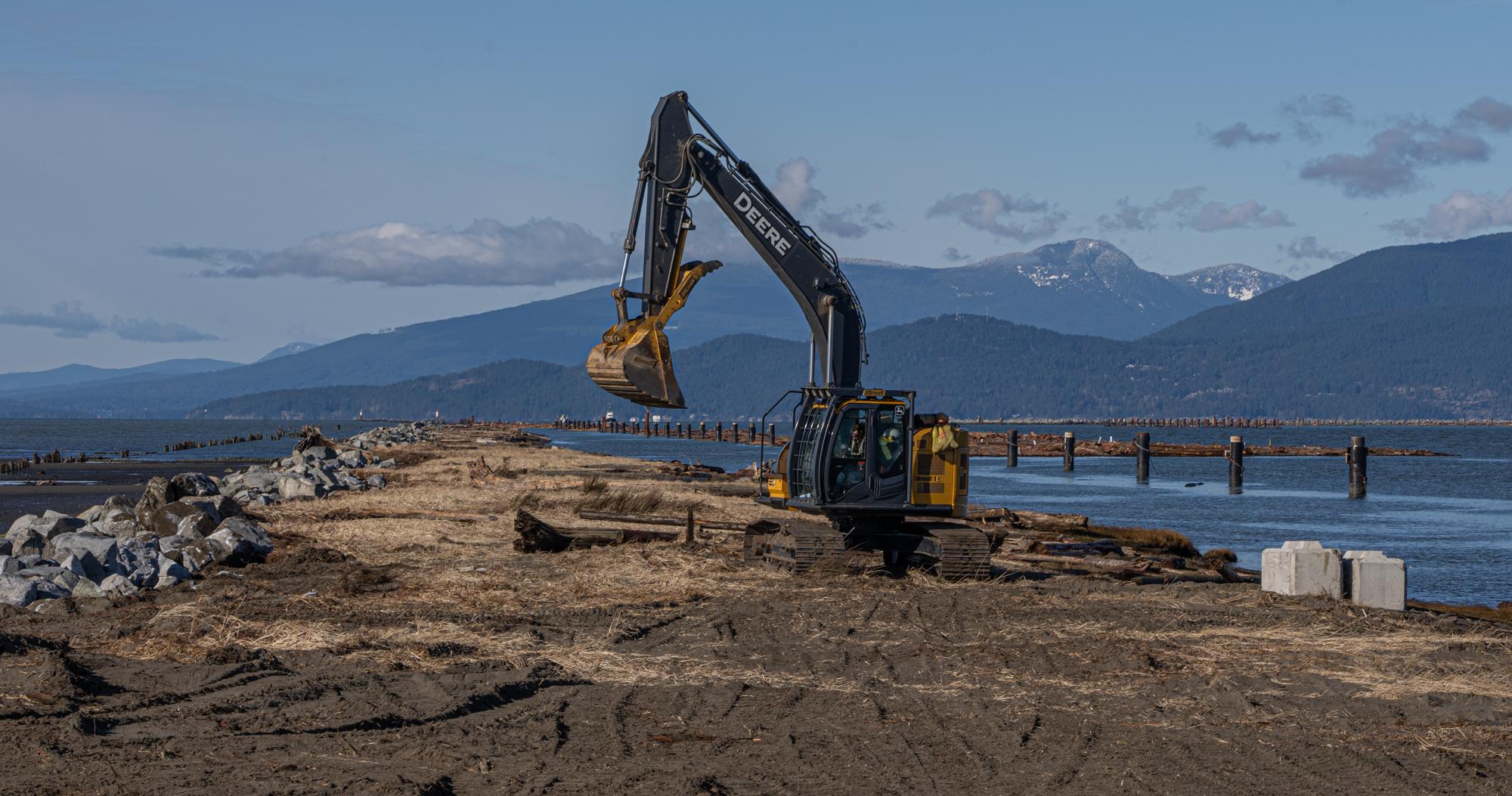
This work created employment for 50 people, with more than $885,576.48 in grant funding directly supporting local jobs. The projects brought together a diverse range of expertise, including biologists, Indigenous Knowledge Keepers, First Nations youth, environmental monitors, engineers, heavy machinery operators, construction consultants, archaeologists, and graduate students.
By investing in habitat restoration, this initiative has contributed to the recovery of endangered Pacific salmon while demonstrating that conservation can create meaningful employment opportunities – even within one of the most urbanized and highly modified landscapes in British Columbia.
In 2026, we are launching a Conservation Economy Pilot that pairs innovative conservation finance mechanisms with habitat restoration to create a scalable model for nature-positive economic development in rural communities. The pilot will demonstrate how investments in ecosystem recovery can generate long-term employment, attract private and public capital, strengthen local economies, and improve outcomes for fish, wildlife, and people.
By bringing together diverse skill sets – from restoration practitioners and foresters to economists, Indigenous partners, engineers, and community organizations – the pilot aims to test a new model for delivering shared environmental and economic benefits that can be replicated across British Columbia.
References
Askew, T., Quist, C., Botelho, Z., Sawka, M., & Shaw, A. (2026). Exploring Conservation Finance: Insights and Opportunities for BC Watersheds, ACT – Action on Climate Team, Simon Fraser University, Watersheds BC, and Fraser Basin Council. https://www.sfu.ca/content/dam/sfu/act/reports/2026/2026-ACT_Conservation-Finance_Report_final3.pdf
London School of Economics. (2023). What is conservation finance? Grantham Research Institute on Climate Change and the Environment. https://www.lse.ac.uk/granthaminstitute/explainers/what-is-conservation-finance/
Smart Prosperity Institute. (2021). Investing in Nature: Scaling Conservation Finance in Canada for A Nature-Smart Economy. https://institute.smartprosperity.ca/sites/default/files/Invest-in-Nature-Report_SPI.pdf
The Nature Conservancy. (2026). Gaining Ground: State of Private Investment in Nature. https://www.nature.org/en-us/newsroom/gaining-ground-private-investment-nature-2026-report/