Scientists agree: Southern Residents can recover, but only if threats are reduced
The problem is not identifying threats; it is reducing those threats at a scale sufficient to enable recovery. The greatest risk is failing to act.

In 2025, a panel of 31 international scientists laid out a plan to recover endangered Southern Resident killer whales. Without action, these whales have a high probability of extinction.12 The plan tackles their key threats: insufficient food, underwater noise and disturbance from vessels, and toxic pollution.3
The science is clear
The recommendations reflect the most recent data and ecological understanding of these whales, emphasizing long-term conservation strategies that support recovery.4
Rebuild killer whale food supply
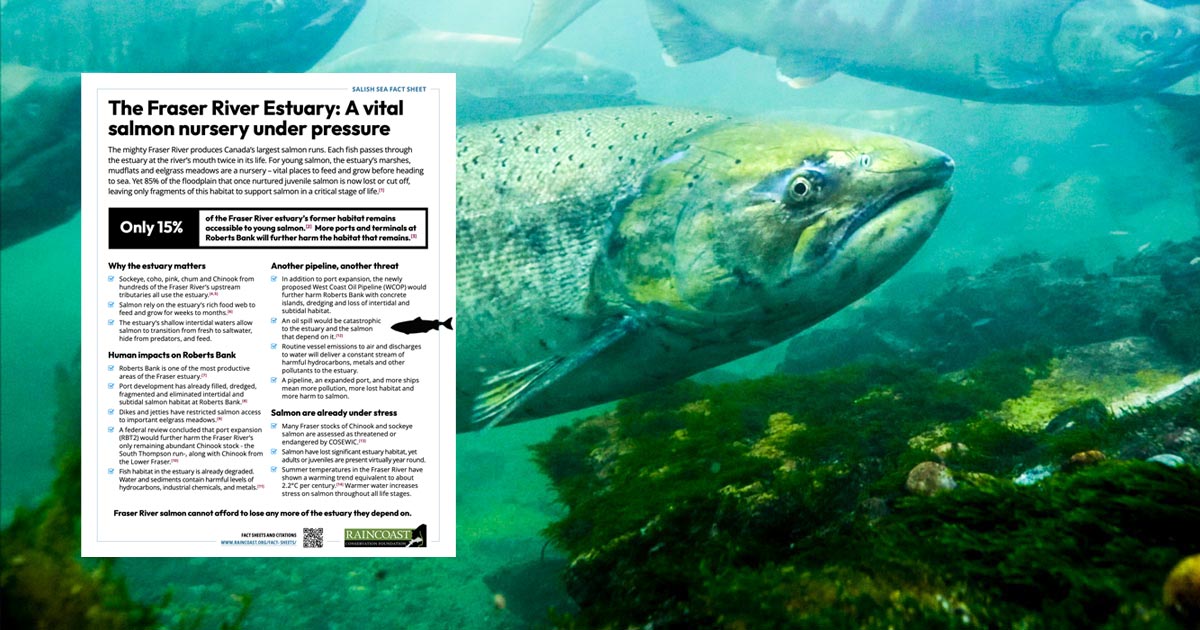
- Protect whales’ access to fat rich Fraser River Chinook salmon that migrate through the river from March to August.56
- Recovering wild Chinook is key to rebuilding prey.7 Hatchery fish are often too small and too low in fat to support their needs.8
- Set prey thresholds that trigger fishery closures when Chinook abundance falls below the whales’ energy needs.9
- Move ocean fisheries closer to rivers: this gives whales access before fisheries & helps rebuild bigger, older Chinook salmon.1011
Quiet whale feeding grounds
- Set noise reduction targets that ensure the whales can communicate and hunt. Require new projects to stay below the targets.12
- Since vessel noise increases with speed, ship slowdowns should expand in time & area.13
- Set mandatory noise standards for large commercial vessels entering Salish Sea ports. Target the loudest ships first.14
Stop pollution at its source
- High levels of PCBs and PBDEs still occur in whales, salmon and their habitats. End legacy use of PCBs in equipment and in storage. Clean up contaminated sites.15
- Prioritize emerging contaminants like forever chemicals (PFAS) and tire-related chemicals (6PPD-quinone) that threaten salmon.16
- Focus chemical management on long-lived species high in the food chain, like Southern Residents. Address pollutants that can harm salmon and accumulate in food webs.17
Tackle threats together
- Insufficient prey, noise and pollutants are connected threats. Coordinated action is needed on all three, with monitoring and adjustments as new evidence emerges.18
Notes and references
- Independent Science Panel on SRKW Recovery. 2025. Strengthening recovery actions for Southern Resident killer whales. Raincoast Conservation Foundation. 67 p. https://doi.org/10.70766/32.7300
- Williams R, Lacy RC, Ashe E, Barrett-Lennard L, Brown TM, Gaydos JK, Gulland F, MacDuffee M, Nelson BW, Nielsen KA, et al. 2024. Warning sign of an accelerating decline in critically endangered killer whales (Orcinus orca). Communications Earth & Environment. 5(1). https://doi.org/10.1038/s43247-024-01327-5.
- Independent Science Panel on SRKW Recovery. 2025.
- Independent Science Panel on SRKW Recovery. 2025.
- Independent Science Panel on SRKW Recovery. 2025.
- Freshwater C, Luedke W, Toews S, and Thornton SJ. 2026. Southern Resident Killer Whale Prey Selectivity in Relation to Chinook Salmon Stock and Size Composition within Canadian Critical Habitat. DFO Can. Sci. Advis. Sec. Res. Doc. 2026/019. v + 76 p.
- Independent Science Panel on SRKW Recovery. 2025.
- Independent Science Panel on SRKW Recovery. 2025.
- Independent Science Panel on SRKW Recovery. 2025.
- Gayeski N, Swanson D, MacDuffee M, et al. Mixed-maturation fisheries compromise productivity and resilience of Chinook salmon. Sci Rep 16, 17768 (2026). https://doi.org/10.1038/s41598-026-49054-5.
- Independent Science Panel on SRKW Recovery. 2025.
- Independent Science Panel on SRKW Recovery. 2025.
- Independent Science Panel on SRKW Recovery. 2025.
- Independent Science Panel on SRKW Recovery. 2025.
- Independent Science Panel on SRKW Recovery. 2025.
- Independent Science Panel on SRKW Recovery. 2025.
- Independent Science Panel on SRKW Recovery. 2025.
- Independent Science Panel on SRKW Recovery. 2025.