

Keeping watch on the Salish Sea
Janine McNeilly tells us how she fell in love with killer whales and never looked back.
Janine McNeilly is a research scientist for Raincoast’s Cetacean Research Program. A lifelong whale lover, Janine is working to help us understand the effectiveness of Vessel Restricted Zones in Southern BC.
Her fieldwork takes her to the rugged coastlines of Pender Island, where she observes whales from a bluff overlooking the Salish Sea. Janine sat down with me to chat about cetacean conservation, community science, and her favourite whales.
Where did you grow up, and where are you living now?
I’m from Coquitlam, which is a suburb of Vancouver in British Columbia. I’m currently on Pender Island, one of the Southern Gulf Islands between the Lower Mainland and Vancouver Island.
What made you want to study whales?
Way back in 1994, when I was born, my parents bought a membership to the Vancouver Aquarium. I don’t know when I first went there, but I know I was under one year old. They used to have a killer whale there named Bjossa, and from the second I saw her, I thought, “This is it. All I want to do is look at this whale.” Then my parents bought me the Free Willy VHS tape, and I said, “Yep! I’m all in.” Since then, I’ve been very into killer whales and the ocean in general.
I held onto this idea all throughout school, and then briefly, I wondered if I should become a park ranger. But I did that for a summer, and it wasn’t quite satisfying to me. So I went back to grad school and started working with killer whales, and here I am.

You mentioned grad school. Can you tell me a little bit about your academic path?
I went to Simon Fraser University for both of my degrees. It’s a ten-minute drive from my mom’s house, so I didn’t go very far. I have a Bachelor of Science in Environmental Science, and then, because of COVID and other things, I took a couple of years between undergrad and grad school. My sister actually started doing her master’s the year before me, and I thought, “If she can do it, I can do it too!” So I signed up for the same program the year after her, which was a Master’s of Ecological Restoration.
I was really lucky to get a killer whale-related project with Dr. Ruth Joy, my lovely supervisor. That project started my career, and now I am monitoring killer whales and other whales in the Southern Gulf Islands.
Are there any scientists who have inspired you over the course of your journey?
Maybe not so much scientists, but as a 90s kid, there were TV shows that inspired me to want to work with animals. Steve Irwin, of course, what an icon! But also the Kratt brothers. I used to be so obsessed with Zoboomafoo. I always liked the public outreach and education side of those shows, which is a small component of the work I do now. As for scientists, I didn’t pay close attention to them. Wait, in Free Willy 2, caretaker Randolph becomes a scientist!
Tell me about your current project.
We monitor the Pender Vessel Restricted Zone (VRZ), which is a seasonally enforced vessel-free area in the Southern Gulf Islands. There’s one off Pender Island, and one off Saturna Island. These zones were put in place to try to protect the Southern Residents from the physical and acoustic disturbances caused by vessels. These two small strips of ocean were chosen because, historically, there have been a high number of Southern Resident sightings in these locations. When the whales come into the Salish Sea, they have a little protected zone that they can swim through.
I stand on a cliff, and I look out over the ocean. I have this cool instrument called a theodolite that allows me to track the exact locations of any whales or boats that go through the study area. I track Southern Residents, Bigg’s (transient) killer whales, humpback whales, and any other whale or dolphin that pops up. I also track all the boats that transit through the area, which helps me determine the compliance rate with the VRZ.
This project allows us to determine what types of whales are common in this area, how boaters behave around whales, and whether whales are using the zones. There’s a lot going on.

What’s your impression of the compliance rate? Do you feel like people are generally respecting it, or is it the wild west?
It’s the wild west for sure. Commercial vessels tend to respect the zone because they have AIS transponders on their vessels. If you have AIS and you go into the zone, you’re automatically reported to Transport Canada. The zones are also pretty close to shore, so really big commercial ships typically wouldn’t enter them. Small recreational vessels sometimes do.
Last year, we reported over 800 infractions in the Pender VRZ. There’s obviously more that we don’t see that happens after monitoring hours or on days we’re not working. There’s also just so much vessel traffic in the area; we probably tracked multiple thousands of boats last year. So overall compliance is hard to tell, but it’s not perfect.
What does a typical day look like for you when you are working on the bluff?
I am really lucky that I’m living closer to Oaks Bluff, which is where we monitor from. The first year, we were a twenty-minute drive away, but now it’s exactly eight minutes. I know, because I like to sleep in until the last possible second! Usually, we get to the parking lot around 8:45 or 9:00, and then it’s a 10-minute hike up to the top of the cliff. Once we get up there, we set up all our equipment and try to be ready to go by 9:30. From 9:30 to 3:30, we’re scanning the ocean for whales while tracking any boats that go into our survey zone.
Usually, the busiest time is 10:30 to 12:30, so that’s when we really have to pay attention. Afternoons tend to be quieter. If a whale shows up at 3:30, we typically stay later so we can track it, but if we’re not following a whale, then at 3:30, we pack everything up and head home to download the data and write the reports.
Do you see whales most days? Or is that more of a rare occasion?
I’m up there from May through October, so it varies depending on the time of year or even what year it is. May is a big humpback month; we had humpbacks almost every day during the second half of May in 2025. We also had a lot of Bigg’s killer whale sightings last year, way more than we had in 2024. I would guess we see whales about every three days, give or take. But there’s always a harbour porpoise! They’re there if you look hard enough.
Can you explain how the theodolite is able to get a GPS point?
It’s the same type of equipment that land surveyors use. If you see workers on the side of the road, they have a tripod set up, and they’re looking through a machine, that is a theodolite. You calibrate it with horizontal and vertical reference points and your current location. Then, when you point and shoot the device, it can tell the GPS coordinates of that location. It has a really strong magnifying lens, so we can see whales almost 20 kilometres away on a clear day, which is really cool.
The GPS data goes into Mysticetus, which is the mapping software we use. It displays the location of the whale or the boat on our customized map, which shows the surrounding islands and the Pender VRZ. We’re able to add additional details for each point, like how many whales we saw and if we thought they were foraging or travelling, whether a boat was a large sailboat or a small pleasure craft, and whether the whale or vessel was in the VRZ. The theodolite and Mysticetus are really great tools for this kind of monitoring.
Shifting our focus a bit, how are killer whales doing in BC?
The killer whales in BC are not doing great.
We have four populations of killer whales that are frequently in BC waters. The only ones I’ve never seen are the offshores. They’re the cool ones that eat sharks, and they hang out, as their name implies, offshore. Because of that, we don’t know a lot about them; they’re very mysterious, at least they are to me! They’re currently listed as threatened under Canada’s Species at Risk Act.
The ones that we see most often where I work are the Bigg’s or “transient” killer whales. They’re the mammal-eating ones, and they are also listed as threatened. Their population seems to be stable, at least locally. But I’ve heard a theory from another researcher that this increase in Bigg’s in the Salish Sea might just be a population range shift. It might not be that the population is growing, but we’re seeing them come down here more often. While we’re saying, “There are Bigg’s everywhere!” people in a different location might be thinking, “Where did all the whales go?”
Next are the Northern Resident killer whales. We don’t really see them where I’m working; they like to hang out between Northern Vancouver Island and Alaska. There are a lot of Northern Residents, with over 300 whales in the population, but they’re still listed as threatened.
The Residents that we see more often down here are the Southern Resident killer whales. The 2025 census counted 74 of them in the population. Many of them are in poor body condition, and a lot of their calves don’t survive beyond a couple of months. The Southern Residents are critically endangered, and all these management measures are put in place to protect them.
That’s really sad. Have any Southern Resident babies survived in recent years?
Last year, they had three babies, and two of them are still alive. In 2024, there were also three babies, but only one survived.
What threats are killer whales facing in BC?
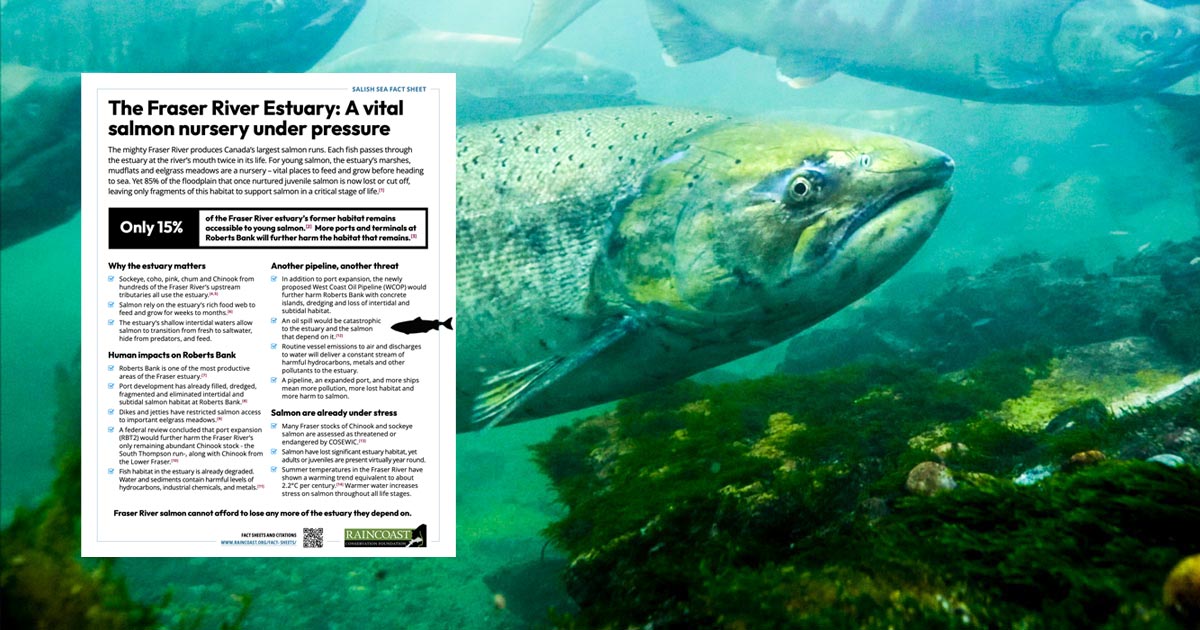
For the Southern Residents in particular (the ones that eat fish, not mammals), they don’t have enough food. Their favourite food is Chinook salmon, and while they do eat other fish, overall, they just don’t have as much food available to them as they used to. The fish that are around are also smaller than they used to be.
Think about historical photos from 100 years ago, where you’d see a man standing next to a five-foot-tall, 100-pound salmon. If you’re a whale, you catch one of those, you’re good to go for the day! Now we’ve got these little foot-long Chinook swimming around. They have to put way more effort into finding them and catching them, and that extra effort is not worth the reward.
There are also a lot of toxins in the environment. Pollution from big cities like Vancouver and Seattle ends up in the Salish Sea. Killer whales are at the top of the food chain, so they bioaccumulate a lot of toxins. One of the reasons so many babies don’t make it is because their mothers are offloading their own toxins into their milk. Firstborn calves are especially vulnerable, as they are getting the highest concentration of contaminants while nursing.
Underwater noise is another big issue. The Port of Vancouver is one of the biggest ports in the world, so we see a lot of commercial traffic. But noise is not just from the big ships; it also comes from recreational vessels. The Salish Sea is home to millions of people who might want to spend some time on the water. All those boats contribute to underwater noise and make it hard for the whales to communicate and find food.
Those are the three main threats to killer whales: prey availability, toxins, and underwater noise.
It’s striking to me that those are the same three things that we’re worried about for belugas in the St. Lawrence estuary.
Yeah, it makes you think! I really wouldn’t be surprised if whales all over the world are facing those same three threats.
What’s a fact about killer whales that you think would surprise most people?
For the Residents, people may not know that the children never leave their mothers. You’ll see these big 30-year-old males that are absolutely massive, and you might think, “That whale doesn’t need help from his mom.” Oh yes, he does! They remain with their maternal families for life.
I also think their prey-sharing behaviour is really cool. One or a few whales will hunt together and bring the food up to the surface, and they’ll split it up amongst a larger group. I once saw a big male catch a salmon and tear it apart at the surface, then one of the little juveniles swam over and they snacked on it together. I think it’s sweet that they look out for each other.
You mentioned that some killer whales eat mammals. Are killer whales ever dangerous to humans?
People are always asking me whether I would get in the water with a killer whale. I tell them, “Of course I would, if it were ethically okay to do so!” Killer whales rarely act aggressively towards humans in the wild, and as far as I know, only one person has been bitten. Trainers have been killed by captive killer whales. In those cases, I think the whales had lost their minds from being trapped in a tank year after year. They don’t do things like that in the wild.
However, there are those amazing killer whales that have been ramming into boats in the Strait of Gibraltar. I wish I could go there and learn more about them! I don’t think they’re doing that with the intent to kill the humans on the boat. I feel like it’s either like aggression against the boat itself, or they just think it’s fun.
What’s your favourite part of studying killer whales?
I just love them! I used to think that after doing this job for a few years, seeing them would become a more neutral experience. But it’s not! Every time I see them, it’s so exciting. They’re always doing something really cool or really cute. They’re so smart, and they seem so playful. Even when I’m just listening to recordings of them, I’m having a good time. I love their little squeaks and whistles. It’s all so fun.
What’s the most challenging aspect of studying killer whales?
It’s hard to watch the Southern Residents and know that they’re not doing well. In the summer of 2024, we saw a mom pushing her brand-new calf at the surface. The calf didn’t die that day, but it didn’t live much longer. That was so sad and, frankly, horrifying to see. It can be really frustrating to feel like we’re not doing enough to protect them.
With the Bigg’s, it can be very disheartening to see large groups of vessels pursuing them. There has been more pressure on these whales in the Salish Sea since commercial whale-watching vessels have agreed to avoid the Southern Residents. I’ve tracked pods of Bigg’s with twenty vessels watching them at once, while other pods have had ecotourism vessels with them for the entire day. I worry about the long-term impacts this could have on the population.
We’ve put so much effort into studying and protecting Southern Residents, which is really important, but that means the Bigg’s aren’t getting the same level of attention and resources. I think we could all learn from the precautionary principle, the idea that if something may pose a risk, we shouldn’t wait for perfect scientific evidence before acting. It suggests we should give these whales a little breathing room, just in case, rather than be sorry in the future.
Let’s talk about something more cheerful. Do you have a favourite whale?
Off the top of my head, I really like Birdsall, or T065B1. I was so confused by his name until I learned he was named after the scientist Caitlin Birdsall. He has a very distinctive fin, which I like because I can identify him really quickly. He’s 15 now, a “sprouter”, which is when the males are transitioning from being juveniles into adults. His fin is getting bigger, but it’s not quite the big, beefy fin that you’d see on an adult male. It’s still kind of curved and lanky, like a teenager!
Another whale I really like is Slice, T037B3, my sister Lauren’s favourite whale. Lauren came to visit me for my birthday when I was on Saturna two years ago, and we had a big group of whales come by. One was Slice, and Lauren thought her name was hilarious. Now every time I see Slice or hear of her whereabouts, I have to tell Lauren about it!
For the Southern Residents, I have a soft spot for L88, or Wavewalker. He’s only a year older than me, his saddle patch is beautiful and easily identifiable, and I love that he was adopted by L54, Ino, after his mother died.


What is your advice for people who’d like to see killer whales in the wild?
Commercial whale-watching has become really competitive in the Salish Sea, with boats vying to get into the best position for their customers. From what I’ve observed over the past two years, some whale-watching companies consistently break the rules and get too close to the whales. There needs to be more restrictions in place before I could recommend getting on a boat. Hopefully, in the future, we can reach a point where it’s not as disruptive.
Watching from shore is the best option: it doesn’t bother the whales, it’s just as fun, and it’s free! A great shore-based whale-watching resource is The Whale Trail, which lists all the best places to see whales from shore between BC and California. You can look up sites near you to see where you have the best chance of seeing a whale. The Southern Gulf Islands have lots of locations on The Whale Trail, including where I work at Oaks Bluff on Pender and East Point on Saturna.
I love watching whales from shore. Some of my favourite memories from the last two years have been driving around after work with my coworkers, trying to beat the whales to the next viewpoint. You’re not guaranteed a sighting, so you get the thrill of the chase as well as the thrill of seeing a whale! It adds this extra element of suspense to the whole event. I’ve had whales come within five meters of shore, where they’re so big that they don’t even fit in the frame of my photo. I’ve also had really cool experiences from Oaks Bluff, where we get a bird’s-eye view of whales in the Pender VRZ.
What are some other actions that people can take to help protect whales in Canada?
If you have a boat and you’re out on the water, be cautious and alert. If you’re in an area where there could be whales, which is almost everywhere, avoid speeding and keep an eye out for blows or fins. If you do come across a whale, the best thing to do is to slow down to less than seven knots, position your boat out of the path of the whale, and, when it’s safe to do so, turn off your engines and sonar so you’re not making noise. Then both you and the whales can have a great experience!
People can also avoid eating Chinook salmon so that our Southern Resident friends have enough fish to eat. Otherwise, it’s all about telling the people in charge that we need to protect these whales. We need more regulations that support their recovery, whether it’s the Southern Residents or other whale populations. Write to your local MP or MLA and let them know that these whales are important to you, and that you support legislation that will help their recovery.
What’s your favourite part about working for Raincoast?
The people that we work with are so encouraging and kind. At the staff retreat this year, everybody was giving these lovely, inspiring speeches. Whether they were working on the wolf team, the cetacean team, or the salmon team, I got the feeling that everybody shared similar values, and we were all working towards a common goal. As a bonus, Lance and Valeria are leading experts in the field, so it’s been really cool to get to work with them.
What’s next for you?
I will be back on the cliff this summer. It’s officially confirmed! So I’ve got a bit of time to strength train, and then I’ll be hiking up the cliff every day. That’s the immediate future.
Beyond that, I would love to start my PhD and study Bigg’s killer whales, because I feel like they are understudied and underappreciated! I’m interested in their movement patterns, their vocal behaviour, and finding out exactly how vessel noise impacts them. My personal goal for this summer is to figure out if Bigg’s use bathymetry to guide them through an area. They always seem to follow a similar path, and it makes me wonder what’s happening beneath the surface. What do they know that I don’t know?
Do you have any advice for people who want to get involved in cetacean research and conservation?
Everyone can download Ocean Wise’s Whale Report App and report any whales or porpoises that they see. That helps researchers get location and timing information on where different whales are. You can even submit your whale photos to different websites, which I think is the most fun part! Finwave and Happywhale are the two websites I use. Not only will people get to enjoy your beautiful photos, but they will contribute to science by telling us which whales you saw and where they were.
I got involved in the whale world through school, but you can also volunteer. There are a lot of community science organizations in the Salish Sea who would love your help. You can also reach out to people who are doing projects that interest you. Everyone likes to talk about their work. If anyone is on Pender Island this summer, you can hike up to the bluff, and I’ll talk to you about whales for the rest of the day!