Clues to help you tell Southern Resident and Bigg’s (transient) killer whales apart
Raincoast CSI: Cetacean Species Identification.
The summer boating season is right around the corner! Whether you’re heading out for a day on the water with friends and family or seeking solitude at your favourite fishing spot, it’s important to be prepared. Wear a life jacket, pack sunscreen and plenty of water, and know what to do if you spot a blow on the horizon.
Vessels should never intentionally approach marine mammals, whether that’s a harbour seal or a humpback whale. Close approaches can cause stress, disrupt important behaviours like feeding and resting, and create unsafe situations for both the animals and people on the water. Underwater noise from vessel engines and propellers is also a serious concern, as it can mask the calls and echolocation clicks that whales rely on to communicate, navigate, and find food. When it comes to noise, the further away a vessel is, the better. Watching whales from land is always the safest option.
Transport Canada’s recent Interim Order increased the approach distance for critically endangered Southern Resident killer whales from 400 metres to 1,000 metres. DFO has proposed adopting a permanent 1,000-metre approach distance, matching the existing 1,000-yard law in Washington State. Help strengthen protections for Southern Resident killer whales by supporting DFO’s proposed 1,000-metre approach distance. Submit your comments by April 21.
Current regulations require vessels travelling anywhere between Campbell River and Ucluelet to stay:
- 1,000 m away from Southern Resident killer whales (SRKW)
- 200 m away from all other killer whales
- 200 m away from any whale, dolphin or porpoise that is resting or with a calf
- 100 m away from all other whales, dolphins, and porpoises.
Because the approach distance for SRKW is five times that of other killer whales, being able to tell them apart matters. If you are ever unsure which type of killer whale you are seeing, the safest and simplest rule is: if in doubt, stay out!
The usual suspects: Southern Residents and Bigg’s
The two types of killer whales you’re most likely to encounter in the Salish Sea are Southern Resident killer whales (SRKW) and Bigg’s (transient) killer whales. While SRKW are fish-eaters, Bigg’s killer whales hunt marine mammals like seals and porpoises. The two ecotypes do not interbreed and have completely different call repertoires, meaning they effectively speak different languages.
Unless you catch a Southern Resident snacking on a salmon or a pod of Bigg’s hunting a harbour seal, telling them apart can be tricky. Here are some key clues to help you identify which ecotype you’re seeing out on the water.
Clue 1. Dorsal fins


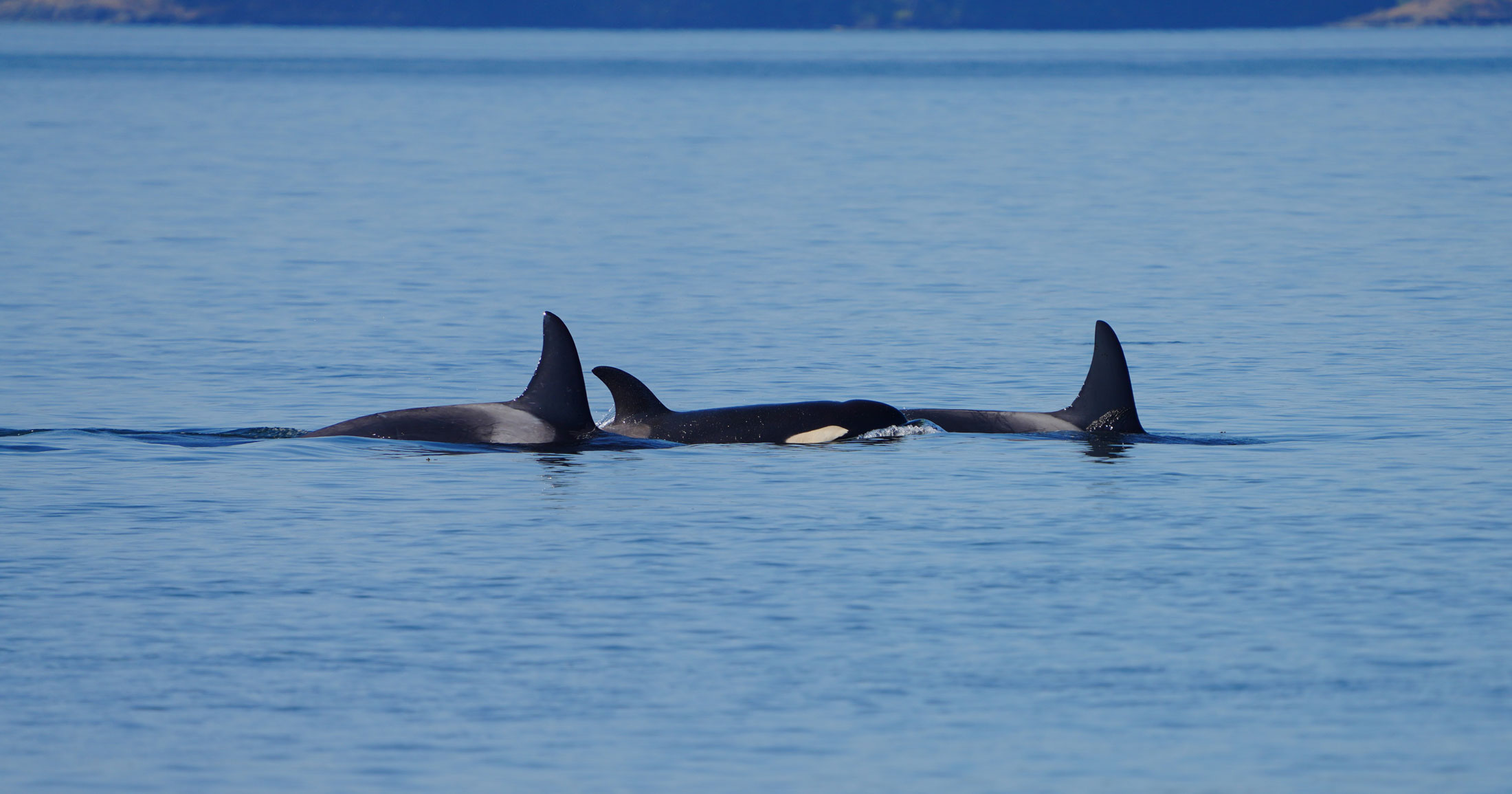
Killer whale dorsal fins can reach over six feet tall, so they are often the first thing you see on the horizon. Southern Residents tend to have narrow, rounded dorsal fins that are typically free of nicks or scratches. Adult male dorsal fins can have a wavy trailing edge, which is how J1 earned the nickname “Ruffles.” Bigg’s killer whales have dorsal fins that are broader at the base with pointed, shark-like tips. Their fins often have nicks and notches, likely from hunting large prey with big teeth!
Clue 2. Saddle patches


A killer whale’s saddle patch is the grey area just behind and below their dorsal fin.
SRKW often have “open” saddle patches, where black pigmentation cuts into the grey, creating a unique pattern that can be used to identify individual whales. Bigg’s killer whales typically have large, solid saddle patches with no black pigmentation patterns.
Fun fact: One exception to the rule is T037B1 Lance, a Bigg’s killer whale with an “open-ish” saddle patch. He’s named after Dr. Lance Barrett-Lennard, seasoned killer whale scientist and Senior Advisor to Raincoast’s Cetacean Research Program!
Clue 3: Eye patches


Killer whales have distinctive white eye patches that vary in shape and angle. SRKW have level or slightly upward-slanting eye patches, while Bigg’s have downward-slanting eye patches.
Hint: If you’re able to spot unique markings on a killer whale’s eye patches, you’re way too close!
Clue 4: Vocalizations
If you have a hydrophone onboard, you might be able to hear the difference between ecotypes.
Southern Residents are highly vocal, using a mix of shared and pod-specific calls. These calls often have an upward inflection, making the whales sound happy and excited. If you’re near J pod, you might hear their signature goose-honk call, S04. Bigg’s killer whales are usually quieter, often travelling in silence to avoid alerting their prey. When they do vocalize, many of their calls have a downward inflection, which some people describe as “sad cat” calls. I like to think they sound like a disappointed child saying, “aww” after being told no!
Clue 5: Behaviour


Killer whale behaviours can offer helpful hints, but this clue shouldn’t be used on its own.
SRKW are often boisterous and social, frequently breaching, tail-slapping, and spyhopping. They usually travel together as a pod, and if you’re lucky, you might see a “superpod” with more than 70 whales swimming together. Bigg’s killer whales can be stealthy, moving smoothly through the water with minimal surface disturbance. They are typically seen in smaller pods, and adult males are known to venture out on their own. That being said, I’ve seen groups of over a dozen Bigg’s splashing around together, so behaviour alone is not definitive.
Operational protocols for surprise whale encounters
If a whale surfaces near your vessel, slow down to less than seven knots and position your vessel out of their path. When it is safe to do so, turn off your engine and any sonar or fish-finding equipment to reduce underwater noise. If you’re fishing, stop hauling gear until the whales are over 1,000 metres away. Let’s do our part to keep these beautiful animals safe as we travel through their home.