Plastic pollution

Photo by April Benze.

Plastic pollution is choking our waterways and threatening the health of fish and wildlife. We are collecting plastic and microplastic data as part of our community-oriented water pollution monitoring program. We are collaborating on research projects with universities, governments and experts in the field. We are providing advice to local, regional and federal governments on plastic science, policies, and regulations. We are working with Ocean Diagnostics to support a strong science-based foundation for solutions.


Lots of garbage on a beach.
Photo by Simon Ager.
People working together to take samples of water in jars.
Photo by Alex Harris / Raincoast Conservation Foundation.

Our approach

  • Design a source identification toolbox for plastic pollution; 
  • Working with Indigenous and coastal communities to document plastic pollution and track this back to its source;
  • Conduct research on the source, transport and fate of micro and macroplastics in the environment;
  • Engage in outside-the-box dialogue with industry and governments to support more sustainable design, manufacturing and processes that stem the release of plastics during the life cycle of a product;
  • Support community-oriented outreach and training to support solution-oriented actions and capacity building.

Plastics are everywhere

Plastics from just about every sector can now be found all over the world – from mountain tops to the seafloor, from the Arctic to the Antarctic, and from our homes to the ocean. A modern-day scourge that is blighting remote beaches and shorelines, getting mistaken for food by wildlife, and getting into the foods that nourish us. Whether it’s the structural features of plastic products that suffocate, entangle, or create intestinal blockages – or the endocrine disrupting-contaminants that serve as ingredients of the product (e.g. Bisphenol A or phthalate esters) or as hitchhikers soaked up by plastics in the environment (e.g. PCBs or metals) – plastics are harmful.

Underwater photo of plastic floating near the top of the water.
Chinook salmon swim in a river as seen from head on; epic.
Photo by Fernando Lessa.

The impact on the environment

Without a dramatic re-think, the plastic crisis is here to stay. Despite the best intentions of governments, industry, and consumers to reduce, recycle or re-use, global plastic production continues to enjoy exponential growth. And the unintentional loss to the environment of plastic products and byproducts will continue – plastic bags, bottles, and fishing gear, as well as the discharge of microplastics through domestic and industrial waste. With that will come a constant stream of items that will be mistaken for food but offer zero nutrition, that will entangle wildlife, and will deliver endocrine disruptors to our aquatic food webs. We will document impacts, share findings, and work for change through science, community engagement, and expert advice.

Recent articles

Luke Wallace events coming up in Tofino and sidney on behalf of Safeguard Coastal Carnivores campaign.

Live performances by musician Luke Wallace

Join Raincoast and Musican Luke Wallace for a series of events in support of Raincoast’s campaign to safeguard Coastal Carnivores. It’s now time to permanently end commercial trophy hunting of all large carnivores in the Great Bear Rainforest. Join us in Sidney on March 22nd and in Tofino on March 23rd…
Juvenile killer whale and mother off the coast of British Columbia.

National Energy Board’s failure haunts governments

The cries of condemnation emanating from the Alberta and Canadian federal governments are deafening. The burgeoning conflict began when BC announced the province would limit shipments of diluted bitumen from Alberta…
Southern Resident killer whales swim side by side, as seen from the air.

A killer whale emergency

We are requesting an emergency order under Canada’s Species at Risk Act. Southern Resident killer whales were recognized as endangered in 2002. Despite this, the Federal Government has taken no action to date to reduce the threats to these whales…
Achiever rests, sails down, in the twilight.

Sailing with Raincoast in 2018

In May, our spring ‘hunts’ visited lush estuaries as the days grew longer and bears were down low grazing on sedges. Marine wildlife started to make their way back to the rich, cold waters of the coast. Their annual migration to foraging areas beginning and lasting well…
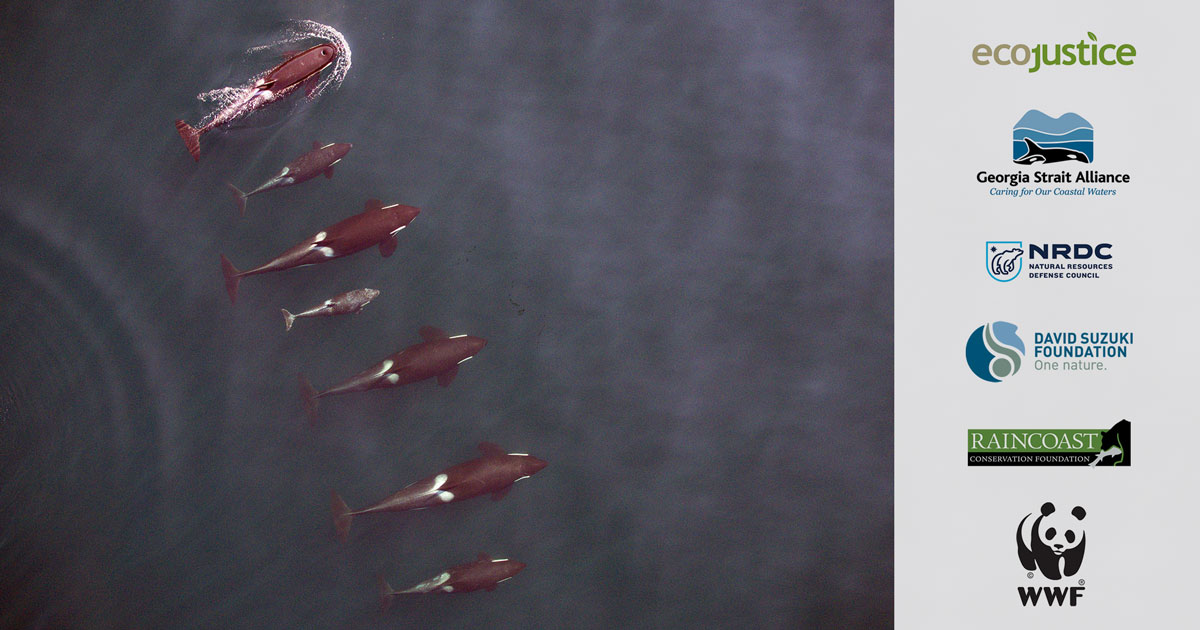
Southern Resident killer whales swim side by side in the Salish Sea, with joint partner logos on the right, including David Suzuki Foundation

Critical situation for Southern Resident killer whales provokes call for urgent action

Only 76 Southern Resident killer whales remain. This is a critical situation. Today, represented by Ecojustice, and in collaboration with other science and environmental organizations, we are calling on the Canadian government to take immediate action to protect these whales…
A map of the proposed emergency order, with logos of the various orgs involved including Ecojustice and the David Suzuki Foundation.

Emergency order requested for Southern Resident killer whales: time is running out

Raincoast and its partners, represented by Ecojustice, are calling on federal cabinet ministers LeBlanc and McKenna to recommend cabinet issue an emergency order under Canada’s Species at Risk Act…
Achiever rests in the water, while a bear sniffs the air in the foreground on an outcropping of land.

What next for coastal carnivore conservation?

In Victoria and Vancouver: We have teamed up with renowned wildlife photographer John E Marriott to present an evening of Tall Tales, Long Lenses and Wildlife Conservation. Don’t miss it…
Tall Tales, Long Lenses, Book cover by John E. Marriot

Events: Tall Tales, Long Lenses and Wildlife Conservation with John E. Marriott

Join renowned wildlife photographer John E. Marriott and the Raincoast Conservation Foundation for an evening of inspiring stories about BC’s wildlife and its conservation. February 20th and 21st in Victoria and Vancouver, John will share stories and photographs from his latest book…