
Climate change

We use a comprehensive approach to inform actions that benefit salmon ecosystems in a changing climate.

Photo by Fernando Tessa.

Climate change is causing severe hydrological shifts in salmon streams through long-term reductions in snowpack, earlier spring melts, increased frequency of heat waves, atmospheric rivers and flood events, and increased drought frequency. These impacts create conditions unsuitable for wild salmon to recover and thrive.

Juvenile salmon in a fish viewfinder.
Photo by Alex Harris / Raincoast Conservation Foundation.
School of coho in a river.
Photo by Fernando Lessa.

Unsustainable land use is compounding the impacts of climate change

Unsustainable land use occurring throughout the province is making these conditions even worse. Clear-cut logging, mining, and water withdrawal for industry and agriculture alter salmon habitat, reduce streamflow, and increase water temperatures. Stream-type Chinook and coho salmon that spend a year in freshwater before migrating to the ocean are particularly vulnerable to degraded freshwater habitat caused by logged forests, fires, droughts, and floods.

Forestry degrades salmon habitat

Logging can alter the delivery and storage of water, nutrients, wood, and sediment in streams. This results in changes to the habitat, growth, and survival of juvenile salmon. Clear-cut logging can increase turbidity in salmon-bearing streams affecting survival of eggs and fry, while the conversion of old growth forest into plantation monocultures can lower summer stream flow and increase temperatures. The legacies of antiquated forest management that prioritizes harvestable timber above all other values confounds the effects of climate change on freshwater habitat quality and quantity for salmon.

A rivers running through the forest right next to a large clearcut area.
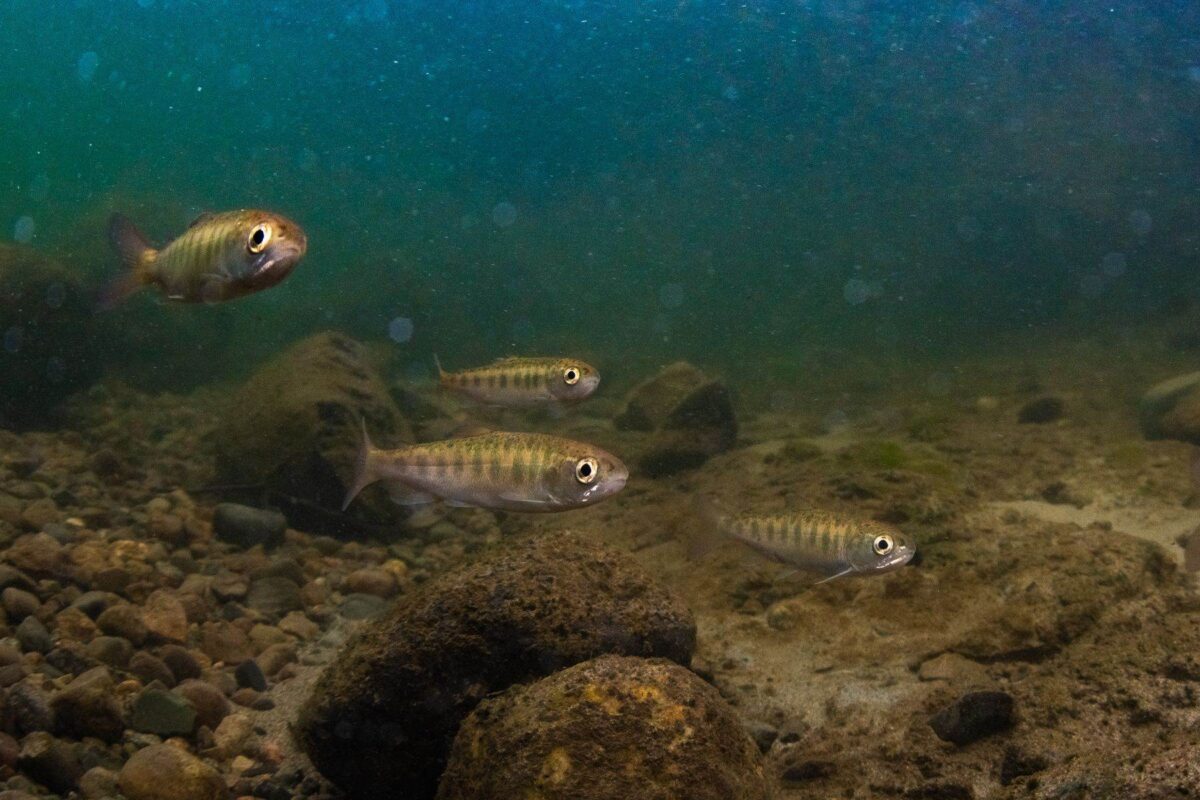
Four small salmon swimming near the bottom of the water.
Photo by Fernando Lessa.

Wildfires impact salmon

Recent wildfires in BC have brought climate-change related effects into focus: wildfires are getting larger, more intense, and more frequent. The suppression of wildfires can increase fuel load and the corresponding severity of wildfires, particularly in the drier and hotter regions of the province.

The loss of vegetation and alteration of soil properties from hot wildfires can dramatically change the way rainfall permeates soil, and can cause increased runoff, sedimentation, and landslides that can smother incubating salmon eggs. Additionally, fire retardants used to suppress fires contain compounds that are toxic to aquatic life and can increase fish mortality, particularly for young Chinook salmon. 

Floods impacting salmon

The forest management paradigm of British Columbia has increased the magnitude of and frequency of the biggest floods. In snow-dominant watersheds, such as those of the BC interior, reduced forest cover from logging leads to faster snowmelt and larger floods. Increased flood risk can degrade water quality through increased sedimentation and contaminants, and can kill incubating salmon eggs from riverbed scouring.

Underwater image of salmon swimming.
Photo by Fernando Lessa.
Coho salmon swimming in a river.
Photo by Fernando Lessa.

Engaging with decision-makers

Now is the time to improve federal and provincial land-use policies for the health and climate resiliency of ecosystems and to advance the recovery of at-risk salmon populations. These policies must support freshwater security at the community level and uplift the rights and priorities of Indigenous peoples.

Raincoast is engaging with decision-makers at all levels of government to advocate for science-based policy solutions that ensure wild salmon are resilient in a changing climate.   

Recent reports

Recent articles

A group of people standing in front of a building with totems painted on it.

Gvukva’áus Haíɫzaqv. House of the Haíɫzaqv, it’s always been here

The Haíɫzaqv (Heiltsuk) community of Waglisla (Bella Bella) who have been our friends, supporters and partners for over a generation, were about to celebrate the historic opening of the stunning new Gvukva’áus Haíɫzaqv (house of the Haíɫzaqv) with a five day potlatch celebration. Over 3000 people were expected. Knowing that accommodations were limited in the…
A bear stands or floats in the water eating a giant salmon.

Where bears, fish, and humans roam

Transitioning between seasons can often push your senses to work overtime. This is especially true in summer and autumn in the Atnarko River corridor, where the river comes alive with Chinook, chum, pink, sockeye, and coho salmon runs. The smell of a river containing spawned-out fish is unforgettable, and one I have grown fond of….
Mountain goat blending in with rocks and moss on the BC west coast.

Searching for sentinels at the top of the world

White on white is hard to see. It is especially difficult when what’s white is a mountain goat tucked into the nooks and crannies at the top of a mountain. These elusive animals cling to the windswept peaks of the coastal mountains of British Columbia where they find relief from warm summer temperatures and the…
Stories From the Magic Canoe of Wa'xaid, by Cecil Paul.

Stories from the Magic Canoe, Victoria on November 21st

This November we are inviting you to an evening conversation with author Briony Penn, Raincoast’s Brian Falconer, and photographer Alex Harris, hosted by CBC’s Bob McDonald. They’ll share stories about one of North America’s most important Indigenous leaders, Wa’xaid, Cecil Paul and the watershed he helped protect. Find this event on Facebook. November 21st, UVic…
A rhinoceros and juvenile rhinoceros stand in the brown grass of the Botswana flats.

Evidence, values, policy, and the advance of science

Last month, a group of scientists published a letter in the journal Science that advocated for trophy hunting, arguing that the practice can help safeguard biodiversity. In today’s issue of Science, there are six response letters, and Raincoast scientists (Drs. Kyle Artelle, Chris Darimont and Paul Paquet), contribute to three.  Our team argues that there…
A small coho salmon fry swim on the bottom of the lake.

Join us at the Salish Sea Ecosystem Conference in Vancouver

Along with the Lower Fraser Fisheries Alliance, Raincoast is chairing a traditional session at the upcoming Salish Sea Ecosystem Conference April 19-22, 2020 Vancouver Convention Centre Vancouver BC. The session, Toward a vision for Ecological Resilience in the Lower Fraser River, session ID1438, is accepting abstracts until November 1st. Our goal is to bring together…
A salmon in a stream, with four partner logos, Watershed Watch, David Suzuki Foundation, SkeenaWild Conservation Trust, and Raincoast.

Backgrounder on Canada’s Pacific salmon fishery losing its Marine Stewardship Council certification

What is the Marine Stewardship Council? The Marine Stewardship Council, or “MSC”, is an international, independent non-profit organization which sets a standard for sustainable fishing. Fisheries that wish to demonstrate they are well-managed and sustainable compared to the science-based MSC standards are assessed by a team of experts who are independent of both the fishery…
Rain wolf, by Christina Mittermeier, on a white wall with a lovely yellow chair.

Beautiful photographic prints from our favorite photographers for sale

A picture is worth a thousand words, and we are selling prints for $98. We are very grateful for photographers who are able to capture exceptional images who donated a limited number of prints. These images not only capture the beauty of the wildlife they also directly support our efforts to Safeguard Coastal Carnivores in…