When will Ottawa act to remove salmon-killing chemical from vehicle tires?
The harm caused by 6PPD in tires on the road today demands immediate action by Ottawa.
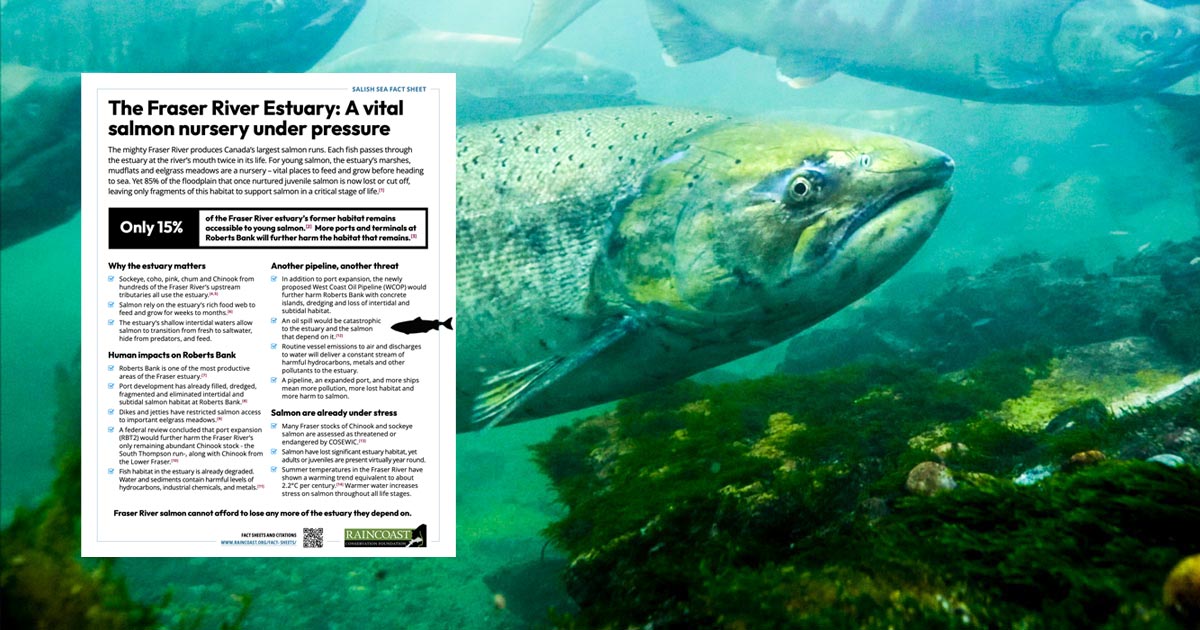
Every fall in British Columbia, thousands of coho salmon make their way home from the ocean to spawn in our thousands of kilometers of freshwater streams and creeks.
But, in many urban waters, they never make it back, with dozens of dead coho being reported in creeks and streams in the greater Vancouver area.
Researchers have described a gruesome “dance of death”, with fish gasping for air, swimming erratically and flipping onto their backs. Within hours, they are gone. Scientists were long puzzled by the regular reports of these dying coho, eventually referring to the perplexing phenomenon as ‘Urban Runoff Mortality Syndrome’.
A variety of causal factors were investigated over the years, including road salts, metals from automotive brake pads to which salmon are sensitive, including copper and zinc, pathogens and hydrocarbons. Salmon are sensitive to all of these, and yet none seemed to explain the mysterious appearance of dead and dying coho in BC waterways.
Finally, scientists solved the mystery by identifying the causal agent in a seminal study in 2021. The culprit was 6PPD-quinone, a chemical that’s formed when a common tire additive called 6PPD reacts with ozone in the air. This chemical is added to tire rubber to prevent cracking and extend the life of tires. When rain washes tire particles from roads into streams, this toxic compound enters salmon habitats, severely impacting coho salmon populations and other salmon species.
A recent University of B.C. study documenting significant and persistent discharges of 6PPD-quinone from artificial turf sports fields made of crumb rubber from discarded vehicle tires provides an additional and disturbing source of concern for this chemical in salmon habitat.
The harm caused by 6PPD in tires on the road today demands immediate action by Ottawa.
Yet since committing in March 2025 to prioritize 6PPD for an updated toxicity assessment under Canada’s cornerstone environmental law, the Canadian Environmental Protection Act, we were surprised to learn that another year could pass before the first phase of the assessment was ready. Not only that, but the money that Environment and Climate Change Canada relies on to conduct these toxicity assessments has yet to be renewed, with the current funding cycle ending later this month.
This does not look like urgency by the federal government.
Even at extremely low concentrations, 6PPD-quinone is lethal to coho salmon – just 41 parts per trillion, making it perhaps the most toxic chemical they encounter in their habitat. Put another way, this would be the equivalent of putting 41 drops of 6PPD-quinone into 35 Olympic-sized swimming pools and killing half the coho salmon within 24 hours. Tire wear is set to increase on Canadian roads as electric vehicles, whose batteries result in heavier cars, become more prevalent and shed more tire particles.
While we wait for the government to take its next steps in the assessment process, leadership on this issue is coming from municipal governments and First Nations. Green infrastructure initiatives adjacent to roadways are being built throughout communities, including bioswales, rain gardens, and engineered wetlands, contributing to a renewal of healthy urban waters. Some of these initiatives have reduced the release of 6PPD-quinone into streams by as much as 95 per cent. Given that road runoff also contains other harmful substances, including metals and hydrocarbons, these projects are an important means of protecting salmon and rebuilding healthy urban waters.
But this promising green infrastructure does not eliminate the need for federal regulatory action on 6PPD. It’s simply not enough, especially as salmon are already grappling with the effects of climate change in British Columbia’s vulnerable and dwindling freshwater salmon habitats.
The science is clear – Ottawa must act now to regulate 6PPD before it’s too late for BC’s coho salmon.
Peter S. Ross is the senior scientist at the Raincoast Conservation Foundation. Lina Azeez is the habitat programs director at Watershed Watch. Lindsay Beck is a staff lawyer at Ecojustice.
A version of this article was first published in The Vancouver Sun on April 16, 2026.