How to measure a tree
Measuring height, diameter, and crown spread of a big tree can present many challenges. Here’s a few tips and tricks to help you out.
There are many reasons to want to measure trees. This how-to will help you do just that.
If you are measuring a tree in order to register it in a particular tree registry, like the Pender Island Tree Registry, or the BC Big Tree Registry, you will often have specific requirements.12
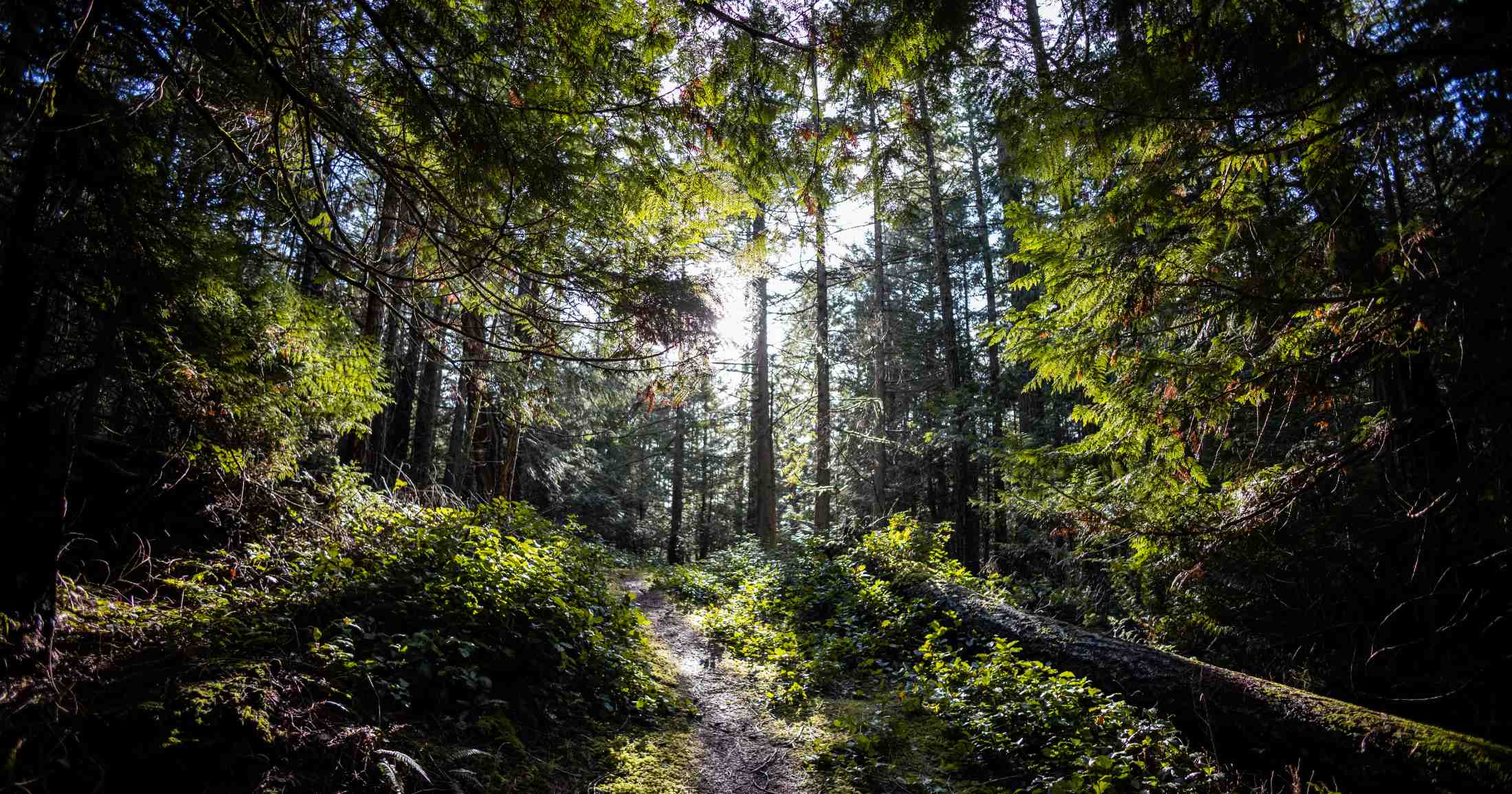
When you’re out measuring trees, have fun! But also stay safe. Be aware of your surroundings when exploring the forest, watch out for raised roots, branches at eye level, and other safety hazards.
Doll S, Puri P. 2026. How to measure a tree. Raincoast Conservation Foundation. (PDF)
Taking height measurements
Height is a difficult measurement to accurately collect, especially for taller trees. Dense forest can make it challenging to get a clear view of the tree top, and ground slope can add further complications. Due to these challenges, we recommend making more than one attempt to measure height. If possible, try to re-measure from a different view point, and always double check your measurements. All heights will be verified by a qualified tree measurer after the nomination has been received.3
Equipment
- Measuring tape
- Inclinometer or Smartphone with Smart Measure or iHandy Carpenter installed
- Calculator (with cosine and tangent functions)
- Brightly coloured flag or chalk
Instructions
To measure the height of a tree, you must first put some distance between yourself and the tree. Best practice is for the distance between yourself and the tree to be greater than the total estimated tree height. As you move away from the tree use your measuring tape to record the distance between yourself and the tree. Make sure to maintain a sightline to the top of the tree. If the tree has a significant lean, it should be measured with the lean to the right or left, not toward or away from you.
Calculating tree height requires the use of basic trigonometry: H= TanA x D
H=Height
A=Angle to the top of the tree
D=Distance from the tree
Level ground
To find the height of tree on level ground you need to know your eye height (the height of your eye above the ground)
Measurements needed:
- Distance to tree (D)
- Tree top angle (TanA)
- Eye height from ground (Eye Height)
The equation becomes:
H= TanA x D + Eye Height

Moderately sloped
To find the height of a tree up slope (base of the tree is below eye-level) or down slope (base of the tree is above eye-level) you need to know the angle to the tree base.
Measurements needed:
- Distance to tree (D)
- Tree top angle (TanA1) and Tree base angle (TanA2) (sloped ground)
Up-slope equation
(added)
H= (TanA1 + TanA2) x D

Down-slope equation
(subtracted)
H= (TanA1 – TanA2) x D

Obscured base
To find the height of a tree without being able to see the base, you need to mark a place on the trunk (with chalk or flagging) and measure its height from the ground. Alternatively, have someone stand at the trunk base, and measure the angle to the top of their head. If underbrush is obscuring visibility, have them use the flag to increase visibility.
Measurements needed:
- Distance to tree (D)
- Tree top angle (TanA1) and Tree base angle (TanA2) (sloped ground)
- Height of trunk marker (x)
Up-slope equation
(added)
H= (TanA1 + TanA2) x D + x

Down-slope equation
(subtracted)
H= (TanA1 – TanA2) x D + x

Steeply sloped
To find the height of a tree in situations where the ground is sloped (up or down) more than 6 degrees (10% slope) you will need to measure slope distance. Once you measure the slope angle and slope distance, the horizontal distance can be calculated.
First, you must calculate the distance (D) using slope.
Measurements needed:
- Slope (S)
- Slope distance (SD)
D = cos S x SD


Then, use your newly calculated D value to follow the “Up-Slope” or “Down-Slope” equation laid out in the “Moderately Sloped” section above.
Taking diameter measurements
A commonly collected data point in forest studies is circumference, which is then converted to diameter. This measurement is known as “diameter at breast height” or DBH. Standard practice is to collect this measurement at 1.37 m (4.5 ft) from ground level (i.e. “ breast height”) on the uphill side of the tree if on a slope. If a burl or obstruction makes this location unrepresentative of the trunk’s actual circumference, measure at the most suitable point (outlined below) and take note of the actual measurement height. There are specialized DBH tapes that allow one to collect this measurement without doing any calculations. However, if you’d prefer to use your own equipment, all you need is a measuring tape or a non-stretchy string/rope and something to measure it with.4
Equipment
- Measuring tape or non-stretchy string/rope or DBH tape
- Ruler or metre stick
- Calculator (to calculate DBH)
Instructions
If using a DBH tape, notice that one side measures circumference, the other has done the calculations for you, and thus measures DBH. You can be sure you are using the correct side by inspecting the tape. If you see “ø DIAMETER” just past the 4 cm mark you have it right! These tapes conveniently have a metal hook at one end, making this measurement easy to collect even without a partner. Connect the metal hook to the tree at breast height (1.37 m/4.5 ft) and wrap it around the circumference of the trunk. Pull the tape taut making sure it has not been obstructed by any burls or branches. Where the tape intersects with the 0 cm mark is the final diameter of the tree.
If you do not have access to a DBH tape, use a string or flexible measuring tape and follow the procedure outlined above. Carefully mark the point where the end of your string intersects with its body using your thumb, and then measure the length from that point to the end using a ruler, meter stick, or tape measure. You now know the circumference of the tree. To find the diameter, divide the circumference by (3.14159). For example, if your tree has a circumference of 100 cm, divide 100 by 3.14159. The DBH is 31.8 cm.
Forked trees

Measure as one tree if fork occurs at or above 1.37m/4.5 feet (left). Measure as two trees if fork occurs below 1.37m/4.5 feet (right).
Burl/bulge/excessive butt swell

If a tree has a large burl or branch obstructing your tape, measure directly above a bulge or branch whorl (left). On trees with extensive butt swell, measure at least 0.45m/1.5 feet above the butt swell (right).
Canker/deformity

If a tree has a large burl or canker, measure above the deformity and adjust the diameter down slightly (left), or take two measures equidistant from DBH above and below the deformity, and use the average (right).
Leaning tree

If a tree is leaning, the tape is held perpendicular to the tree bole, and is measured on the uphill side of the tree if on a slope (left); on the short side of the lean if on flat ground (right).
Raised root crown

If a tree’s roots are above ground, measure at 1.37m/4.5 feet above the root crown.
Grown together

If two trees have grown together, count as two trees. Measure halfway around each, and double the measurement.
Measuring stem basal width
It is possible that you may need to measure a short tree that is not tall enough to have its DBH measured, i.e., the tree is shorter than 13.7 m/4.5 feet. Instead, you can measure the basal stem width of this tree. Basal stem width is measured at the lowest point of the main stem at ground-level using a hand caliper.
If the tree has multiple main stems fused together below a visible branching node, the width is measured at the lowest point of the fused stems at ground-level below the branching node. If the tree has multiple stems from ground-level and no visible above-ground branching node, stem width can be 1) measured only for the widest main stem, or 2) measured for all stems and averaged.
Crown spread
Crown spread is easily measured with a single measuring tape, but can be made easier by using markers on the ground.5
Equipment
- Measuring tape
Instructions
Many trees have an irregularly shaped, uneven crown. To account for this, two measurements must be taken. First, the crown must be measured from branch tip to branch tip at its widest point. The second measurement must be taken at 90 degrees from the first, again at the crown’s widest point. Finally, the two measurements must be averaged. This measurement might be easier to collect if using a branch or other marker on the ground to indicate the position of each branch tip above.
Crown spread = (Width 1 + Width 2) 2

Notes and references
- The BC BigTree Registry is a project to document, monitor, and protect British Columbia’s ancient trees and associated old-growth forests. As a citizen science initiative, it invites the public to get hands-on and contribute to conservation by measuring trees and nominating them to the registry. Launched in 1986, it is now hosted by UBC’s Faculty of Forestry & Environmental Stewardship.
- The Pender Island Tree Registry, like other big tree registries, invites nominations by community members who collect species information along with a few simple measurements including trunk diameter at breast height (DBH), height, and crown spread. Nominations are made using the iNaturalist smartphone app, a Google Form submission, or manually using a prepared datasheet (PDF) depending on the nominator’s preference. These nominations are then verified by a qualified professional working with Raincoast Conservation Foundation to ensure measurements and location information have been accurately recorded. Findings will be used to document the biodiversity on Pender Islands and data may be useful for a number of potential projects.
- All height diagrams from the field package at the BC BigTree Website.
- DBH diagrams from Open Oregon Educational Resources.
- Crown spread diagram from the BC BigTree Field Package (PDF).