

Shifting salmon policy
Photo by Alex Harris.
Ecosystems are complex. They are communities of living organisms connected through interacting processes and features on the land, in water, and between the two. Yet BC’s antiquated environmental policy doesn’t reflect this. Colonial society governs ecosystems by siloing them into distinct ministries and resources instead of reflecting the interconnected nature of habitats that make them function in the living world. This “siloed decision making”is the root cause of many of the ecological challenges we face today.


Our policy goals
1. Manage fisheries for ecosystems
- Set salmon harvest at levels that optimize the benefits of spawning salmon to watersheds and wildlife.
- Shift away from historic management paradigms that minimize the number of spawning salmon reaching rivers and maximize harvest (called Maximum Sustainable Yield). Move towards fisheries management that meets salmon spawning targets that are ecologically based, not harvest-based.
- Shift harvest toward selective terminal fisheries (conducted in or near the rivers of origin) that respect the ‘place-based’ nature of salmon, and optimize the benefits to ecosystems, Indigenous cultures, and local communities.
2. Implement ecological-based governance
- Conservation planning and a commitment to sustainability that looks 7 generations ahead.
- A “whole-of-government” approach that implements shared solutions by Indigenous, federal, provincial, and municipal governments to achieve salmon recovery from inland watersheds and rivers, to the open ocean.
- Governance that honours Aboriginal rights and title, inherent Indigenous jurisdiction and law, and the United Nations Declaration on the Rights of Indigenous Peoples (UNDRIP) and the Declaration on the Rights of Indigenous Peoples Act (DRIPA).
- Sustainable funding strategies for watershed-scale restoration and planning.


3. Advance land-use policies that prioritize the health of wild salmon and biodiversity
- Zoning that bolsters functioning watersheds and riparian habitat (i.e.protect natural features, limit impervious surfaces, reduce urban sprawl, adopt nature-based solutions).
- Forestry policy that prioritizes salmon health by restricting clear-cutting in salmon watersheds, and incentivizes a sustainable, second or third-growth forest economy.
- Climate adaptation policy that incentivizes nature-based solutions including natural shorelines, intact riparian areas, unrestricted floodplains, managed retreat, and use of rain-gardens in urban areas.
Our recent reports
Recent articles
RVM 10-10-10 Join the salmon run
Raincoast is an Official Pledge Charity of the 31st Annual Royal Victoria Marathon! Did you know that some Fraser River sockeye salmon swim upstream the equivalent of 12 full marathons? Join our Raincoast Salmon Run team, and help us reach our goal of walking and running 12 full marathons and our financial goal of $30,000. Your…

The ‘Get Out’ Migration
Reflecting on last Saturday’s finale of Alexandra Morton’s amazing Get Out Migration, the walk from Sidney (starting at the Shaw Ocean Discovery Centre) to the legislature was absolutely inspiring. The Ocean Discovery Centre had a great Get Out Migration exhibit, along with a moving montage of images from the Get Out Migration’s previous legs, accompanied…
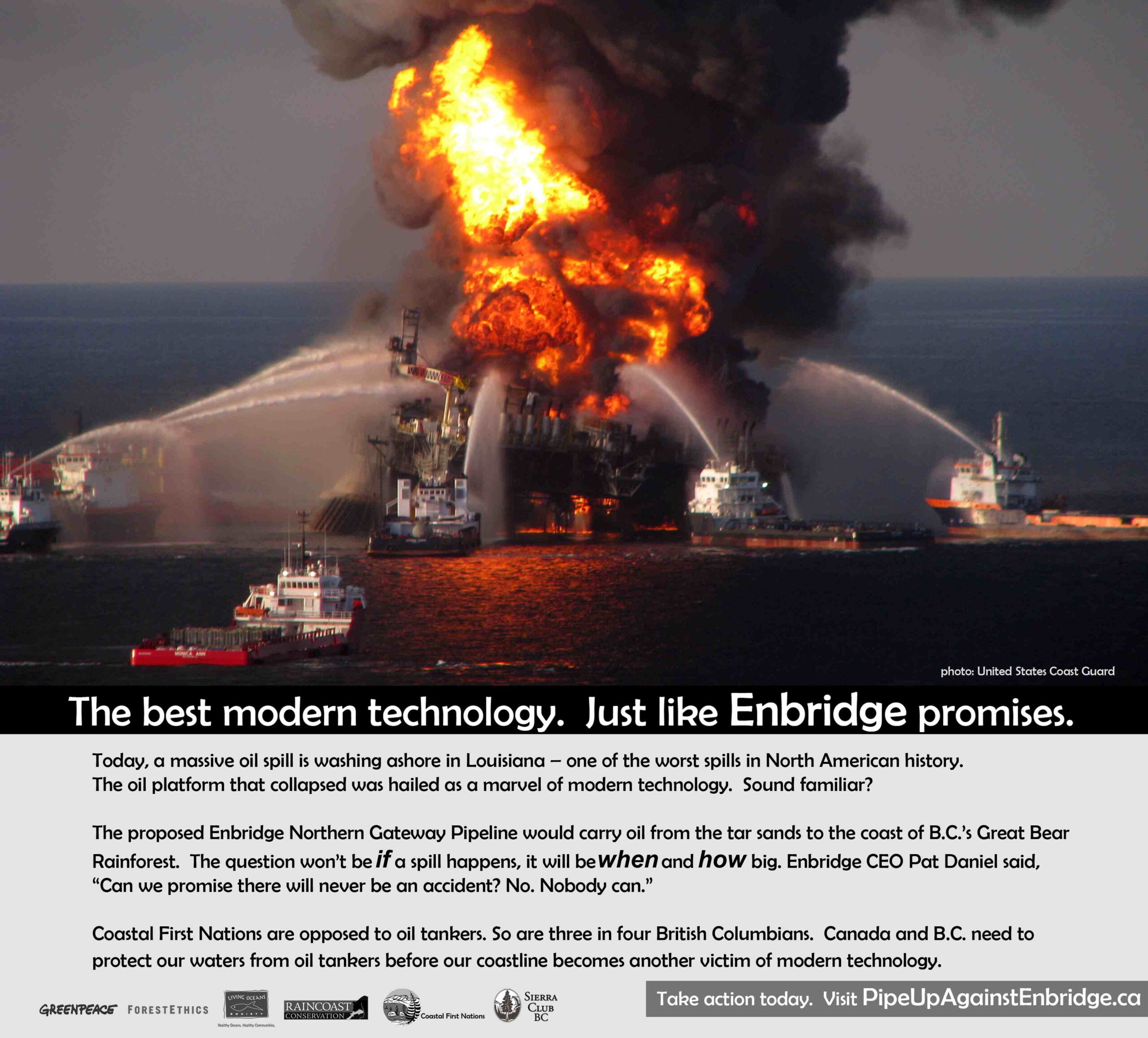
Ad draws attention to oil spill risk
The best modern technology. Just like Enbridge promises. Half page ad taken out by Raincoast, Greenpeace, coastal First Nations and others, points to the risks associated with oil extraction and transport. Read about one person’s perspective on BP’s safety record and the constant drive of the oil industry to reduce costs.

Our first blog entry!
More notes, more ideas, more reflections. More action. The Raincoast Conservation Foundation has been at the fore front of science and research on the coast of British Columbia for a number of years. We publish peer reviewed papers, we develop reports, we host conferences. We also have a talent for getting press, we produce a…

Groups decry province’s proposed aerial wolf kill
By Andrea Woo, Vancouver Sun A collective of Canadian environmental groups has written an open letter to Premier Gordon Campbell decrying the provincial government’s proposal for an aerial wolf kill in efforts to protect the dwindling mountain caribou population.
Emerging from the den
Our spring field season has arrived and is led by Dr. Chris Darimont, Raincoast Director of Science by Chris Darimont Possessing only a rudimentary knowledge of gravity, delicate little claws for braking, and pure trust in their momma, brand new grizzly cubs are slip-sliding their way down snowfields this month as they emerge from their…