

Shifting salmon policy
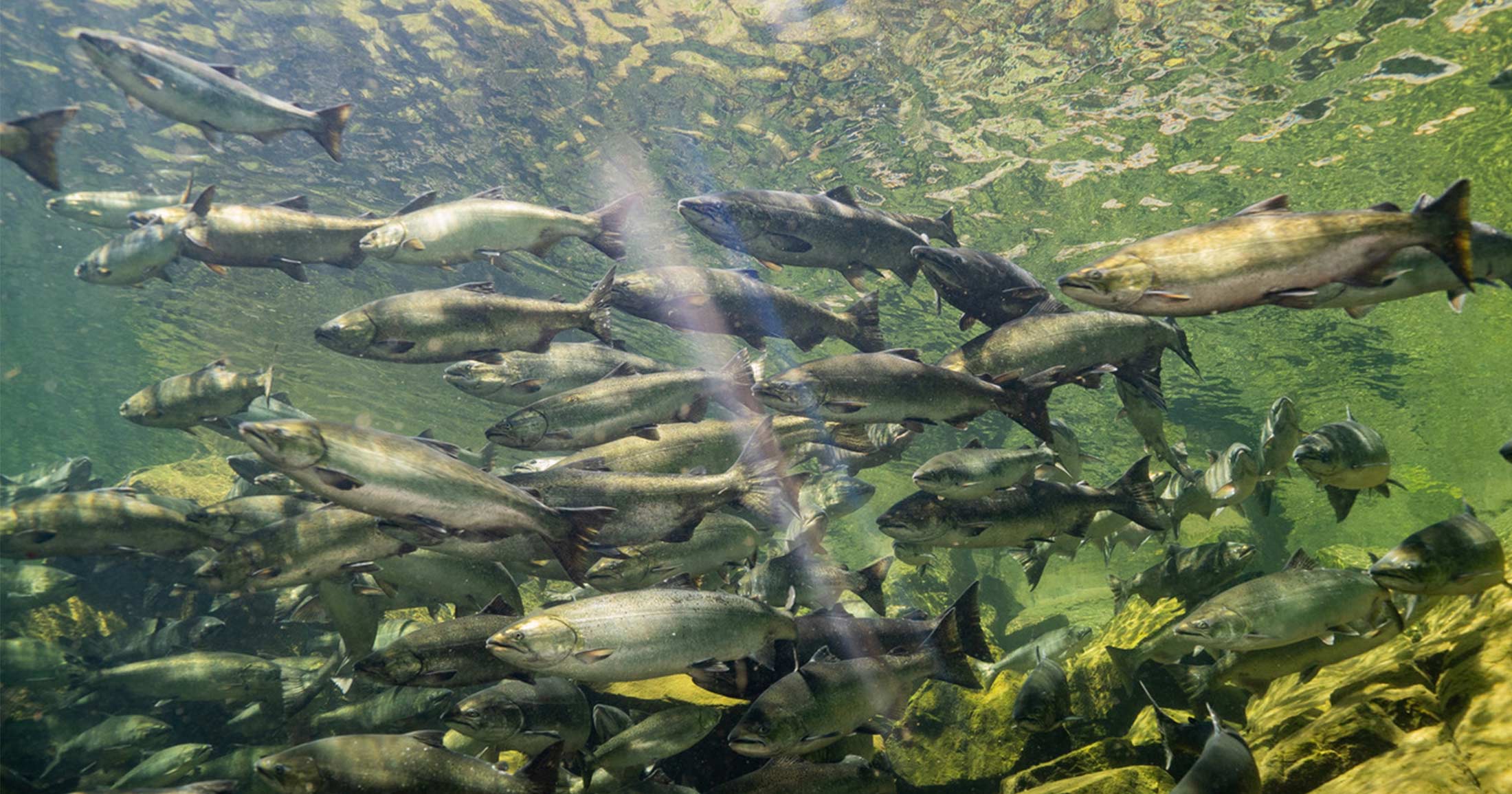
Photo by Alex Harris.
Ecosystems are complex. They are communities of living organisms connected through interacting processes and features on the land, in water, and between the two. Yet BC’s antiquated environmental policy doesn’t reflect this. Colonial society governs ecosystems by siloing them into distinct ministries and resources instead of reflecting the interconnected nature of habitats that make them function in the living world. This “siloed decision making”is the root cause of many of the ecological challenges we face today.


Our policy goals
1. Manage fisheries for ecosystems
- Set salmon harvest at levels that optimize the benefits of spawning salmon to watersheds and wildlife.
- Shift away from historic management paradigms that minimize the number of spawning salmon reaching rivers and maximize harvest (called Maximum Sustainable Yield). Move towards fisheries management that meets salmon spawning targets that are ecologically based, not harvest-based.
- Shift harvest toward selective terminal fisheries (conducted in or near the rivers of origin) that respect the ‘place-based’ nature of salmon, and optimize the benefits to ecosystems, Indigenous cultures, and local communities.
2. Implement ecological-based governance
- Conservation planning and a commitment to sustainability that looks 7 generations ahead.
- A “whole-of-government” approach that implements shared solutions by Indigenous, federal, provincial, and municipal governments to achieve salmon recovery from inland watersheds and rivers, to the open ocean.
- Governance that honours Aboriginal rights and title, inherent Indigenous jurisdiction and law, and the United Nations Declaration on the Rights of Indigenous Peoples (UNDRIP) and the Declaration on the Rights of Indigenous Peoples Act (DRIPA).
- Sustainable funding strategies for watershed-scale restoration and planning.


3. Advance land-use policies that prioritize the health of wild salmon and biodiversity
- Zoning that bolsters functioning watersheds and riparian habitat (i.e.protect natural features, limit impervious surfaces, reduce urban sprawl, adopt nature-based solutions).
- Forestry policy that prioritizes salmon health by restricting clear-cutting in salmon watersheds, and incentivizes a sustainable, second or third-growth forest economy.
- Climate adaptation policy that incentivizes nature-based solutions including natural shorelines, intact riparian areas, unrestricted floodplains, managed retreat, and use of rain-gardens in urban areas.
Our recent reports
Recent articles

Raincoast welcomes five summer team members!
We are very pleased to have five passionate students joining our team for the summer. Over the summer, these five youth will contribute to several of our programs, while developing their own skills.

2021: Our impact so far
We are already halfway through the year, and I wanted to share with you some of Raincoast’s achievements thus far. This progress relies on donors like you and the entire team at Raincoast sincerely appreciates your support. Here’s a snapshot of Raincoast’s efforts over the past six months.

Cycles, seasons and sediment of the Fraser Estuary
The Soul of the Fraser by Ken Ashley, Director of the British Columbia Institute of Technology (BCIT), tells the story of the important intertidal habitat in the Fraser River Estuary.

Recommendations towards greater transparency in the science, science communication, and values-driven processes of natural resource management
A new paper, published by a team of researchers including Raincoast scientists, dives into the tangle of cognitive bias, institutional agendas, human interests, and pays special attention to the role of undisclosed value judgments.

Big trees, big stumps and broken promises
For the last two years, I’ve been documenting clearcut logging on Salt Spring Island, and with Raincoasts’s Gulf Islands Forest Project, on Pender Island too. On a small island such as Pender, these relatively small clearcut patches can have a disproportionate impact on the landscape. I wanted to go to the Fairy Creek Blockade to see this intact watershed and support the Indigenous people and land defenders who’ve been protecting this place.
Funding habitat restoration and conservation in the Lower Fraser Region
The AFER Network features working groups to provide space for focused discussion of key topics related to conservation initiatives in the Lower Fraser. On June 17th from 1-3 pm, we are launching our Funding and Fiscal tools Working Group, which will discuss what a post-covid funding world could look like, shifts in funders’ strategic focus, and the role of Diversity, Equity, and Inclusion in shaping funding priorities.