Plastic pollution

Photo by April Benze.

Plastic pollution is choking our waterways and threatening the health of fish and wildlife. We are collecting plastic and microplastic data as part of our community-oriented water pollution monitoring program. We are collaborating on research projects with universities, governments and experts in the field. We are providing advice to local, regional and federal governments on plastic science, policies, and regulations. We are working with Ocean Diagnostics to support a strong science-based foundation for solutions.


Lots of garbage on a beach.
Photo by Simon Ager.
People working together to take samples of water in jars.
Photo by Alex Harris / Raincoast Conservation Foundation.

Our approach

  • Design a source identification toolbox for plastic pollution; 
  • Working with Indigenous and coastal communities to document plastic pollution and track this back to its source;
  • Conduct research on the source, transport and fate of micro and macroplastics in the environment;
  • Engage in outside-the-box dialogue with industry and governments to support more sustainable design, manufacturing and processes that stem the release of plastics during the life cycle of a product;
  • Support community-oriented outreach and training to support solution-oriented actions and capacity building.

Plastics are everywhere

Plastics from just about every sector can now be found all over the world – from mountain tops to the seafloor, from the Arctic to the Antarctic, and from our homes to the ocean. A modern-day scourge that is blighting remote beaches and shorelines, getting mistaken for food by wildlife, and getting into the foods that nourish us. Whether it’s the structural features of plastic products that suffocate, entangle, or create intestinal blockages – or the endocrine disrupting-contaminants that serve as ingredients of the product (e.g. Bisphenol A or phthalate esters) or as hitchhikers soaked up by plastics in the environment (e.g. PCBs or metals) – plastics are harmful.

Underwater photo of plastic floating near the top of the water.
Chinook salmon swim in a river as seen from head on; epic.
Photo by Fernando Lessa.

The impact on the environment

Without a dramatic re-think, the plastic crisis is here to stay. Despite the best intentions of governments, industry, and consumers to reduce, recycle or re-use, global plastic production continues to enjoy exponential growth. And the unintentional loss to the environment of plastic products and byproducts will continue – plastic bags, bottles, and fishing gear, as well as the discharge of microplastics through domestic and industrial waste. With that will come a constant stream of items that will be mistaken for food but offer zero nutrition, that will entangle wildlife, and will deliver endocrine disruptors to our aquatic food webs. We will document impacts, share findings, and work for change through science, community engagement, and expert advice.

Recent articles

Doug Brown

Honouring ‘Wolfman’ Doug Brown Jr.

Our first ‘real’ blog post from the heart of the Great Bear Rainforest! Perhaps you are expecting tales of bears, wolves, or salmon.  Well, after three days of fieldwork, we have not yet seen any charismatic wildlife (except a nice spike buck in velvet). And we have heard that locals have been catching some salmon,…
Royal Victoria Marathon logo.

RVM 10-10-10 Join the salmon run

Raincoast  is an Official Pledge Charity of the 31st Annual Royal Victoria Marathon! Did you know that some Fraser River sockeye salmon swim upstream the equivalent of 12 full marathons?  Join our Raincoast Salmon Run team, and help us reach our goal of walking and running 12 full marathons and our financial goal of $30,000. Your…
A man smiling in front of a tree.

The ‘Get Out’ Migration

Reflecting on last Saturday’s finale of Alexandra Morton’s amazing Get Out Migration, the walk from Sidney (starting at the Shaw Ocean Discovery Centre) to the legislature was absolutely inspiring. The Ocean Discovery Centre had a great Get Out Migration exhibit, along with a moving montage of images from the Get Out Migration’s previous legs, accompanied…
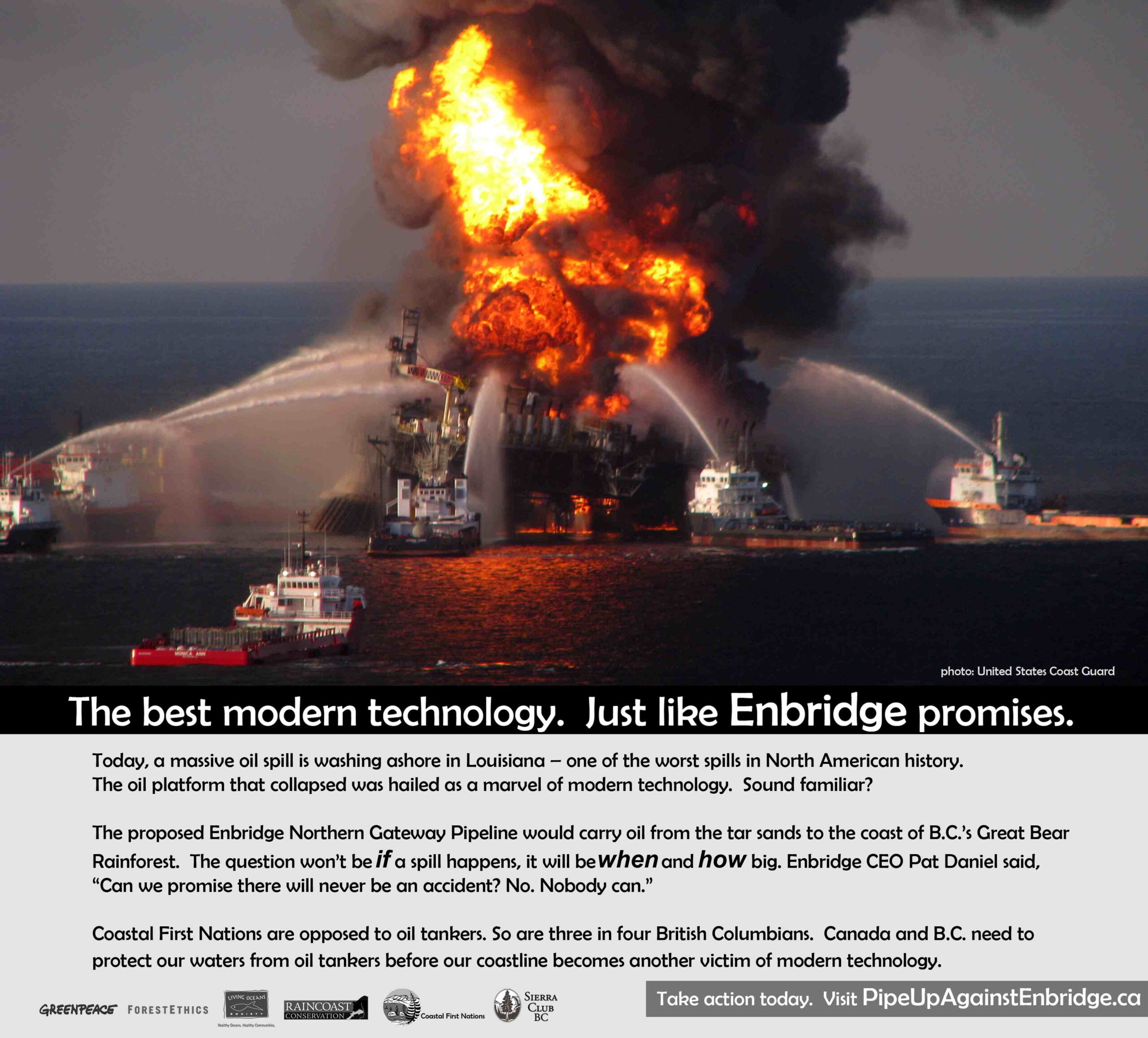
The best modern technology, just edwards.

Ad draws attention to oil spill risk

The best modern technology.  Just like Enbridge promises. Half page ad taken out by Raincoast, Greenpeace, coastal First Nations and others, points to the risks associated with oil extraction and transport. Read about one person’s perspective on BP’s safety record and the constant drive of the oil industry to reduce costs.
A man and woman holding a baby in front of a tree.

Our first blog entry!

More notes, more ideas, more reflections. More action. The Raincoast Conservation Foundation has been at the fore front of science and research on the coast of British Columbia for a number of years. We publish peer reviewed papers, we develop reports, we host conferences. We also have a talent for getting press, we produce a…
A wolf laying on a pile of wood.

Groups decry province’s proposed aerial wolf kill

By Andrea Woo, Vancouver Sun A collective of Canadian environmental groups has written an open letter to Premier Gordon Campbell decrying the provincial government’s proposal for an aerial wolf kill in efforts to protect the dwindling mountain caribou population.
A man and woman holding a baby in front of a tree.

Emerging from the den

Our spring field season has arrived and is led by Dr. Chris Darimont, Raincoast Director of Science by Chris Darimont Possessing only a rudimentary knowledge of gravity, delicate little claws for braking, and pure trust in their momma, brand new grizzly cubs are slip-sliding their way down snowfields this month as they emerge from their…
A wolf laying on a pile of wood.

Wolf kill to save caribou strongly opposed

The following open letter has been sent to BC Premier Gordon Campbell opposing the killing of wolves and cougars to save mountain caribou May 3, 2010BY FAX AND E-MAIL Premier Gordon CampbellPO Box 9041 STN PROV GOVTVictoria, BC V8W 9E1Fax: (250) 387-0087 Dear Premier Campbell: The undersigned organizations are strongly opposed to the killing of…