Wolves role in healthy ecosystems
Protecting wolves protects the ecological processes that sustain life across entire landscapes.
Wolves are a keystone1 and umbrella2 species that help keep entire ecosystems in balance. By directly consuming prey, wolves influence not only prey numbers but also their overall health and behaviour. Wolves tend to target young, old, injured, or sick individuals, a form of selective predation that can help maintain healthier ungulate populations. This is important because healthier prey populations are less likely to experience overpopulation, habitat degradation, or large-scale disease outbreaks, all of which can have cascading effects throughout the ecosystem. Through this selective predation, wolves may also help limit the spread of diseases such as bovine tuberculosis and Chronic Wasting Disease. By removing individuals that are more likely to be infected or immunocompromised, wolves may reduce opportunities for disease transmission within prey populations.
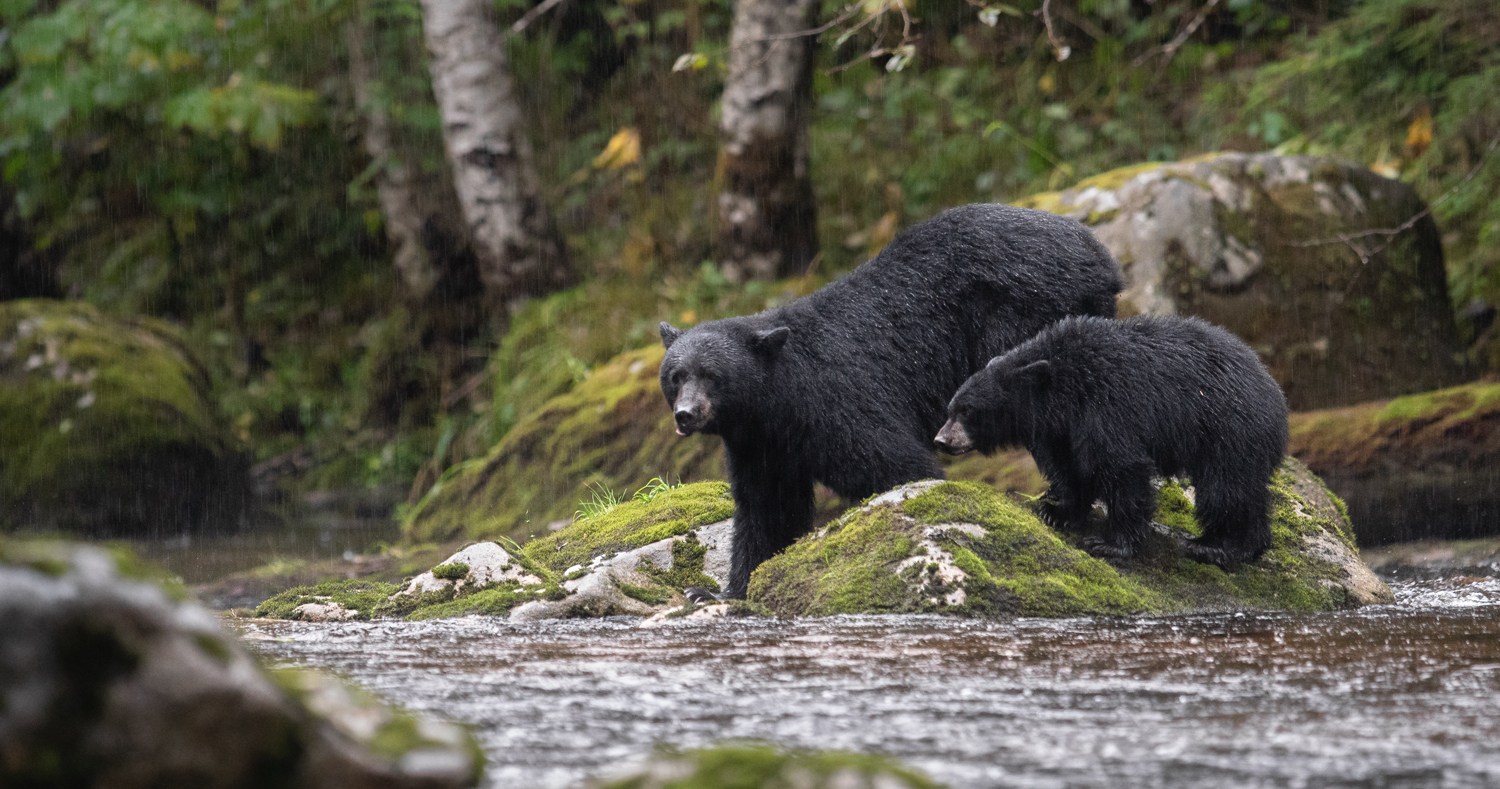
Beyond population regulation, wolves drive powerful nutrient cycling processes. Carcasses left behind from hunts feed scavengers like bears, ravens, eagles, and even invertebrates, redistributing nutrients into the soil and promoting plant growth. Additionally, wolf scat enriches soils with nitrogen and phosphorus, further supporting primary productivity. In salmon-bearing regions, coastal wolves feed heavily on spawning salmon from fall to winter and transfer valuable marine-derived nutrients into terrestrial ecosystems, linking ocean and forest food webs.
Wolves also provide a suite of important benefits known as non-consumptive effects, meaning their ecological influence extends well beyond the animals they directly kill. Simply by being present in an ecosystem, wolves alter the behaviour, movement, and habitat use of prey species such as deer and elk. This phenomenon, often described as a trophic cascade, occurs when changes at the top of the food web ripple downward through multiple levels of the ecosystem.
When prey animals must remain alert and mobile to avoid predators, they are less likely to linger in one area for long periods. This reduces intense browsing pressure on vegetation, particularly in sensitive areas like riverbanks and valley bottoms. As a result, plants such as willows, aspens and cottonwoods are better able to regenerate, which stabilizes streambanks, improves water quality and supports a wider array of life. Recovering riparian vegetation – plant life adjacent to rivers and streams – creates habitats for songbirds, insects, and amphibians, while also benefiting aquatic species by providing shade and cover over streams.
These behaviour-driven effects demonstrate that wolves help shape healthier, more resilient ecosystems not only through predation, but by restoring natural patterns of movement and habitat use across the landscape. In this way, wolves act as ecological regulators, reinforcing connections between terrestrial and aquatic systems and supporting biodiversity far beyond their role as apex predators. Protecting wolves, therefore, protects the ecological processes that sustain life across entire landscapes.
References
Beschta RL, Ripple WJ. 2009. Large predators and trophic cascades in terrestrial ecosystems of the western United States. Biological Conservation. 142(11):2401–2414. doi:https://doi.org/10.1016/j.biocon.2009.06.015.
Brandell EE, Cross PC, Smith DW, Rogers W, Galloway Nathan L, MacNulty DR, Stahler DR, Treanor J, Hudson PJ. 2022. Examination of the interaction between age‐specific predation and chronic disease in the Greater Yellowstone Ecosystem. Journal of Animal Ecology. 91(7). doi:https://doi.org/10.1111/1365-2656.13661.
Bump JK, Peterson RO, Vucetich JA. 2009. Wolves modulate soil nutrient heterogeneity and foliar nitrogen by configuring the distribution of ungulate carcasses. Ecology. 90(11):3159–67. doi:https://doi.org/10.1890/09-0292.1.
Darimont CT, Reimchen TE, Paquet PC. 2003. Foraging behaviour by gray wolves on salmon streams in coastal British Columbia. Canadian Journal of Zoology. 81(2):349–353. doi:https://doi.org/10.1139/z02-246.
Estes JA, Terborgh J, Brashares JS, Power ME, Berger J, Bond WJ, Carpenter SR, Essington TE, Holt RD, Jackson JBC, et al. 2011. Trophic Downgrading of Planet Earth. Science. 333(6040):301–306. doi:https://doi.org/10.1126/science.1205106.
Hoy SR, Vucetich JA, Peterson RO. 2022. The Role of Wolves in Regulating a Chronic Non-communicable Disease, Osteoarthritis, in Prey Populations. Frontiers in Ecology and Evolution. 10. doi:https://doi.org/10.3389/fevo.2022.819137.
Oliveira-Santos GR, Moore SA, Severud WJ, Forester JD, Isaac EJ, Chenaux-Ibrahim Y, Garwood T, Escobar LE, Wolf TM. 2021. Spatial compartmentalization: A nonlethal predator mechanism to reduce parasite transmission between prey species. Science Advances. 7(52). doi:https://doi.org/10.1126/sciadv.abj5944.
Ripple WJ, Beschta RL. 2012. Trophic cascades in Yellowstone: The first 15 years after wolf reintroduction. Biological Conservation. 145(1):205–213. doi:https://doi.org/10.1016/j.biocon.2011.11.005.
Ripple WJ, Beschta RL. 2004. Wolves and the Ecology of Fear: Can Predation Risk Structure Ecosystems? BioScience. 54(8):755. doi:https://doi.org/10.1641/0006-3568(2004)054[0755:wateof]2.0.co;2.
Tanner E, White A, Acevedo P, Balseiro A, Marcos J, Gortázar C. 2019. Wolves contribute to disease control in a multi-host system. Scientific Reports. 9(1). doi:https://doi.org/10.1038/s41598-019-44148-9.
Wilmers CC, Schmitz OJ. 2016. Effects of gray wolf-induced trophic cascades on ecosystem carbon cycling. Ecosphere. 7(10):e01501. doi:https://doi.org/10.1002/ecs2.1501.
Wolf C, Ripple WJ. 2018. Rewilding the world’s large carnivores. Royal Society Open Science. 5(3):172235. doi:https://doi.org/10.1098/rsos.172235.
Notes and references
- A keystone species is a species that has a disproportionately large influence on the structure, function, and health of an ecosystem relative to its abundance, meaning that its presence (or absence), even in small numbers, can shape entire ecosystems. Their loss can trigger cascading negative effects, altering food webs, nutrient cycles, and habitat structures.
- An umbrella species is a species whose conservation helps protect many other species because it requires large, diverse, and healthy habitats. By protecting the umbrella species, entire ecosystems and the biodiversity within them are also safeguarded.