
Giving back to what you love
How a passion for plants blossomed into a local stewardship journey.
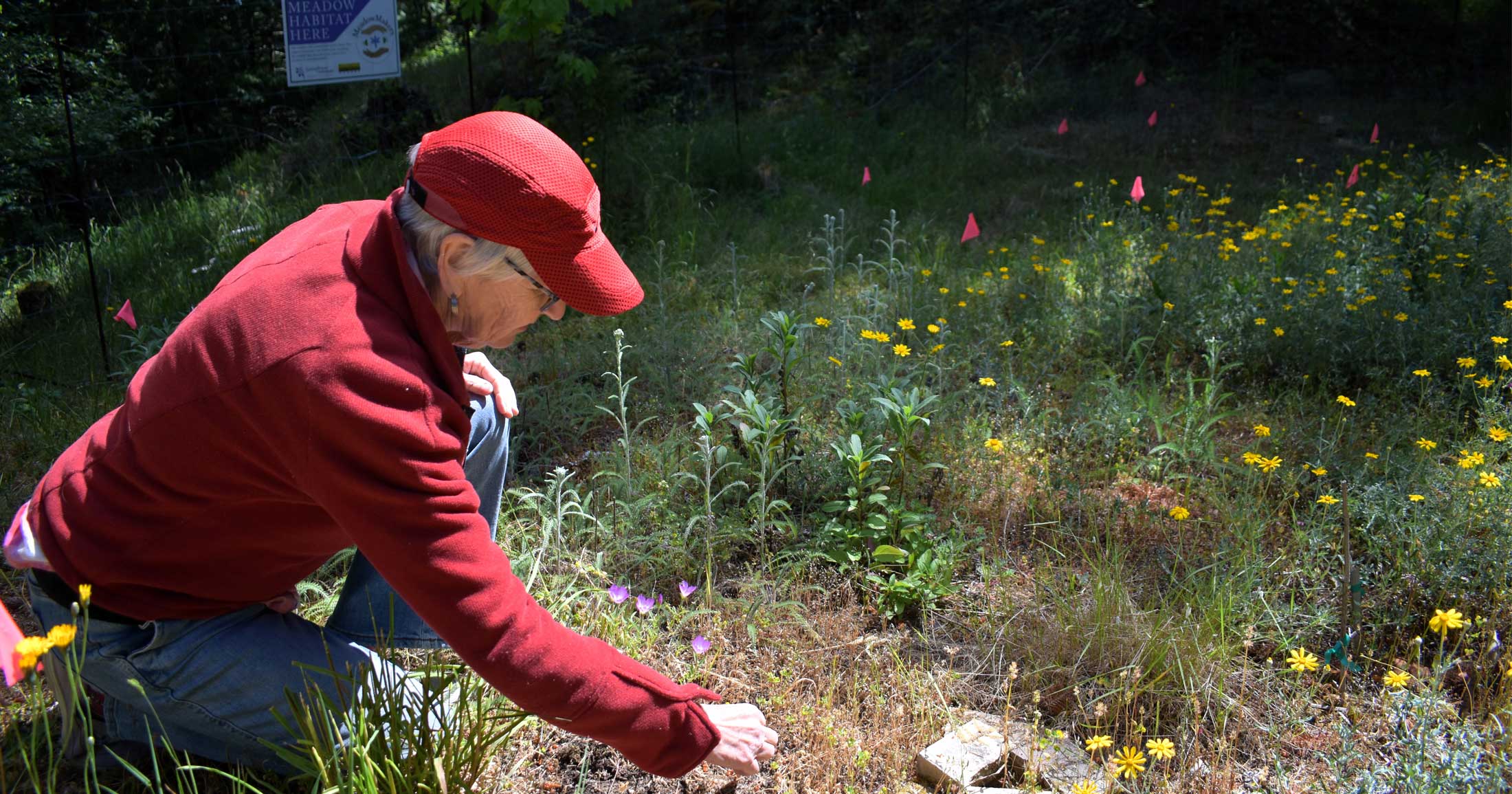
As I made my way up the last stretch of grassy slope on a mild spring morning, turning toward the meadow in S,DÁYES Flycatcher Forest, I was welcomed by a warm and familiar sight: Kathy Jago, our ever compassionate and plant-loving neighbour, bundled in her blanket, plant book in hand, enjoying a moment of quiet in the meadow she has tirelessly tended.
Since 2022, Kathy has been stewarding our small meadow patch by removing the invasive plants, watering the plantings, and monitoring it. We couldn’t have asked for a better scenario – a lifelong plant lover with a horticultural background, who just happened to live on the property directly neighbouring our nature reserve.

Meadow musings on a May morning
While others bustled to the farmers market, we sat in our lawn chairs in the meadow, with the sound of whistling wind in the trees, bees buzzing, and chickadees chirping. Before our steadfast meadow steward leaves S,DÁYES (Pender Island) to move onto her next journey, I took this moment to talk to her about plants, people, and places. From laughing over our shared titles of ‘crazy plant ladies’, to realizing the healing power of plants, it was the perfect way to commemorate our dear Kathy.
Tell us about yourself! What is your relationship with S,DÁYES (Pender Island) and plants? What brought you to where you are now?
We came from Ontario in 2007. I had a diploma in landscape design. The reason I had that [diploma] was because my little brother – my 39 year old brother – had died of AIDS, and I had stopped teaching. I taught for 25 years. I really wanted to experience a new climate, a new way of being, and so, we moved to Victoria. But before we got settled in, before we had our stuff here, my husband was diagnosed with colon cancer, which went on for four surgeries, four and a half years, and six months of chemo.
In the middle of that, when the cancer was looking the most dire, I was at a retreat on Salt Spring Island, and I thought, I’m gonna live on a Gulf Island. So, in the midst of waiting for his very serious surgery, I came and looked at Pender, and the first place I saw was this place [gesturing to her house next door to the meadow]. I looked out the window, and I just thought, this is where I want to be. But it was an alien landscape. It was a 45 degree slope, it was all rocks, it was drought, there was nothing but [invasive Scotch] broom.
That’s how we came to be here, and then, of course, next door was the forest [S,DÁYES Flycatcher]. But it wasn’t the forest then, it belonged to an individual who wasn’t doing anything with it, which was nice. Prior to him, there’d been a family or a couple who had kept a trailer here in the place where the meadow is. In fact, you can still see the exact spot where the trailer sat – with vegetation really good on this side and really bad over there [gesturing to the two halves of the meadow]. I knew about the Scotch broom and I set about to clear this space.
I just thought this was a magic space. Then I got really frightened when they said they were gonna sell it, and I was afraid that it would be a developer. I also realized it was probably gonna be the first time I chained myself to a tree, because I really didn’t think I could bear them cutting down the big trees. People would come and look, and we would see them from the balcony. I did everything I could to discourage them – I walked around in weird clothes with a stick!
To our amazement, the fund began to buy the forest, and they needed half a million dollars. Then, they [Raincoast and the Pender Islands Conservancy] bought it, and that was just miraculous. I have a background in horticulture, so when they said they were going to make a meadow here as well, I was like this is phenomenal, this is beyond my belief.
When Shauna (Doll) came in 2022 from Raincoast, they planted a bunch of stuff and put up a very makeshift fence. I pretty much stayed away from it then, because the fence was falling down. I picked the broom around the edges as best I could. In April of 2024, along came Colin Hamilton, who built this magnificent fence, all the way around the outside. So now, I could really see what was going to happen.
Because I lived next door, I couldn’t ignore it. So, I started to tend to it, I couldn’t not tend to it. I tried to figure out which plants had survived, and Bob and I set about to water them. Initially we didn’t have the rain barrels, so we just carried jugs of water from the house. Then we got the rain barrels, which fill up amazingly.
I’ve had to learn about a whole lot of new plants. A lot of these are not deer-resistant, so you don’t see them. I’ve had to get to know some new plants, and I’ve had to get to know Satinflower Nurseries who provided the plants in the first place.
What is your favourite plant in the meadow, and why?
I just seem to love them all! Well, particularly the perennials – I just like the seasonal stuff, you know? Three or four days from now, that farewell-to-spring (Clarkia amoena) will be gone. I love the cycle, I love the return.
I had a garden business once, and I called it Next Spring Garden Design.

Where did your background in horticulture come from? How did you start your business?
Previously, I taught school for 25 years. I got a phone call one night from my brother telling me that he was HIV positive, that he had AIDS. He got infected in 1986, which was the worst possible time to get infected, and he died in 1992. He would have been quite a gardener.
I really didn’t want to go back to teaching. I’d done a lot of different things in teaching, but I was like, I’m not learning anything new. My brother left me $25,000, and at the time, that was about the equivalent of a halftime teaching salary. He died in October, and I received the first book – the distance education box came with the first course from the University of Guelph. I spent five years doing the 13 courses, and the practicum, and the projects, and this, and that, and in the process of that, started up a little gardening business. The horticultural background came about out of grief.
You’ve had some challenging times in your life with people that are close to you. How do you think plant and forest communities are similar to human communities, and how are they different? How do you think plants can teach us lessons about ourselves as humans, or how can plants help us navigate challenging times?
The meadow has been interesting for me because it’s made me think a lot about people and their interaction with the Earth, or the forest, or anything. There’s just so few places in the world that most people encounter that have not been modified by humans. I mean, even this forest, of course, a lot of it’s been logged over time, the deer have had a huge impact, the invasive species have had a field day. So for me, it was difficult to figure out how much to intervene in the meadow, and how much I intervene in other people’s lives or other landscapes. What views am I carrying?
When the meadow first was fenced, I started to think people were going to come and look at it. So, how am I gonna make them stay on the path? One of the first things I did was I whacked around the edge of it because I wanted them to stay there, stay off the plants. But there, again, I was intervening. We’re just so accustomed to controlling and fixing, and I don’t think it matters what it is.
I understand that my intervention has kept the plants alive, but is that what they wanted? I don’t know. I wanted to keep them alive because I like to keep things alive, but things die, and things are not intended to be in some places. This whole forest has been, for me, a completely different experience, to try to see what I think I need to control or why.
It is lovely to sit here and see a bird come to the water that you put out, or the butterflies come and sit on the heads of the Achillea (A. millefolium, yarrow) or, you know, the bees buzzing on the woollies (Eriophyllum lanatum, woolly sunflower). It has taught me a lot.

What is something you would like to share with people, to help inspire interest in nature, or help inspire interest in plants?
Some people are just attuned to nature and the trees. We can’t help ourselves, we can’t help but stop in our conversation, say, did you hear the eagle? I can’t imagine being without plants. If you take a plant, and you put it in the room of someone in a nursing home, and you watch them, compared to the control group who doesn’t have the plant, the ones that have the plant will do better than the ones without the plant.
I suspect childhood is really critical. I think early education is probably the way to go. Growing those beans in the little newspaper containers in the schools.
What do you hope or imagine the meadow will look like in 5 years, 10 years, 50 years?
I don’t think I can really guess what it’s going to look like, because I don’t know whether someone is going to tend it or not, or whether it even needs to be tended, whether it can just be like an old totem pole. From an educational standpoint, I’d like it to persist, because I would like people to see what you can do with some of these plants, besides just the little pot that you buy down in the great native plant nursery that we have on Pender.
What are some of the changes you’ve observed in the meadow, and on a larger scale, with the climate, during your time living on the coast?
I mean, I’m looking at the Achillea here, it’s much earlier this year. They’re a lot shorter and they’re blooming a lot earlier.
Certainly, it’s been the water issue I think that is probably the most noticeable. Water is the thing that I notice the most. It’s unpredictable – it’s too much, it’s too little. I’ve been here 20 years and I’m still learning about this drought, this temperate rainforest stuff, where it’s just so dry and so wet. I’m just thinking more in terms of everything being unpredictable – that I can’t count on rainfall.
The extreme temperatures, too. In the time we’ve been here, we’ve had the one heat dome where it was more than 40 degrees in the kitchen of the house. Nobody can stand that. I guess there are some plants that can cope with 40 degrees, but not all of a sudden, they were not bred to deal with 40 degrees.
It’s very easy to get despairing with climate change. My only way of coping with that is to pull it in, you know, look after what I can in this space, and this time.

We very affectionately refer to you as Kathy the Meadow Steward. What does the word ‘stewardship’ mean to you?
I wasn’t acquainted with the word stewardship until we moved here. I always thought, you know, you were a gardener, or a maintenance person. I think it’s quite a nice word. I think it’s caregiving. I don’t think it really matters whether it’s caregiving for yourself, or for your neighbours, or for the land. I think it’s all the same. Certainly, we sometimes put people first at the expense of the land.
The older I get, the more I’m careful with what I take on, and if I take on something, then I’m gonna look after it. And it’s looked after me. I’ve spent many afternoons sitting here, reading or meditating, and if you sit long enough, a flicker comes, the butterflies go by – everyone comes to visit. I can’t imagine being without that ability to look and see and appreciate, and be nurtured by it. I mean, who can resist those little yellow flowers? Those woollies are just smiling!
There’s beauty in things that are meticulous and cultivated by individuals, and then there’s the beauty that just makes itself. The forest looks after itself, as well. All those trees talk to one another. Everything is going on out of sight, largely. It’s miraculous. It’s so precious.

Our deepest gratitude
Kathy has more than embodied what it means to be neighbours with nature, and we cannot thank her enough for the genuine care, time, and labour she has put into stewarding this meadow. At 78 years strong, Kathy’s journey reminds us that there will always be losses in life, but we can find constancy and healing through our unique connections to nature.
We thank you, Kathy, for showing us the power of local stewardship and what community conservation means. You’ve created a lasting legacy that will grow and flourish with every bloom of a meadow flower.
If you are inspired by Kathy’s stewardship journey and want to also give back to what you love, consider participating in the Pender Islands Conservancy’s many initiatives.