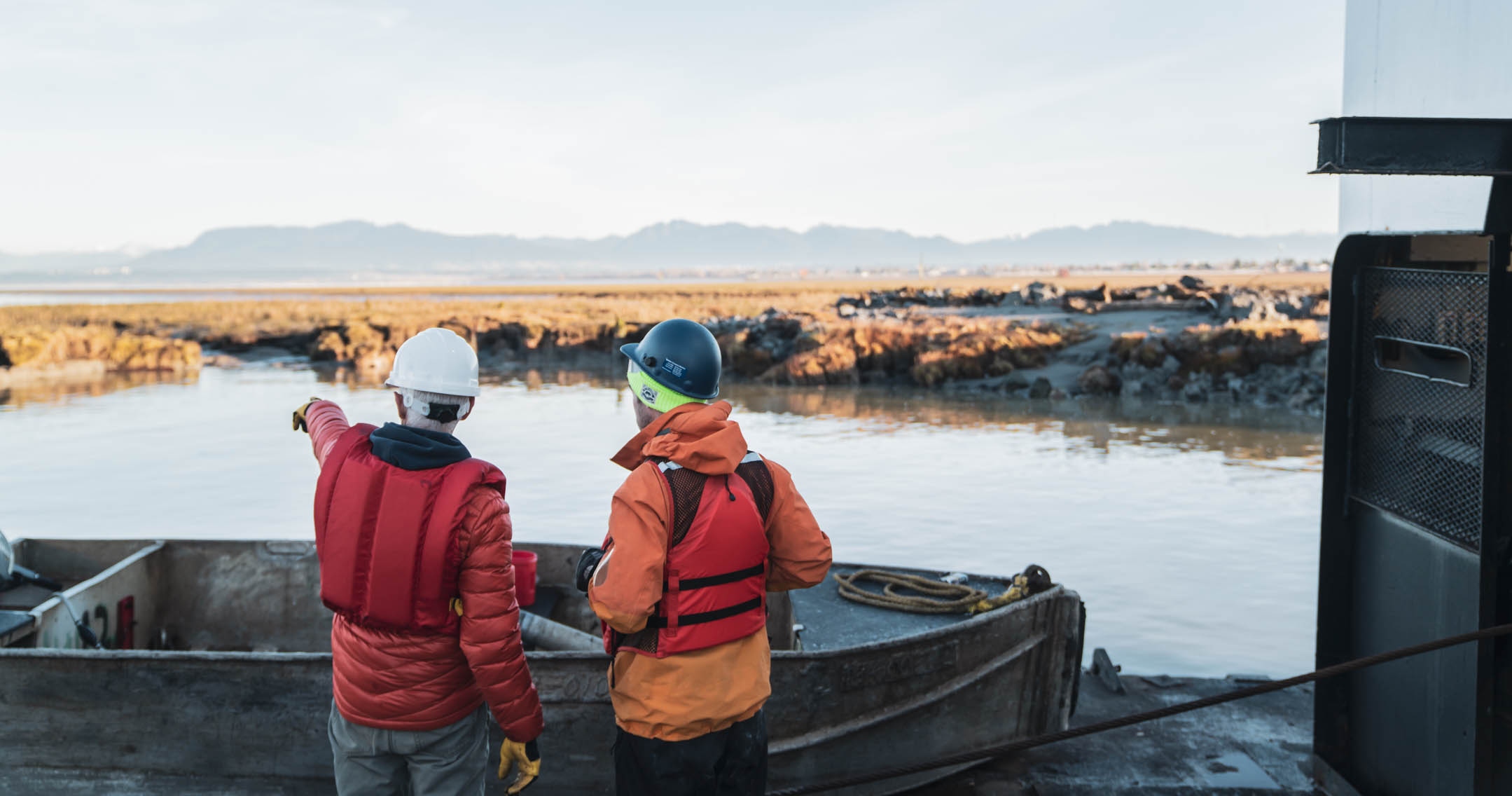

Raincoast scientist gives testimony to Government of Canada on the threat posed by plastic pollution
This month, a standing committee of the House of Commons on Environment and Sustainable Development invited Dr. Peter Ross to give testimony.
Watch Dr. Peter Ross’s opening statement to the House of Commons Standing Committee on Environment and Sustainable Development.
See the entire exchange and read the minutes.
Committee motion
That the committee undertake a study, pursuant to Standing Order 108(2), of one meeting, on the implementation and impacts of the single use plastics prohibition regulations as well as the suspension of the government’s export ban on single use plastics; that the study takes into account the scientific evidence that shows that plastic pollution poses a threat to the environment; that the committee invite the Minister of Environment and Climate Change, and any other witnesses appropriate to this study to appear before it; and that the committee report its findings and recommendations to the House.
Remarks to the Standing Committee of the House of Commons on Environment and Sustainable Development by Dr. Peter Ross
Ottawa, June 11, 2026
Good morning, Madam Chair, thank you for inviting me today. Thank you to the Honourable members of this Committee.
I have been studying plastic and microplastic pollution for the past 20 years, during which time I worked as a scientist for the federal government, the Vancouver Aquarium, Ocean Wise, and now Raincoast Conservation Foundation. I am a toxicologist, and for four decades, have studied a variety of pollutants in killer whales, beluga whales, harbour seals, salmon, shellfish and air, water and sediments. Most of what I have studied has been chemical in nature: PCBs, dioxins, pesticides, hydrocarbons and metals, among others.
Plastics emerged in my professional world as a topic of significant public, scientific and policy concern – a unique form of ‘structural’ pollutant. A pollutant where every piece or particle is nearly unique in shape, size and formulation – think ‘snowflakes’. This renders the technical characterization of plastics and microplastics challenging, and offers significant opportunities for scientific advances, information exchange and innovation.
I summarize below salient points that reflect my professional perspective on the topic of plastics and microplastics. Firstly,
1. Plastics and microplastics
- Have been widely detected throughout Canada’s three oceans, as well as in freshwater and terrestrial environments;
- Kill fish and wildlife (entanglement, suffocation and starvation);
- Are pervasive and persistent pollutants, and are found in the air we breathe, the water we drink and the food we eat;
- Break down over time into smaller and smaller pieces, with each size range threatening different sized animals;
2. The plastic pollution problem is only getting worse, each and every day
- Global plastic production is doubling every 10-15 years;
- Shoreline or ocean cleanups are useful for data and education, but are an ineffective ‘Band aid’ for the growing plastic pollution problem;
- Recycling systems fail to collect the vast majority of plastic waste in Canada;
- Additives, colours and chemical formulations prevent a circular plastics economy; the majority of plastics in our blue bins end up in dead-end products (park benches or carpets) or landfills. This means ‘recycling’ entails a ~maximum of two uses for virgin plastic;
3. Plastic pollution comes from
- fishing and aquaculture sectors remain an important source in the oceans;
- Millions of fibres from clothes are shed with each laundry, much of this polyester that we have detected throughout the Arctic Ocean, with as many as 47 polyester fibres per cubic meter of seawater at the North Pole;
- Municipal wastewater treatment reduces but does not eliminate discharge into our waterways, with the microplastics retained in biosolids are spread on our farms and gardens;
- Single-use packaging from restaurant customers, recreational users and travellers can be found on our streets and shorelines.
- Plastic packaging accounts for 47% (approximately 1.4 million tonnes) of plastic waste in Canada.
- More than 86% of plastic waste ends up in landfills.
4. Canada is well positioned for global leadership
- Canada’s SUPPR (Single Use Plastic Prohibition Regs) regulations have directly led to less plastic litter on beaches across Canada;
- Canada’s addition of ‘plastic manufactured items’ to the Domestic Substances List under CEPA allows Ottawa to identify and eliminate those products or processes that present particular risks to the health of Canadians and the environment.
- Canada’s leadership at the Global Plastics Treaty negotiations remains a priority effort as we live in an interconnected global marketplace;
5. Canada should strengthen its leadership
- further enable innovation in research in the material sciences, textile designs, and wastewater treatment sectors;
- facilitate national knowledge exchange through working groups, conferences and consultations;
- strengthen research capacities through inter-laboratory calibration, a national repository for plastic materials, and standard reference materials;
- encourage home source controls through updated appliance standards, consumer education (lint filters on laundry, best practices);
- Strengthen the market value and safety of recycled plastics through the labelling of plastic formulations for additives and dyes;
- Continue to build a national recycling framework to increase the market value of recycled resins through Canadian Council of Ministers of the Environment (CCME) leadership – an estimated $11 billion per year could be generated if we captured and recycled that which we throw away today;
- Consider the value of braided western science and Indigenous Knowledge.
With Ottawa’s leadership, the Provinces, territories, First Nations and local authorities can work as a team to create a thriving, innovative and sustainable economy for all Canadians.
Thank you Madam Chair.