

To restore salmon habitat, one must act like the beaver
Rebuilding riparian habitat, one stick at a time.
The feeling of a lopper slicing through a branch might just be one of the most satisfying feelings in the world. After a long winter spent at a desk staring at screens, there’s something so cathartic about pulling the waders on and doing some good old-fashioned manual labour.
In a world where progress can move at a glacial pace, habitat restoration projects are one of the only times where we can feel like we’re making a tangible difference in the span of a couple weeks.
I’m back in the Nicola watershed, known for its cowboys, sagebrush, and salmon. After a summer spent mapping thermal refuges in the Coldwater River – the Nicola’s largest tributary and important salmon stream – we spent time this spring planting riparian vegetation at strategic sites along the river, directly turning our research into on-the-ground action.


Building on our work from last year
During our site visits last summer, we noticed that many thermal refuges lacked shade due to recent degradation of the riparian environment. Many sites had eroding banks and lacked structure, overall contributing to poor quality salmon habitat. At the end of the season, we selected four of these sites to target for restoration this spring.
Our simple approach
We’re taking what’s known as a Low-Tech Process-Based approach to habitat restoration. Low-tech means we only use hand tools, human power, and small-scale designs to achieve our restoration goals. Process-based means that the goal of each project is to re-establish naturally occurring habitat processes, such as wood recruitment and shading, that ultimately create high quality salmon habitat. This approach is akin to treating the root cause of a disease rather than the symptoms.
In the long-term, process-based restoration projects can require less maintenance, be more effective, and be more resilient to change. My discussion with Jess Hutchinson on an episode of our podcast, Raincoast Radio, was the spark for trying this approach to restoration.
In practice, our approach emulates what beavers naturally do on their own. We took cuttings from live Willow, Cottonwood, and Red-Osier Dogwood and transplanted them to our sites as stakes, vertical bundles, and fascines. Because these species can propagate from branch cuttings, all we have to do is get them in the ground and new plants will sprout. Walk the river in the summer and you’ll see branches moved around by beavers, rooting on their own, and in the long run, stabilizing the riverbank.

The goal
Our aim was to address two common causes of habitat degradation at thermal refuge sites: a lack of shade and eroding banks. Planting on exposed south-facing banks maximizes shade, and using wattles, fascines, and vertical bundles help stabilize eroding banks without the use of hardened structures like rip rap. Over time, these cuttings will root, leaf out, and act like a “catcher’s mitt” during high flows, accumulating dead wood and eventually creating logjams that are safe havens for juvenile salmon.
Seeding a better tomorrow
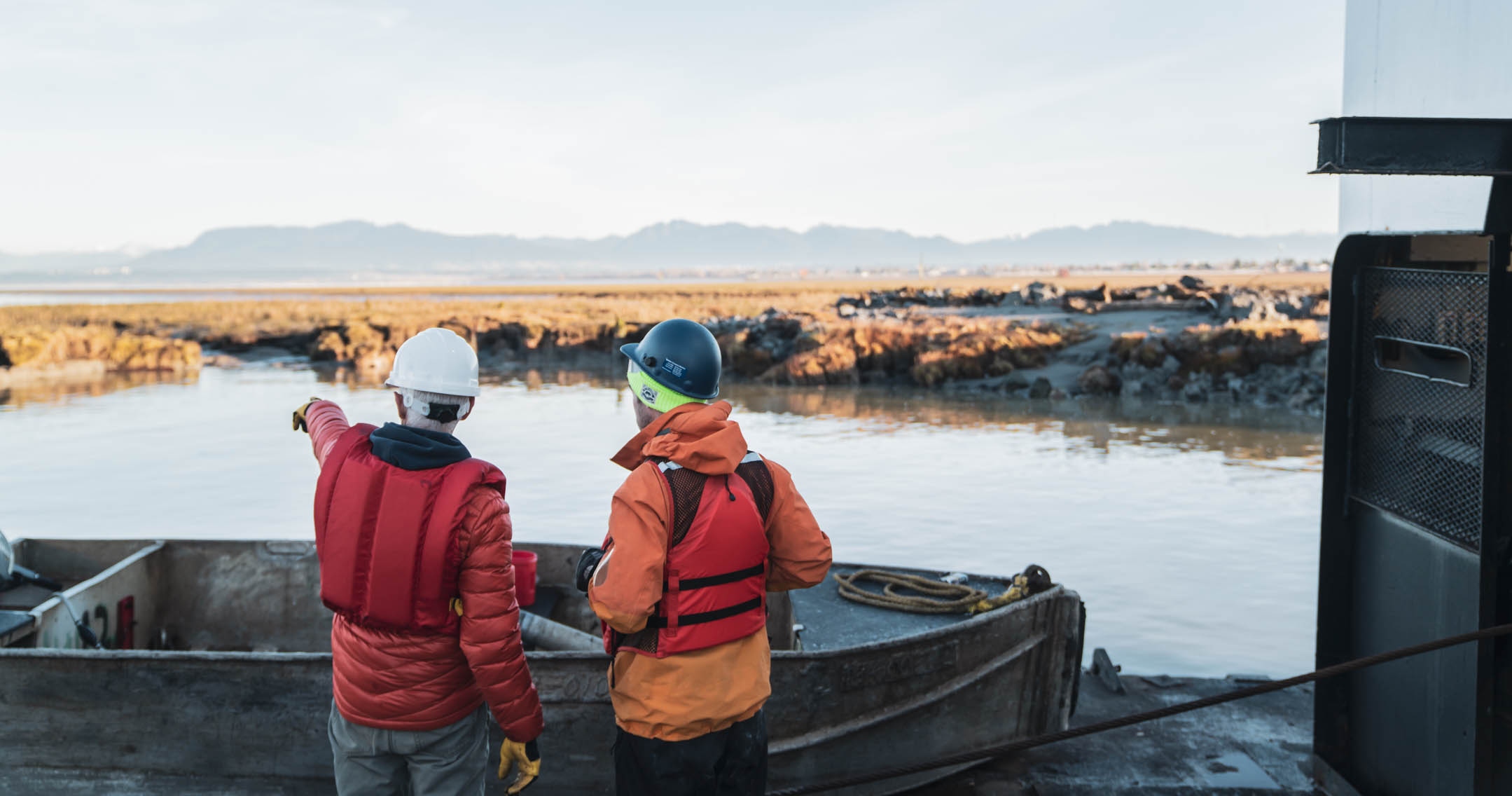
After a week’s work the sites already look different: staked with hundreds of cuttings, banks reinforced with wattles and fascines, the river’s edge beginning to look a little less bare. We’re excited to return to these sites to monitor how our cuttings do, and watch for signs that salmon are using their brand-new habitats. But it won’t happen overnight. Process-based restoration asks us to work on nature’s timeline, not human ones. As we leave our sites for the season, there’s a trust that has to happen. Trust that the river, given a little head start, knows how to heal itself.