

Community water monitoring
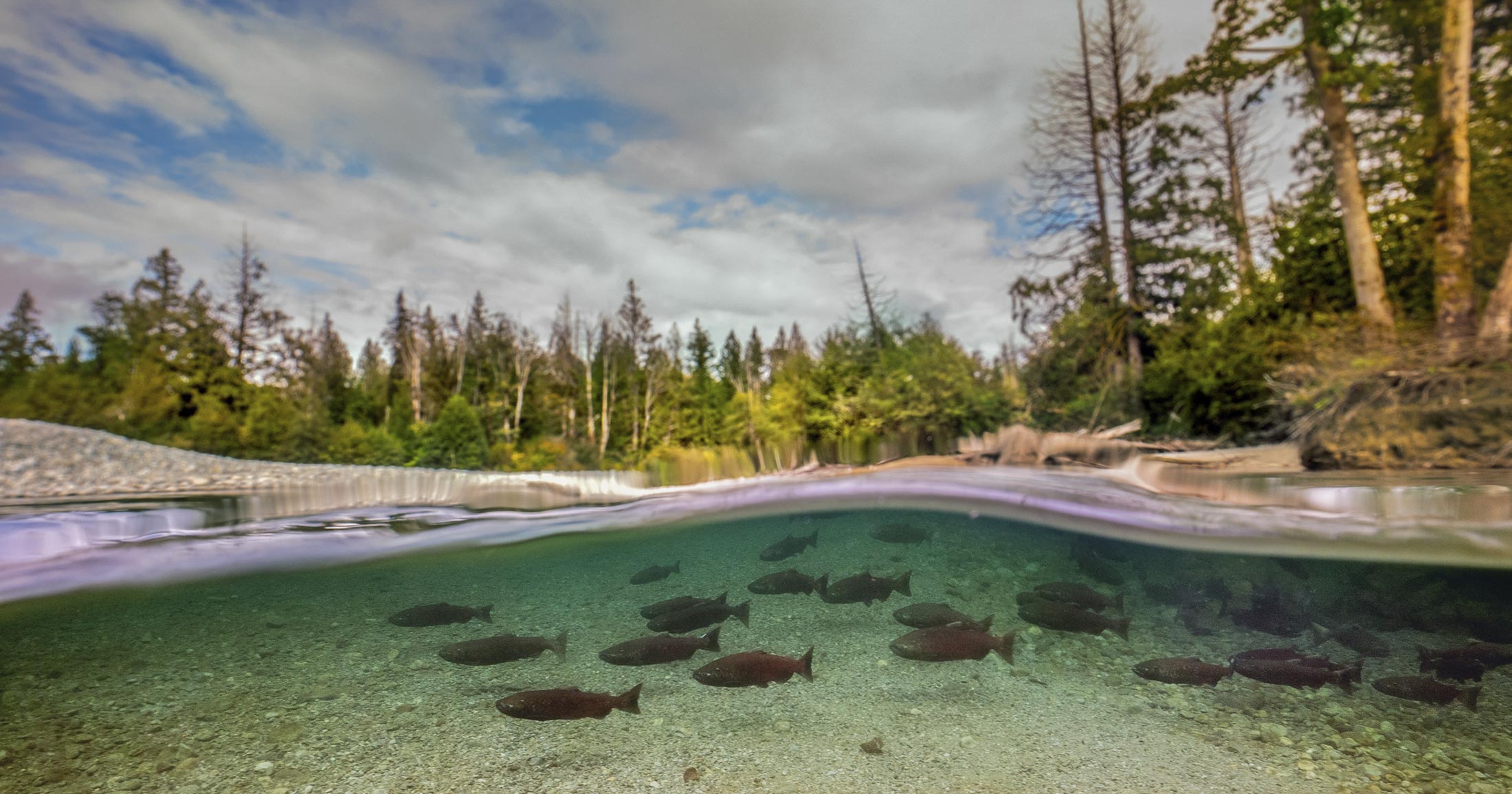
Clean water is essential for people, salmon, and whales. We are working with Indigenous Nations, communities, and governments as we operationalize a new approach to water pollution monitoring. Watersheds are serving as the basis for characterizing water quality from mountain peaks to the sea, providing an opportunity to identify pollution sources or activities that degrade fish habitat.
We have begun our work in select watersheds that drain into the Fraser River and Salish Sea. Our goal is to combine a high quality analysis of water in all partnering watersheds, with a mix of engagement and capacity-building activities that are unique to each area.

Working with partners
Our Healthy Waters community water pollution monitoring program works within several watersheds in BC. These include the Chemainus River, Cowichan River, and Tod Creek on Vancouver Island, and the Cheakamus River at Whistler, Sumas Lake watershed in the Fraser Valley, and Hope Slough near Chilliwack. We have conducted a first round of sampling in all of these watersheds during the ‘wet season’ in late 2023, after an initial ‘dry season’ sampling in the Whistler/Cheakamus corridor. We have also conducted focused pilot projects in the Sumas Lake area in the Lower Fraser Valley, and in Fulford Harbour on Salt Spring Island.
We continue to grow our program, and are expanding our partnerships with new Indigenous Nations and communities. Each watershed will benefit from expert support, transparent data sharing, training, and capacity-building. Findings from each watershed-based project will be integrated into a public-facing website featuring an in-depth summary of contaminant threats within and among watersheds.
Science to inform conservation
Findings from our water pollution monitoring will enable solution-oriented activities and practices that protect and restore fish habitats in BC. Our comprehensive, high-resolution analysis of water will document the extent to which hundreds of different contaminants that are released into BC waters, such as nutrients, metals, hydrocarbons, pesticides, pharmaceuticals, surfactants, PCBs, perfluoro-alkyl substances and tracers of human waste. This spectrum of analyses will support source identification and a ranking of risks to fish habitat within and among watersheds, supporting source controls and best practices in waste management, civil engineering and riparian zone design.
Mobile lab providing access to watersheds
We have acquired an all-wheel drive cargo van, and are now working on converting this into a fully functional mobile laboratory. This means designing, building, and deploying this vehicle – to be named Tracker as a community-oriented, mobile water pollution monitoring lab in support of healthy ecosystems in BC.
Watershed PARTNER reports
Anderson Creek watershed reports
- 2023/2024 wet season, DOI: 10.70766/126.498
- 2024 dry season, DOI: 10.70766/769.770
Chemainus River watershed reports
- 2023/2024 wet season, DOI: 10.70766/2681.52
- 2024 dry season, DOI: 10.70766/2051.77
Quw’utsun Sta’lo’ (Cowichan River) watershed reports
- 2023/2024 wet season, DOI: 10.70766/16804.3
- 2024 dry season, DOI: 10.70766/66.9084
- 2024/2025 wet season, DOI: 10.70766/1726.66
- 2025 dry season, DOI: 10.70766/78.658
False Creek watershed reports
Reports forthcoming.
Green/Cheakamus watershed reports
- 2023 dry season, DOI: 10.70766/955.423
- 2023/2024 wet season, DOI: 10.70766/9365.56
- 2024 dry season, DOI: 10.70766/4792.51
Harrison River watershed reports
Reports forthcoming.
Sqwa:la (Hope Slough) watershed reports
- 2023 wet season, DOI: 10.70766/81.8319
- 2024 dry season, DOI: 10.70766/16224.5
Tatalu (Little Campbell) River watershed reports
Reports forthcoming.
Louis Creek watershed reports
- 2024 dry season, DOI: 10.70766/86831.4
Nicola River watershed reports
- 2023/2024 wet season, DOI: 10.70766/3744.26
q̓ʷətəms t̓ɩšosəm (Sliammon River) watershed reports
- 2024 dry season, DOI: 10.70766/3261.54
Tod Creek watershed reports
- 2023/2024 wet season, DOI: 10.70766/76.9001
- 2024 dry season, DOI: 10.70766/489.069
- 2024/2025 wet season, DOI: 10.70766/42.6309
- 2025 dry season, DOI: 10.70755/61342.6
Accessory reports
Grafton Lake, Nexwlélexwm (Bowen Island)
Dry season, 2025, DOI: 10.70766/31.2601
W̱E¸NÁ¸NEĆ/Hwune’nuts (Fulford Harbour, Salt Spring Island, British Columbia)
Semá:th X̱ó:tsa (Sumas Lake) region
Flood waters 2021, DOI: 10.70766/1077.18

Our partners
- Cheam First Nation
- Chemainus First Nation
- Cowichan Tribes
- Tsartlip First Nation
- W̱SÁNEĆ Leadership Council
- Lower Fraser Fisheries Alliance
- Fisheries and Oceans Canada
- Environment and Climate Change Canada
- Metro Vancouver
- Capital Regional District of Victoria
- Pacific Salmon Foundation
- Ocean Diagnostics Inc.
Recent articles

Take action: Stop the government from fast-tracking extinction
Coastal prosperity, ecosystems, economic and cultural security are all at…

New Canada Post stamps highlight the ecological importance of wolves in Canada
Stunning wolf stamps will inspire Canadians to love wolves as…

The roles of wolves in healthy ecosystems and how their presence benefits other species
Protect wolves, protect entire ecosystems.

Uniting BC’s Salmon People
Raincoast, alongside our allies, is proud to support Salmon United,…

New killer whale active hat now available in the Raincoast store
Wear what you stand for.

New study investigates prey sharing in two closely related killer whale populations
Drones reveal hidden differences in how fish-eating killer whales cooperate.

By listening in on belugas, scientists can better understand their social structure and their conservation needs
New research highlights strong population structure in the endangered St.…

Take action: Give public comment until July 22, 2026
Action alert: It’s not just endangered species being undermined by…