
Tracking Raincoast into 2026
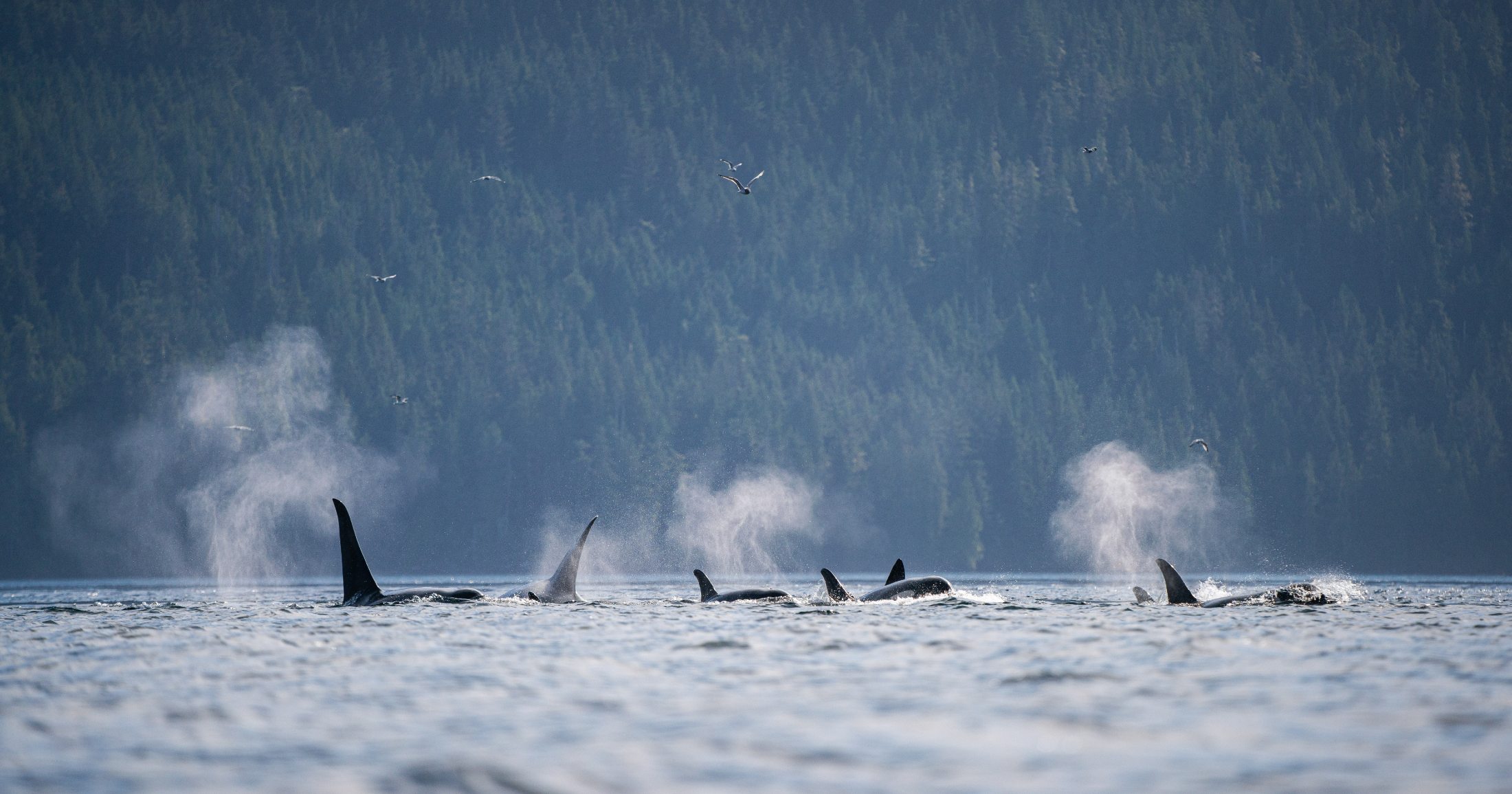
Photo by Nicole Van Zutphen. Taken under SARA Research License XMMS-2-2022 – Amendment 3.
Contents
30 years in the Great Bear Rainforest

For over 30 years, Raincoast Conservation Foundation has worked to understand and protect the ecosystems of the central coast of British Columbia, a region referred to as the Great Bear Rainforest. Rather than being defined by its few mighty arterial rivers, the region is threaded by thousands of small salmon streams, each infusing the landscape with nutrients from the sea like capillaries. These streams wind through ancient trees, weaving a complex network of interdependence between the land and sea, supporting an environment rich with coastal wildlife.
Since Raincoast began our work in the Great Bear Rainforest in the mid 1990s, this region has experienced significant change. Chum salmon have declined by upwards of 90% since 1960. Industrial forestry has targeted much of the long-lived, productive forest in rich valley bottoms. And the region’s remoteness has not safeguarded it against the effects of climate change.
But some things have remained unchanged. The Haíɫzaqv (Heiltsuk) Nation, in whose territory Raincoast’s work has taken place, has continued to govern and steward the land as it has for more than 14,000 years. Guided by Haíɫzaqv principles, Raincoast is looking ahead to the next three decades of work, undertaking new research to deepen our ecological understanding of this unique region – and what’s at stake – in a rapidly changing world.
In partnership with the Heiltsuk Integrated Resource Management Department, we’ve embarked on a large-scale wildlife monitoring program, with remote cameras capturing wildlife activity across 25 watersheds in their vast territory. Building on more than a decade of grizzly and black bear research – itself catalyzed by the Haíɫzaqv – this new monitoring program advances our understanding of the complex ecology of coastal wildlife to support evidence-based decision-making.
Allison Dennert, PhD
Quantitative Salmon Ecologist
Wild Salmon Program
Persia Khan, PhD candidate
Research Associate
Wolf Conservation Program

Listening to protect
This summer, Raincoast and Earth Species Project (ESP) launched a pilot study to better understand killer whale communication. Three ESP team members joined our researchers aboard Achiever to test a new method of data collection that involved pairing high resolution drone footage of whale behaviours and interactions with simultaneous underwater recordings. Together, we are building a rich, ground-truthed dataset to help train AI models that can uncover patterns in killer whale communication, and reveal how it may be affected by underwater noise.
Our Pender Island underwater monitoring station, installed in 2023 in the Vessel Restricted Zone for Southern Resident killer whales (SRKW), continues to livestream whale vocalizations and videos while gathering data for collaborative studies with the Saturna Island Marine Research and Education Society (SIMRES). We’ve completed a study on SRKW acoustic presence and the impacts of noise on their calls, with researchers stationed on a nearby cliff to monitor whale activity, vessel and fishing violations, as well as ship traffic. A full report is coming soon.
We also re-deployed our Sunshine Coast listening station (after the first one was snagged by a fishing boat), restoring a critical node in a region where humpback whales have been steadily returning since 2015.
Another study we’ve completed, in collaboration with the North Coast Cetacean Society, “Singing to be Heard,” examines how humpback whales develop their songs on North Pacific feeding grounds. The manuscript is now being prepared for publication.
We’ve also launched a new collaboration with the University of Windsor, Oceans North, and Frontier North Adventures to study the vocal and social behaviour of Churchill River belugas. With increasing Arctic shipping, there is an urgent need to document baseline noise levels and beluga behaviour before the Churchill River estuary’s soundscape is fundamentally altered.
Aerial insights into whale health
This year we wrapped up fieldwork on our long-running Northern Resident killer whale photogrammetry project, but analysis continues. We just submitted a paper, titled “Costs of maternal care revealed through body condition in Northern Resident killer whales” and presented body condition observations at the 2025 Orca Symposium in Tarifa, Spain.

What it will take to recover the Southern Resident killer whales

Canada’s federal and provincial governments increasingly prioritize economic growth at the expense and exclusion of species and natural systems. Under this model, safeguarding British Columbia’s ‘most iconic symbol’ – endangered, salmon-dependent Southern Resident killer whales (SRKW) – is slipping from the nation’s list of priorities.
In early 2025, the federal government acknowledged that current measures have failed to initiate signs of recovery. Their statement recognized that Southern Resident killer whales remain at imminent risk of extinction under ongoing conditions of noise, pollution, and inadequate prey.
In response, Raincoast, in collaboration with academic and NGO partners, brought together 31 international scientists to address a critical question: “what will it take to save this population?” The goal of the three-day expert workshop, convened in Vancouver in March 2025, was to assess the effectiveness of current management measures and to identify the most urgent, evidence-based actions required for recovery.
The workshop culminated in a comprehensive report calling for urgent, bold, and practical action to reverse the extinction trajectory of these endangered whales. Drawing on more than three decades of focused research, the panel issued 26 recommendations designed to provide governments, Indigenous Nations, industry, and conservation groups with a clear, science-driven path forward. Findings from the workshop have been shared with governments on both sides of the Canada-US border.
.
Raincoast’s team of killer whale, salmon, and marine pollution scientists continues to champion the solutions identified in the report, with specific approaches to reduce underwater noise from vessels, reduce pollutants to the ocean, and improve the quality, quantity, and year round availability of Chinook salmon prey.
The fate of the Southern Residents need not be a choice between human ambition and ecological responsibility. With bold, coordinated action, recovery of this population can co-occur with a thriving future for people and the coast. We remain steadfast in our commitment to ensure a future for these whales. Their recovery can be our shared success.
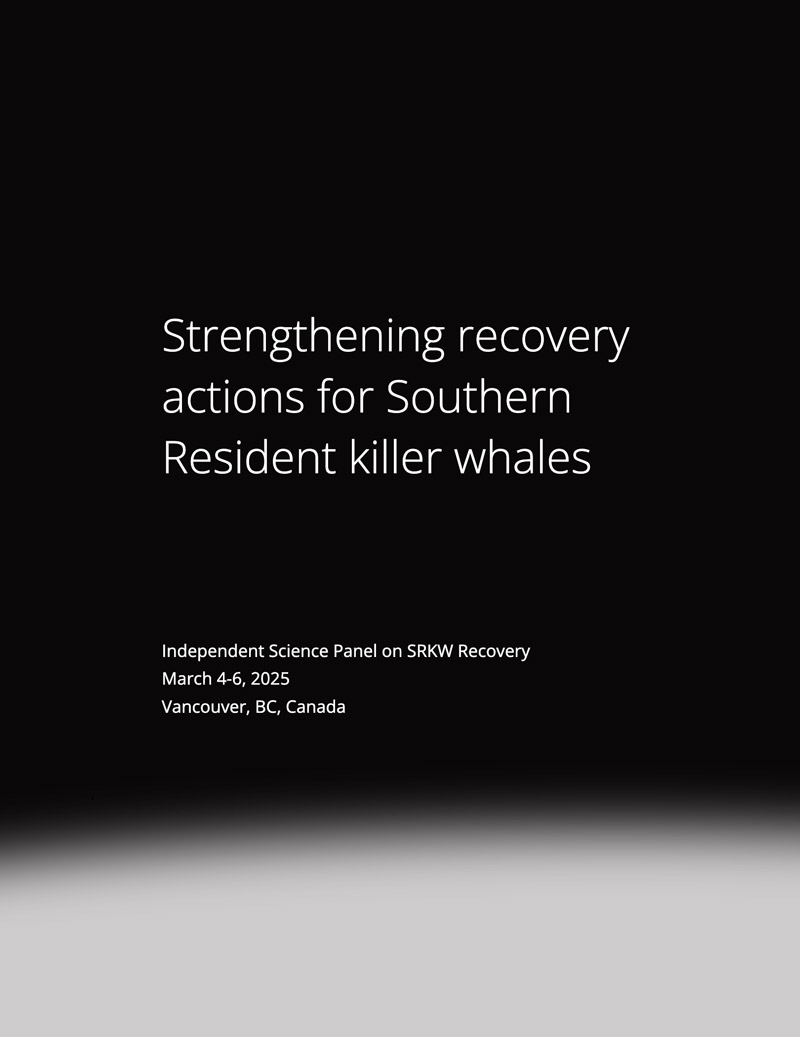
Independent Science Panel on SRKW Recovery (2025). Strengthening recovery actions for Southern Resident killer whales. https://doi.org/10.70766/32.7300
In 2025, Achiever again proved its strength as a nimble and efficient research and conservation support ship, spending significant operating time in the Great Bear Rainforest. Our crew provided guide and mothership assets to a science conservation film project focused on the interrelationship between coastal wolves and Pacific herring during the spring herring spawn. Late spring was spent in the shipyard, focused on maintenance and general repairs, before heading to the Southern Gulf Islands for youth and training trips, community outreach, and engagement activities in both Victoria and Vancouver. July brought our return to the central coast for annual Indigenous youth trips in both Haíɫzaqv and Kitasoo Xai’xais territories.
August marked the commencement of a new pilot project in the Johnstone – Broughton areas with our cetacean team, focused on killer whale communication. One of the most dynamic research projects onboard Achiever to date involved towing a hydrophone to record underwater noise while simultaneously collecting aerial footage with our drone.
September saw Achiever back into the central coast to focus on grizzly bears and coastal wolves. During October, Achiever relocated to the Southern Gulf Islands in support of the Salish Sea Emerging Stewards program and its new pilot project, the Land Healing Stewards Initiative.
Looking ahead, our marine operations team is focused on the feasibility and planning of repowering Achiever with the objective of turning it into the first hybrid electric research ship on the coast. Achiever and crew will be back on the water in the spring once again to support our research and education teams as they build upon a successful year of pilot projects becoming new staples amongst our ship operations.
Donate now and help us save Southern Resident killer whales
Biodiversity in BC, monitoring, and informing

Raincoast’s Conservation Genetics Lab has had a busy year working on established projects and embarking on exciting new studies as well. Working with our partners at Fisheries and Oceans Canada, we have supported a study that uses DNA from archived killer whale fecal samples to identify the fish species being consumed by Northern and Southern Resident killer whales during the summer months. Each sample provided insight into when, where, and what each individual killer whale is eating, and provided valuable information on some seasonally important prey species other than Chinook salmon. In addition, we participated in a collaborative study of the North Pacific humpback whale diet, and a genetic fingerprinting study for humpback whales that will help aid future efforts to match fecal samples to individuals.
The genetics lab also worked closely with our Wolf Conservation Program and First Nations partners to analyze scat samples and identify the prey species wolves have been consuming in our study areas. We also expanded our lab capabilities to examine the genetic makeup of these populations through mitochondrial DNA analysis to differentiate between coastal rainforest and Northern Rocky Mountain wolves. These findings will offer valuable insights into both the feeding ecology and genetic history of local wolf populations.
We have a number of publications in preparation, and were part of a study published in August that demonstrated a new method of determining the sex of whales from eDNA samples. As we head into 2026, we are excited to announce that Raincoast will be part of a Genome BC study monitoring genomic biodiversity in BC. Our genetics lab will be one of three co-leads on the project along with professors from the University of Victoria and the University of British Columbia. We are thrilled to be part of such an important project at a trying time for biodiversity, both within and between populations.
Protection and conservation of gray wolves
Photo by Colleen Gara..
In collaboration with our First Nations partners, the Wolf Conservation Program continues to expand research and monitoring of wolves on the south coast of BC. Our monitoring efforts, once centred on a tributary watershed of the Fraser River, are now expanding. 2026 marks an exciting step forward as we prepare to begin data collection in a second watershed within the Lower Mainland, broadening our understanding of wolves and the ecosystems they help sustain.
Using minimally invasive methods – including camera traps, acoustic recorders, and scat analysis – we are documenting wolf presence, behaviour, pack composition, pup survival, habitat use, and diet. By combining these data, our research can assess individual health and stress factors, improve welfare through informed conservation policies, and identify key habitats for protection. In addition, heading into 2026, we expect preliminary results from our in-house genetic analyses of fecal samples to confirm whether these wolves originate from the coastal rainforest, or Northern Rocky Mountain ecotypes, or are a mix of the two ecotypes, with implications for tailored conservation strategies.

Expanding our research is critical, not only for gaining a more complete understanding of wolf populations and recovering pack dynamics across the south coast, but also for informing ecologically-based management in BC. By building a more comprehensive picture of wolf activity across multiple watersheds, we can provide evidence-based recommendations for habitat protection and long-term coexistence strategies, contributing not only to wolf conservation but to the resilience of ecosystems that support countless ecologically and culturally important species across the province.
Beyond field research, we continue to confront the ongoing persecution of wolves and advocate for wildlife management reform in BC. The province estimates more than 1,000 wolves are killed annually from recreational hunting and trapping alone. Moreover, despite public opposition and scientific evidence challenging its effectiveness, the killing of wolves as a government-sanctioned management tool continues, with hundreds of individuals “culled” each year through methods such as aerial gunning from helicopters. Framed as protection for endangered caribou, livestock, and even recreational hunting interests, these lethal approaches divert attention from the true drivers of species decline and wildlife conflict: habitat loss, industrial development, and poor coexistence strategies. Lethal control typically undermines ecological science, disregards animal welfare, and destabilizes wolf pack dynamics, perpetuating cycles of conflict rather than resolving them.
Looking towards 2026, we will continue to call for an end to the gratuitous killing of wolves in BC and beyond, while encouraging wildlife management policies grounded in long-term habitat protection and restoration, holistic ecosystem approaches, and non-lethal coexistence strategies.
Knowledge and responsibility
Photo by Haíɫzaqv remote camera project.
The pursuit of knowledge implies that learning might involve some sort of capture and possession. The truth is, however, that knowledge includes a responsibility to release what you learn. To inform. And to inspire.
At Raincoast’s Applied Conservation Science Lab, hosted at the University of Victoria, part of our mandate is to create new knowledge. Our graduate students conduct high-quality scientific research. Extraordinary young scholars uncover new and important information about how the world works, and often generate transformative insight.
In one example of many over the last year, we published work with colleagues from the Haíɫzaqv Nation that identified corridors used by grizzly and black bears. These are the safe passageways that allow mobile predators to access spawning salmon runs scattered across ancient temperate rainforest landscapes during their annual seafood feasts. Our connectivity model was built from Haíɫzaqv Knowledge and movement data from individual bears, generated from a decade of non-invasive research. The project provided striking new knowledge about how bears lumber throughout their forested homes to make a living on the coast.
Our work, however, did not end with this creation of knowledge. Instead, it began with a responsibility to use the knowledge; to inform. Conceiving and planning the project with Haíɫzaqv managers, our research was to provide a product to be used in evidence-informed decision-making. Our results provided a constellation of options for consideration by the Heiltsuk Integrated Resource Management Department, fulfilling their objective of safeguarding habitat for wildlife with which they have enduring relationships and responsibility.
We also commit to mobilizing knowledge to inspire people. Inspiration takes many forms. As in years past, during 2025 we gave voice to wildlife. We exercised our extensive reach via prominent media outlets, like The Globe and Mail and The New York Times. In doing so, we inspire the public with both key information and compelling stories. It’s our way of asking the public in turn to ask more of the provincial and federal governments to protect wildlife and their habitat.
Closer to our hearts, we also spend a couple weeks a year inspiring youth from Haíɫzaqv and Kitasoo Xai’xais communities. Participating in their science and culture camps, we not only share our knowledge of science but also receive knowledge from the people of the area. Here we find inspiration to be the best applied scientists we can be.


A black bear rolling in the old growth of Heiltsuk Territory. Photos by the Haíłzaqv remote camera project.
Support what you love

Having a consistent stream of income allows us to plan ahead to achieve our longer term scientific research, conservation efforts, and public outreach goals. We recognize the invaluable support of our donors and the power of our community. Check out our updated monthly giving program to learn more about the perks of becoming a Raincoaster!
Your tax-deductible donations power our research and advocacy.
To invest our work, you can:
- Become a monthly donor
- Send an electronic fund transfer (EFT)
- Send an e-transfer
- Donate securities such as stocks, bonds, and mutual funds
- Add Raincoast to your legacy giving plans
- Mail a cheque
30 years of Raincoast’s reach

In 1996, Raincoast Conservation Foundation was established as a charitable organization in British Columbia. With such a strong presence in this province, it’s not always appreciated just how far Raincoast’s efforts stretch beyond BC. Since the beginning thirty years ago, we’ve grown to have international influence, with our researchers and scientists contributing to groundbreaking work across the globe.
Each sphere represents where we’ve been; locations where we’ve conducted on-the-ground scientific studies, engaged in powerful partnerships to inform industry and government decision makers, or bolstered law-changing campaigns that upheld our vision to protect umbrella species, ultimately safeguarding all species, including humans.
For example, we spearheaded a multi-partner initiative that resulted in banning the importation of grizzly hunt trophies from Canada into the European Union. We have shared our research findings in capitals such as Washington DC, Brussels, and Ottawa, bringing BC’s unparalleled biodiversity to the world.
Because the species we strive to protect move freely across political boundaries, our conservation efforts must reflect that same breadth of perspective and responsibility. Salmon, killer whales, and wolves, as well as other wide ranging mammals and migratory birds, know no borders. As such, we champion conservation decisions and support research beyond BC’s boundaries to other parts of Canada, and in the jurisdictions of our neighbours in the Pacific Northwest, as well as into California, Montana, Colorado, and Alaska.
Looking to 2026 and beyond, we will reach Iceland and Australia, using data from a recent pilot project to advance understanding of killer whale communication and the effects of underwater noise impacts throughout international populations.
Partnerships have been central to everything we’ve accomplished; through this, we learn from others – a practice that lies at the heart of who we are. Our collaborations include First Nations, Indigenous communities, local jurisdictions, and governments at provincial, national, and international levels. We also maintain strong relationships with academic institutions, and vital alliances with NGOs that share our vision for thriving ecosystems and wildlife.
Habitat restoration and salmon research
Photo by Nicole Van Zutphen.
It’s been a big year for salmon research and restoration in the Fraser River estuary. Through our long-term monitoring program of Fraser River juvenile salmon, we partnered with xʷməθkʷəy̓əm (Musqueam) Environmental Stewardship Program, Ducks Unlimited, and enlisted three field crews to monitor a total of 42 salmon-bearing sites in the Fraser River’s estuary. This monitoring builds on our understanding of juvenile salmon in one of Canada’s most important estuaries, while helping us develop and answer questions about the juvenile life stages of salmon.
Our crew successfully supported thesis projects investigating the complex estuary residence of juvenile sockeye and chum salmon, as well as studies on essential marsh habitat for salmon. We hope these will guide conservation efforts in the future. Coupled with our existing Chinook salmon research, we continue to paint a more comprehensive picture of salmon species that spend extended time in estuaries.
While estuary restoration projects in the past tried to offset habitat loss, benefits from these projects were sometimes not long lasting. This year, we completed construction on a previous restoration project at Woods Island, a conservation area that had lost its ability to function as salmon habitat after its initial restoration. Since deepening its channels, lowering elevation, and planting native species, we have improved marsh habitat and have already observed more salmon and native fish passage at this site. There are even more projects on the horizon, so stay tuned on our progress to restore salmon habitat in the Fraser River estuary.

Long may they run
Sustainable fisheries are fundamental to the health of coastal and inland communities, and to the survival of wildlife such as killer whales, bears, and wolves that depend on salmon. Raincoast champions fisheries management that can restore and protect wild, abundant, and diverse salmon runs, ensuring they reach their spawning grounds in the smallest creeks and the largest rivers.
To achieve this, we engage directly in fisheries management – both within federal decision making processes and independent of them. This year, we assessed fishing plans and submitted science-based recommendations for all salmon species. We provided scientific advice on the health of salmon populations under review through the Fisheries Act, and offered input on issues from hatchery policy to prey for endangered killer whales.
We worked with government and stakeholders to advance the application of new research on mortality rates of Chinook salmon released in sport fisheries. In 2024, almost 240,000 Chinook were released in southern BC recreational fisheries. Adequately accounting for the potential mortality that might result from catch and release practices is critical to responsible management, particularly where endangered Chinook populations overlap with healthier runs that support fisheries.
Beyond these processes, we spoke up when government contracts for vital “creekwalkers” were delayed – leaving the guardians who count spawning salmon, and underpin fisheries management, out of the rivers. We published new research assessing the Wild Salmon Policy on its 20 year anniversary, had our solutions for Chinook recovery featured in the documentary Shared Waters, Shared Crisis, and released two new videos exploring the issue of shrinking Chinook salmon and prey for killer whales. Each of these efforts amplifies science, advocacy, and public awareness to help rebuild the health and resilience of BC’s wild salmon.

Subscribe to Raincoast Radio, anywhere you listen to podcasts, and listen to season two, “More than a fish.”
Photo by Alex Harris.
Climate resilience for salmon habitat
This year marked another successful season of our climate resilience project in the Nicola River watershed, located in the southern interior of the province. Raincoast continued to partner with Scw’exmx Tribal Council and Citxw Nlaka’pamux Assembly to study how salmon habitat is affected by drought and extreme heat. We used a new approach that combines thermal infrared drone flights with snorkeling surveys to identify thermal refuges and learn how they are used by salmon during climate emergencies. Informed by our results, we are planning habitat enhancement, protection, and restoration measures into 2026.
Recent wildfire seasons in BC highlight the importance of increasing ecological resilience to wildfire, particularly within drought-affected watersheds that support wild salmon. In 2025, we published a technical report that provides the first comprehensive analysis of how the drivers of severe wildfire – including industrial forestry, fire exclusion, and climate change – affect watershed security and salmon habitat in BC. The report outlines evidence-based policy pathways to achieve ecosystem resilience at the watershed and landscape scale. Recommendations span transitioning from industrial to community-based forestry, increasing funding for Indigenous fire stewardship, and increased investment and protection of riparian habitat. Moving into 2026, we will apply this research on the ground to bolster climate and wildfire resilience in salmon watersheds.
Educating on land and at sea
Photo by John Kelsey.
Raincoast’s youth education program, Salish Sea Emerging Stewards, celebrated its tenth year of educating and inspiring the next generation of conservation leaders. Providing experiential and hands-on environmental education to BIPOC, low-income, newcomer, 2SLGBTQ+, and other underserved youth, we’ve continued to grow and innovate by launching a new initiative and collaborating with new partners.
We provided sailing expeditions to our community partners, the Red Fox Healthy Living Society and the Special Bird Service. Using Achiever as a floating classroom, we explored the Salish Sea, delivered marine science education, accessed the Southern Gulf Islands, and undertook forest-based learning activities. We also brought nature and environmental education to urban centres by partnering with Sea Smart’s marine biology summer camp for girls.
Land Healing Stewards
This year, the Salish Sea Emerging Stewards and Forest Conservation programs launched a joint multi-year project. The Land Healing Stewards is a place-based initiative that blends restoration with education. Focused on healing Coastal Douglas-Fir forests and associated habitats, it engages local communities, including youth, in forest education via hands-on learning and stewardship activities. Through this program, we are engaging with Indigenous Knowledge and land stewardship practices, including the integration of the W̱SÁNEĆ 13 Moons ecological framework into coastal conservation practices. Milestones from this year’s pilot include conducting our first sea-to-soil expedition aboard Achiever to KELÁ_EKE Kingfisher Forest on S,DÁYES (Pender Island), learning from a W̱SÁNEĆ-led community restoration project, and strengthening connections with community partners.
Communities for Coastal Douglas-fir habitats
Photo by Nicole Van Zutphen.
This year, we centered our forest conservation efforts around community connection. We listened and learned from W̱SÁNEĆ community members, we created opportunities for youth and S,DÁYES (Pender Island) locals to be stewards of their home ecosystems. We were driven by the inextricable link between people and place.
We had the privilege to hear directly from W̱SÁNEĆ Elders, Knowledge Keepers, and community members during workshops and community events, from cultural fire, to re-establishing of food and medicine systems, to seeing in practice what Indigenous-led stewardship and restoration looks like. With the W̱SÁNEĆ Lands Trust Society on the ȻENEṈITEL (kwun-ung-eetal; “working together to restore our lands and culture”) project, we came to the table with other Salish Sea-based land trusts to work toward collective conservation actions that uphold W̱SÁNEĆ SḴÁLS (laws, teachings, and beliefs).
KELÁ_EKE Kingfisher Forest (45 acres) and S,DÁYES Flycatcher Forest (13 acres), the conservation properties that the Raincoast Land Trust co-owns with the Pender Islands Conservancy, became classrooms this year for youth and local community members who were passionate about having a hand in stewarding these ecosystems. Stewardship activities ranged from invasive species pulling to native species monitoring, and provided unique learning opportunities for people to better understand the role they play in protecting the ecosystems that breathe life into their home communities.
We successfully decommissioned a section of the gravel road at KELÁ_EKE Kingfisher Forest and built a wetland basin, marking a major milestone in our overall restoration plan. In establishing a wetland, we are planting native species and monitoring the biodiversity returning to the landscape. Communities will also benefit from the cooling effects and wildfire risk mitigation the wetland provides.
We launched two new community-inspired projects, Elders for Old Growth, and a handbook on the propagation of arbutus in the Salish Sea. These projects will bring together citizen science, hands-on local knowledge sharing, and the ethos of stewarding landscapes for ecological and cultural values carried by diverse communities throughout the Salish Sea.

Uncovering the causes of degraded fish and whale habitat
Photo by John Kelsey. Photo taken under SARA Research License XMMS-2-2022 – Amendment 3.
No one enjoys debris-strewn beaches, images of oiled sealife, or those summer beach closures due to fecal coliform contamination. At Healthy Waters, we have been rolling up our sleeves with our watershed partners to conduct a deep dive into pollution, and the results are revealing – and empowering. We are finding both good news and bad news, by sampling water from mountain tops to the ocean, and measuring 600 different contaminants along this journey.
While you might think this is a bad news story, think again: we are learning, sharing, and training, as are our partners. Our findings are providing communities with foundational datasets, and the resulting pollution profiles are revealing much about the leading causes of poor water quality.
Our sleuthing continues, but here’s a hint of what we are finding.
Where agriculture meets a stream, we find excess nutrients, pesticides and metals, and lower levels of life-giving dissolved oxygen for fish.
Runoff from roads, bridges, and parking lots are teeming with contaminants, including the coho salmon-killing tire chemical 6PPD-quinone, road salts, and petroleum products.
Liquid domestic waste from failing septic fields and broken sewage connections is seeping into ditches, creeks, and rivers, carrying with it pharmaceuticals, illicit drugs, and pathogens.
Additionally, the burgeoning number of forest fires associated with climate change are polluting the air, and contaminating drinking water supplies upstream of communities.
These are not just stories about chemistry, numbers, and water quality. These are stories about watersheds, fish habitat, and the well-being of communities. As we head into 2026, we look forward to bringing our watershed stories together, and crafting a powerful narrative around water quality, priority pollutants in watersheds, and the activities that threaten fish habitat. These stories are already helping us ponder targeted solutions that protect and restore healthy waters throughout the region.
There is cause for optimism.


Science publishing
Together, members of the Raincoast team have authored hundreds of peer reviewed papers. So far this year we published 11 reports and 13 peer reviewed articles.
Peer reviewed articles
Bateman AW, MacLean J, Stredulinsky E, Wright B, Ellis G, Doniol‐Valcroze T, Darimont C, Ford JKB. 2025. Revised Age Estimates for Northern Resident Killer Whales (Orcinus orca) Based on Observed Life‐History Events and Demographic Discounting. Ecology and Evolution. 15(3). DOI: 10.1002/ece3.70981.
Eckert LE, Ban NC, MacDuffee M, Scott DC, Paquet PC, Moola F, Owens C, Darimont CT. 2025. Identifying opportunities toward conflict transformation in an Orca‐Salmon‐Human system. Conservation Science and Practice. 7(9). DOI:10.1111/csp2.70108.
Field KA, Moody JE, Levi T, Darimont CT. 2025. Grizzly bears detected at ecotourism sites are less likely than predicted by chance to encounter conflict. Canadian Journal of Zoology. DOI: 10.1139/cjz-2024-0102.
Field KA, Moody JE, Clapham M, Clark DA, Khan PB, Levi T, Paquet PC, Darimont CT. 2025. Integrating spatial and behavioral data provides comprehensive assessment of grizzly bear-ecotourism coexistence in Nuxalk Territory. Scientific Reports. 15(1). DOI: 10.1038/s41598-025-14625-5.
Henson LH, Christensen KA, Sutherland BJG, Johnson HA, vonHoldt B, Stronen AV, Paquet P, Moody J, Koop BF, Darimont CT. 2025. Grizzly bear population genomics across a coastal-interior ecotone in British Columbia, Canada. G3 Genes Genomes Genetics. DOI: 10.1093/g3journal/jkaf237.
Mihalik I, Bourbonnais M, Housty W, Starr K, Paquet P, Darimont C. 2025. Modeling Functional Connectivity for Bears Among Spawning Salmon Waterways in Haíɫzaqv (Heiltsuk) Territory, Coastal British Columbia. Ecology and Evolution. 15(7). DOI: 10.1002/ece3.71579.
Morley ID, Hanna K, Darimont CT, Bourbonnais ML, Morley ID. 2025. Time series modelling spatiotemporal changes in Biogeoclimatic ecosystem classification (BEC) zones between 1997 and 2019 in West-Central British Columbia, Canada. Ecological Informatics. 88:103155. DOI: 10.1016/j.ecoinf.2025.103155.
Robinson CV, Dracott K, Glover RD, Warner A, Migneault A. 2024. DNA from dives: Species detection of humpback whales (Megaptera novaeangliae) from flukeprint eDNA. Environmental DNA. 6(2). DOI: 10.1002/edn3.524.
Ruberg EJ, Yunker MB, Aguirre-Martinez G, Delisle K, Morales-Caselles C, Ross PS, Noël M. 2025. Spatial distribution and source apportionment of polycyclic aromatic hydrocarbons (PAHs) in surficial sediments along the coast of British Columbia, Canada. Marine Pollution Bulletin 218, 118180. DOI: 10.1016/j.marpolbul.2025.118180.
Vergara V, Mikus M-A, Chion C, Lagrois D, Marcoux M, Michaud R. 2025. Effects of vessel noise on beluga (Delphinapterus leucas) call type use: ultrasonic communication as an adaptation to noisy environments?. Biology Open. 14(3). DOI: 10.1242/bio.061783.
White KS, Levi T, Hood E, Darimont CT. 2025. Life‐history trade‐offs and environmental variability shape reproductive demography in a mountain ungulate. Journal of Animal Ecology. DOI: 10.1111/1365-2656.70137.
White KS, Levi T, Hood E, Darimont CT. 2025. Snow Avalanches and the Impact of Climate‐Linked Extreme Events on Mountain Wildlife Population Dynamics and Resilience. Global Change Biology. 31(9). DOI: 10.1111/gcb.70415.White KS, Cadsand B, Côté SD, Graves T, Hamel S, Harris RB, Hayes FP, Hood E, Hurley K, Jessen T, et al. 2024. Mountain sentinels in a changing world: review and conservation implications of weather and climate effects on mountain goats (Oreamnos americanus). Global Ecology and Conservation.:e03364–e03364. DOI: 10.1016/j.gecco.2024.e03364.
Reports
Chhor A, Lustig N, Allan M, Swayze C, Sheena J. 2025. Environmental flow needs assessment for salmonids in the Coldwater River. Sidney BC: Raincoast Conservation Foundation. DOI: 10.70766/483.814.
Independent Science Panel on SRKW Recovery. 2025. Strengthening recovery actions for Southern Resident killer whales. Raincoast Conservation Foundation. DOI: 10.70766/32.7300.
Ross PS, Scott S, Noël M. 2025. A water quality snapshot of Grafton Lake, Nexwlélexwm (Bowen Island). Raincoast Conservation Foundation. DOI: 10.70766/31.2601.
Ross PS, Scott S, Noel M. 2025. Tod Creek watershed: Water quality report for the 2023/24 wet season. Raincoast Conservation Foundation. DOI: 10.70766/76.9001.
Rowley A, Kay S, Mikus M, Vergara V, Visona-Kelly B, Barrett-Lennard L. 2025. The relationship between body condition, fecundity, and mortality in Northern Resident killer whales. Raincoast Conservation Foundation. DOI: 10.70766/01.0775.
Scott S, Blancard J, Noel M and Ross PS. 2025. Anderson Creek watershed: Water quality report for the 2024 dry season. Raincoast Conservation Foundation. DOI: 10.70766/769.770.
Scott S, Blancard J, Noel M and Ross PS. 2025. Anderson Creek watershed: Water quality report for the 2024 dry season. Raincoast Conservation Foundation. DOI: 10.70766/769.770.
Scott S, Donald T, Noel M, and Ross PS. 2025. Louis Creek watershed: Water quality report for the 2024 dry season. Raincoast Conservation Foundation. DOI: 10.70766/86831.4.
Scott S, Dingwall J, Noel M, and Ross PS. 2025. q̓ʷətəms t̓ɩšosəm (Sliammon River) watershed: Water quality report for the 2024 dry season. Raincoast Conservation Foundation. DOI: 10.70766/3261.54.
Scott S, Moskal H, Noel M, and Ross PS. 2025. Chemainus River watershed: Water quality report for the 2024 dry season. Raincoast Conservation Foundation. DOI: 10.70766/2681.52.Walters K. 2025. Forests, fire, and fish: Policy pathways to manage forests for wildfire resilience, salmon recovery, and watershed security. Raincoast Conservation Foundation. DOI: 10.70766/4781.87.
tional scientists to produce a report on
SRKW Recovery: Strengthening recovery
actions for Southern Resident killer whales.
Friends of Raincoast: Tom and Peggy English
Tom and Peggy have long invested energy and enthusiasm in the BC coast. Tom served as a Board Member of the Vancouver Aquarium for 31 years, after which he left to take over the Chairman position of the Ocean Wise Conservation Foundation. He co-founded the Whistler Lakes Conservation Association in 2020 (later Foundation), where he served as Chair and Peggy served as Secretary.
Tom and Peggy have long valued science and the opportunity to learn from others. They were invaluable ‘on the ground’ partners for the Raincoast Healthy Waters initiative in the Green / Cheakamus Rivers, bringing volunteers, students, journalists and family members along for water sampling adventures. “This was such a great opportunity to learn. To understand. To share information.” said Peggy. Their work to better understand and protect the coast ‘makes us happy’, they noted.
“The opportunity to learn from Raincoast” featured prominently in conversation with Tom and Peggy. And yet Raincoast has learned much from Tom and Peggy. Their infectious energy and desire to effect positive change is rooted in their belief that learning is key, and their steadfast support has enabled success in many adventures.“We don’t take this coast for granted – we seize every opportunity to learn, share, and inspire. It gives us great pleasure to see good people protecting this beautiful part of the world.”

Tracking Raincoast artists and photographers
Auston Chhor iv (person in river), 16 inset (underwater adult salmon), 18 (underwater juvenile salmon)
Colleen Gara 8 (wolf)
Haíłzaqv remote camera project 10 inset (bear photo sequence), 10 (cougar)
Alex Harris 1 inset (Allison headshot), 1 inset (Persia headshot)
John Kelsey ii (Achiever aerial), 2 (group of killer whales), 6 (killer whale breath), 6 inset (Achiever sailing), 20 (youth group walking in forest), 21 inset (group aboard Achiever), 22 (arbutus in sun), 24 (killer whale underwater). Photos taken under SARA Research License XMMS-2-2022 – Amendment 3.
Jeremy Koresky iv (bear), 30 (dolphins)
Fernando Lessa iv (salmon)
Ilona Mihalik 14 (wolf)
Raincoast Conservation Foundation 9 inset (wolf by river), 9 inset (wolf sniffing)
Miles Ritter 4 (Southern Resident killer whales from shore)
Dene Rossouw Back cover (wolf)
Nicole Van Zutphen Cover (killer whales), 3 inset (Valeria Vergara on boat), 3 inset (drone launch), 16 (salmon field work), 22 inset (group planting trees), 22
inset (planting by restoration sign), 24 inset (Healthy Waters team), 24 inset (Tracker), 28 (killer whale dorsal fin). Photos taken under SARA Research License XMMS-2-2022 – Amendment 3.