

Healthy Waters Program
Healthy waters for salmon, whales, and people.
Working with Indigenous communities and organizational partners, Healthy Waters has built a community-oriented water pollution monitoring capacity that is providing insight into the quality of water for human consumption and for the habitats of salmon and whales.


Water is essential
Water is essential for life and is shared among all living things. Water creates and sustains healthy habitats for salmon and for killer whales, and provides drinking water for people. From pesticides to tire particles in salmon streams, from PCBs in killer whales to microplastics in zooplankton, from bacteria to lead in tap water – we are all impacted by water pollution. With 80% of ocean pollution coming from land, we are all connected to the ocean.
An invisible crisis
There is no single agency responsible for the pollution of water in all its forms, and there is an urgent need for a more comprehensive approach to monitoring water pollution in British Columbia. One that seamlessly captures and analyzes water along its journey from headwaters to homes, street runoff to rivers, and rivers to the ocean. And one that helps to identify solution-oriented priorities for all of us.
Community water monitoring
We are creating a new approach to monitoring water pollution by working with Indigenous Nations, communities, and governments. Watersheds are serving as the basis for characterizing water quality from mountain peaks to the sea, and providing an opportunity to identify pollution sources or land use practices that degrade fish habitat. We have launched our work in select watersheds that drain into the Fraser River and Salish Sea. Our goal is to combine a high quality analysis of water in all partnering watersheds, with a mix of engagement and capacity building activities as suited to each partner.


Help us build our mobile lab, Tracker
We are designing, converting and equipping a new cargo van to serve as a fully functional mobile laboratory. This vehicle, Tracker, will bring our scientific and technical capacity to watersheds in BC, and provide a community-oriented, mobile water pollution monitoring service in support of healthy ecosystems. Tracker will allow us to measure a variety of contaminants of concern in fish habitat.
Help us realize this dream, as we aim to deploy Tracker in the spring of 2024!
Contaminants of concern in water
Water pollution is complicated by the potential presence of thousands of contaminants. We have selected for analysis key classes of contaminants of historical, current, or emerging concern. These include basic pollutants as nutrients, fecal coliform, metals, but also complex and emerging pollutants categories such as hydrocarbons, pesticides, pharmaceuticals, perfluoroalkyl substances (PFAS), polychlorinated biphenyls (PCBs), sucralose, alkyl phenols, and automobile tire-related chemicals. Some of these contaminant categories have dozens of individual compounds.
Our findings will provide an overall assessment of the health of fish habitat, inform the identification of sources and land use practices that are releasing harmful contaminants into water, and enable priority setting and solution initiatives that protect and restore fish habitat.


Spill response
Accidents happen, and our Healthy Waters team is ready to apply its expertise and capacity to the inevitable spill of oil or chemicals into BC waters. While prevention remains a top priority, experience shows that harmful products are inevitably lost from trains, trucks, and ships, with often significant impacts to fish, whales, and their habitats.
When a spill happens, expert intervention is critical to understand the threats to vulnerable species and Indigenous foods, and to reduce the potential for environmental damage. We are available for expert support during spills and related incidents, and will be conducting high resolution analysis of samples to inform source identification, protection of the environment and recovery after a spill.
We publish our findings in user-friendly reports, web articles and scientific publications.
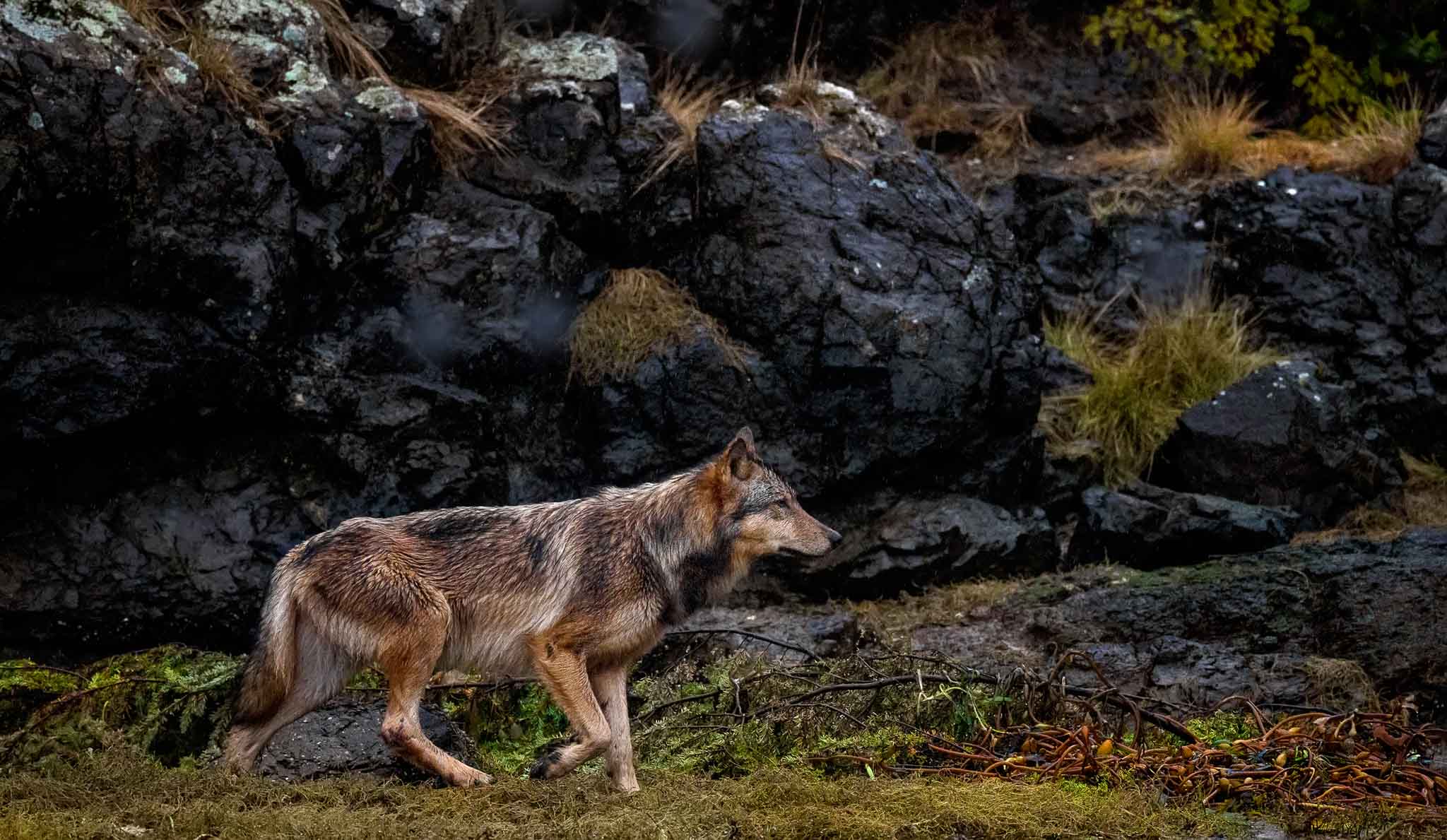
British Columbia’s Rainforest Wolves
Fall was in the air and Raincoast’s wolf project was…

The bear essentials of saving salmon
Fully protected safe havens would have positive effect on ecosystems…

Cross-breeding in Vancouver Island wolves
Raincoast’s Chris Darimont speaks to CFAX. Adam Sterling of CFAX…
Salmon for Bears
How do salmon declines affect coastal bears? And how much…
Cross-bred animals found on Vancouver Island ‘aren’t fit as pets or wild creatures’
By Nicholas Read, Special to the Vancouver Sun A1 September…
Conservation groups send letter to Minister
Multiple conservation groups concerned about grizzly bears on the BC…
New paper tells story of Vancouver Island wolves
The latest publication from the Raincoast carnivore team and collaborators…
Human-driven Evolution
Raincoast’s Chris Darimont speaks to NPR Ira Flatow, host of…