Contributions of Indigenous Knowledge to ecological and evolutionary understanding
New research synthesizes the many contributions of Indigenous knowledge and its importance as a distinct but complementary way of knowing to Western science.


What's new // Scientific literature
Read the published scientific peer-reviewed papers by Raincoast team members and affiliations.

New research synthesizes the many contributions of Indigenous knowledge and its importance as a distinct but complementary way of knowing to Western science.
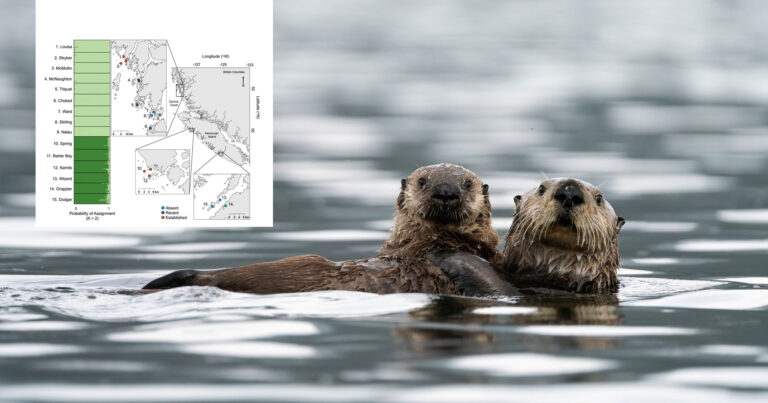
Contrary to how it may appear, it turns out that sea otters ripping up eelgrass actually does the plant – and the nearshore ecosystem – a favour.

A recent journal article, published in Methods in Ecology and Evolution, draws attention to the need for consistent and high standards for animal welfare in research, and the important role that journals have in maintaining ethical standards in published research. The authors, joined by Raincoast scientists Kate Field, Paul Paquet and Chris Darimont, stress that…

The effect of salmon carcass availability on eagle distribution across multiple rivers was previously not well understood.

The presence of microplastics raises concerns that textiles, laundry and municipal wastewater may be an important source of these emerging pollutants.

Salmon have lost access to as much as 85 per cent of their historical floodplain habitat – the biologically rich wetlands next to a river or stream that typically harbour wildlife – due to dikes and similar infrastructure.
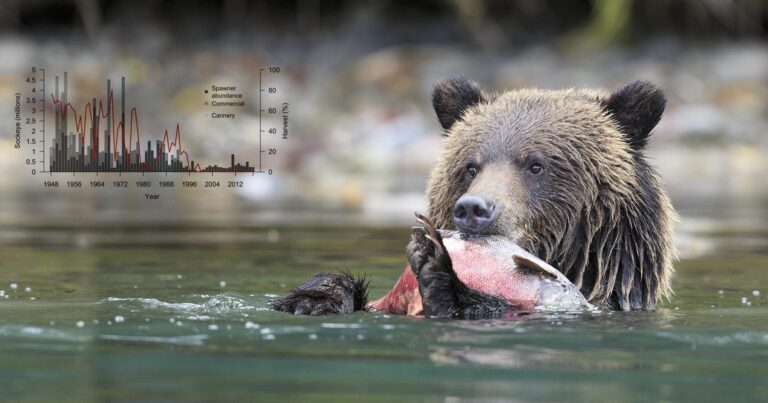
Guided by the Wuikinuxv principle of n̓àn̓akila (to keep an eye on something or someone; a protector or guardian), a new study shows how fisheries managers can allocate salmon for wildlife, while balancing the needs of local communities.

In the landscape on the central coast of what is now known as British Columbia, genetic analyses have identified three distinct genetic groups of grizzly bears. The spatial areas of these groups align strikingly well with the geographies of three Indigenous language families (Tsimshian, Northern Wakashan, Salishan Nuxalk). The explanation the research partnership favours is…

A new paper, published by a team of researchers including Raincoast scientists, dives into the tangle of cognitive bias, institutional agendas, human interests, and pays special attention to the role of undisclosed value judgments.

The paper, “Intrapopulation foraging niche variation between phenotypes and genotypes of Spirit bear populations,” was published in the open-access journal Ecology and Evolution.

A new study suggests killing predators like wolves, grizzly bears, and cougars for trophy is a potential threat not only to these sensitive animals, but also to other hunters…

Using tiny salmon ear bones, or otoliths, Raincoast researchers and partners were able to demonstrate that Chinook salmon from Harrison River rely on the Fraser estuary for one to two months while they feed and grow. These findings underscore the critical nature of this habitat for the persistence and recovery of Chinook salmon…