

Shifting salmon policy
Photo by Alex Harris.
Ecosystems are complex. They are communities of living organisms connected through interacting processes and features on the land, in water, and between the two. Yet BC’s antiquated environmental policy doesn’t reflect this. Colonial society governs ecosystems by siloing them into distinct ministries and resources instead of reflecting the interconnected nature of habitats that make them function in the living world. This “siloed decision making”is the root cause of many of the ecological challenges we face today.


Our policy goals
1. Manage fisheries for ecosystems
- Set salmon harvest at levels that optimize the benefits of spawning salmon to watersheds and wildlife.
- Shift away from historic management paradigms that minimize the number of spawning salmon reaching rivers and maximize harvest (called Maximum Sustainable Yield). Move towards fisheries management that meets salmon spawning targets that are ecologically based, not harvest-based.
- Shift harvest toward selective terminal fisheries (conducted in or near the rivers of origin) that respect the ‘place-based’ nature of salmon, and optimize the benefits to ecosystems, Indigenous cultures, and local communities.
2. Implement ecological-based governance
- Conservation planning and a commitment to sustainability that looks 7 generations ahead.
- A “whole-of-government” approach that implements shared solutions by Indigenous, federal, provincial, and municipal governments to achieve salmon recovery from inland watersheds and rivers, to the open ocean.
- Governance that honours Aboriginal rights and title, inherent Indigenous jurisdiction and law, and the United Nations Declaration on the Rights of Indigenous Peoples (UNDRIP) and the Declaration on the Rights of Indigenous Peoples Act (DRIPA).
- Sustainable funding strategies for watershed-scale restoration and planning.


3. Advance land-use policies that prioritize the health of wild salmon and biodiversity
- Zoning that bolsters functioning watersheds and riparian habitat (i.e.protect natural features, limit impervious surfaces, reduce urban sprawl, adopt nature-based solutions).
- Forestry policy that prioritizes salmon health by restricting clear-cutting in salmon watersheds, and incentivizes a sustainable, second or third-growth forest economy.
- Climate adaptation policy that incentivizes nature-based solutions including natural shorelines, intact riparian areas, unrestricted floodplains, managed retreat, and use of rain-gardens in urban areas.
Our recent reports
Recent articles

Stellar start: launching the 2013 field season
Standing on a rocky outcrop, our field team spots a boat moving towards us on the horizon. As the boat approaches, we see our fellow bear researchers from Kitasoo Territory waving and grinning…

Canmore welcomes oil-free coast exhibit
Canmore Leader, By Justin Parsons
An art exhibit that stirred up controversy in Calgary’s City Hall last week has been receiving a warm welcome in Canmore…
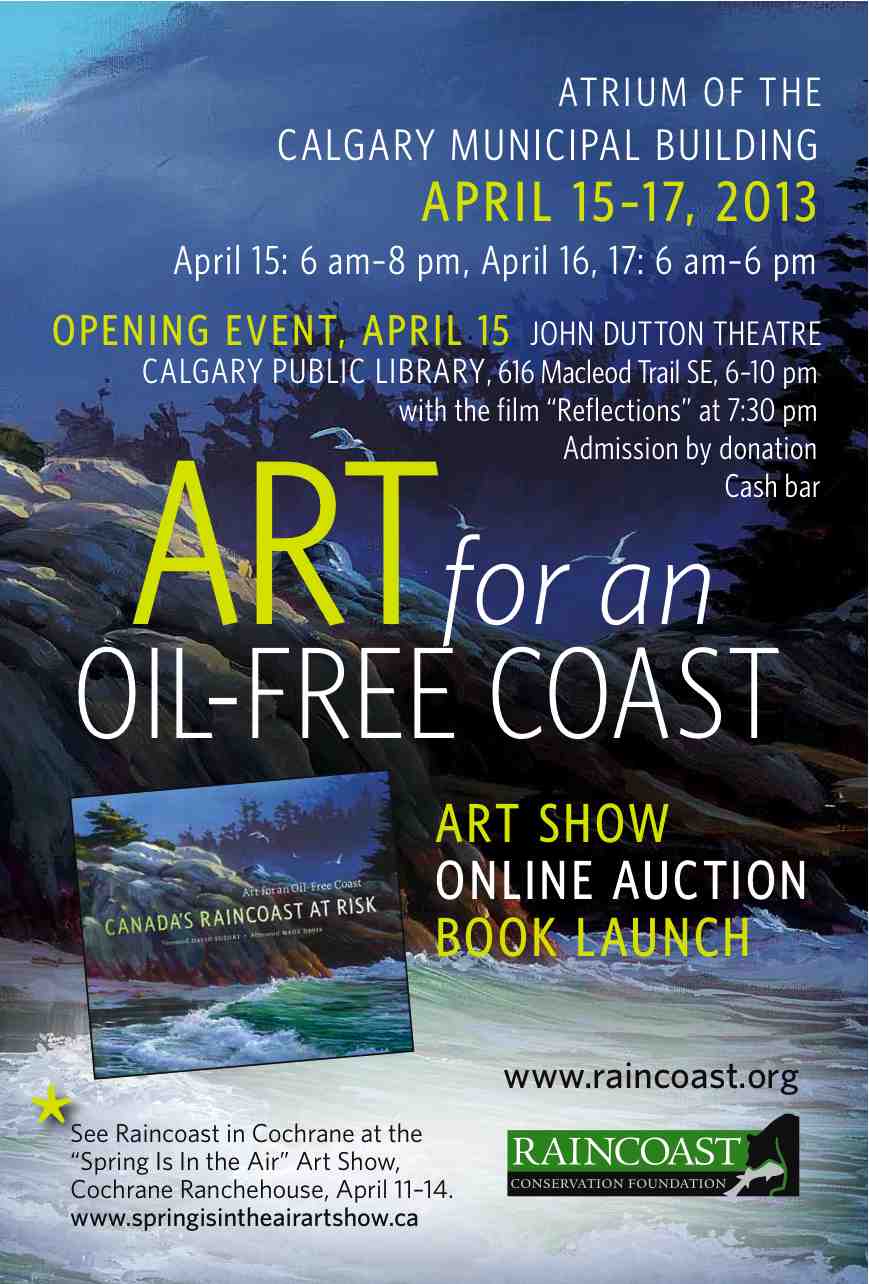
Controversial exhibit stays at city hall
Global News Hour Calgary
A controversial art exhibit at city hall can stay right where it is, even though under normal circumstances it would be forced out. Global’s Reid Fiest reports…

City pulls permit for anti-pipeline art show
Calgary Herald, By Sherri Zickefoose
An anti-oil pipeline art show is being sent packing from City Hall’s atrium after officials yanked the group’s permit over price tags and politics…

Anti-pipeline art exhibit stirs controversy at Calgary City Hall
The Globe and Mail, By Dawn Walton and Nathan Vanderklippe
Serene images of sea lions, spirit bears and cormorants are hardly cause for controversy, but they have created quite a stir…

Art for an oil-free coast comes to Canmore
By Russ Ullyot, Canmore Leader
Canmore’s Solara Resort will host an exhibition of work from more than 40 artists that took up paintbrushes and carving tools to portray Canada’s west coast…