

Shifting salmon policy
Photo by Alex Harris.
Ecosystems are complex. They are communities of living organisms connected through interacting processes and features on the land, in water, and between the two. Yet BC’s antiquated environmental policy doesn’t reflect this. Colonial society governs ecosystems by siloing them into distinct ministries and resources instead of reflecting the interconnected nature of habitats that make them function in the living world. This “siloed decision making”is the root cause of many of the ecological challenges we face today.


Our policy goals
1. Manage fisheries for ecosystems
- Set salmon harvest at levels that optimize the benefits of spawning salmon to watersheds and wildlife.
- Shift away from historic management paradigms that minimize the number of spawning salmon reaching rivers and maximize harvest (called Maximum Sustainable Yield). Move towards fisheries management that meets salmon spawning targets that are ecologically based, not harvest-based.
- Shift harvest toward selective terminal fisheries (conducted in or near the rivers of origin) that respect the ‘place-based’ nature of salmon, and optimize the benefits to ecosystems, Indigenous cultures, and local communities.
2. Implement ecological-based governance
- Conservation planning and a commitment to sustainability that looks 7 generations ahead.
- A “whole-of-government” approach that implements shared solutions by Indigenous, federal, provincial, and municipal governments to achieve salmon recovery from inland watersheds and rivers, to the open ocean.
- Governance that honours Aboriginal rights and title, inherent Indigenous jurisdiction and law, and the United Nations Declaration on the Rights of Indigenous Peoples (UNDRIP) and the Declaration on the Rights of Indigenous Peoples Act (DRIPA).
- Sustainable funding strategies for watershed-scale restoration and planning.


3. Advance land-use policies that prioritize the health of wild salmon and biodiversity
- Zoning that bolsters functioning watersheds and riparian habitat (i.e.protect natural features, limit impervious surfaces, reduce urban sprawl, adopt nature-based solutions).
- Forestry policy that prioritizes salmon health by restricting clear-cutting in salmon watersheds, and incentivizes a sustainable, second or third-growth forest economy.
- Climate adaptation policy that incentivizes nature-based solutions including natural shorelines, intact riparian areas, unrestricted floodplains, managed retreat, and use of rain-gardens in urban areas.
Our recent reports
Recent articles
Confronting the elephant (head) in the room – researchers challenge the conservation community on the ethics of trophy hunting
Writing in the scientific journal, Conservation Letters, an international team of conservation scientists is challenging the conservation community to fully consider the ethics of trophy hunting and think critically about endorsing the practice as a key funding mechanism for wildlife protection. Read our new paper, “The elephant (head) in the room: A critical look at trophy…
Conservation Letters: The elephant (head) in the room: A critical look at trophy hunting
Writing in the scientific journal, Conservation Letters, an international team of conservation scientists argue that trophy hunting – hunting that involves the collection of animal body parts, or “trophies,” – is morally wrong. Led by Chelsea Batavia from the Department of Forest Ecosystems and Society at Oregon State University, the authors identify trophy hunting as…

On the hunt for science in ‘science-based’ hunts
For years, British Columbia’s wildlife management practices, especially its wolf cull and grizzly bear hunt, have been controversial. In 2015, then-Premier Christy Clark defended the province’s wildlife policies, stating they were grounded in sound science. That, at least, was the claim. And not one unique to British Columbia. In fact, hunting in Canada and the…
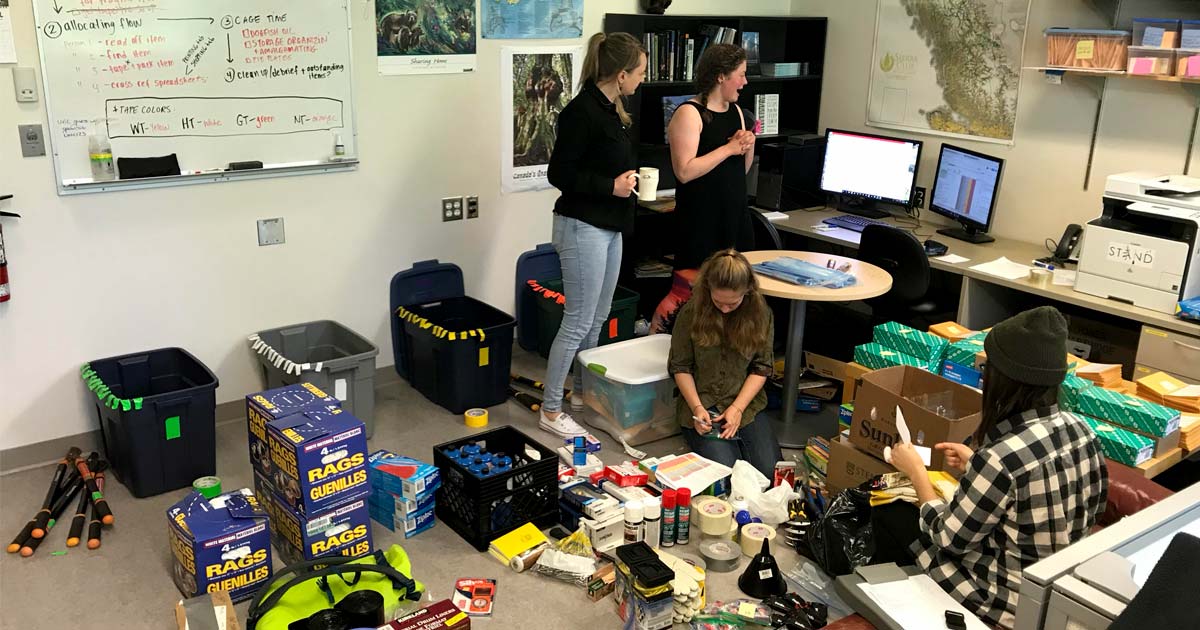
Notes from the (pre) field: “Caution – bear research in progress”
With spring comes organized chaos as graduate students and research associates transition from laboratory work, data analysis and writing, to a flurry of preparation for an upcoming season of monitoring bears on the central coast of British Columbia. We are headed to Gitga’at, Heiltsuk, Kitasoo/Xai’xais, Nuxalk and Wuikinuxv Territories to join…

Predictions from machine learning ensembles: marine bird distribution and density on Canada’s Pacific coast
In February of 2017, a team of researchers, including Raincoast senior scientist Dr. Paul Paquet, from five research facilities published their findings in Marine Ecology Progress Series: “Predictions from machine learning ensembles: Marine bird distribution and density on Canada’s Pacific coast”…

Trans Mountain expansion poses unacceptable risk to Salish Sea
Is Canada’s national interest best aligned with a Texas pipeline company? The suggestion of bailing out U.S.-based Kinder Morgan and investing tax dollars to access public assets in a sunset industry, while momentous questions of Canadian law are still before the courts, is nothing short of absurd…