

Shifting salmon policy
Photo by Alex Harris.
Ecosystems are complex. They are communities of living organisms connected through interacting processes and features on the land, in water, and between the two. Yet BC’s antiquated environmental policy doesn’t reflect this. Colonial society governs ecosystems by siloing them into distinct ministries and resources instead of reflecting the interconnected nature of habitats that make them function in the living world. This “siloed decision making”is the root cause of many of the ecological challenges we face today.


Our policy goals
1. Manage fisheries for ecosystems
- Set salmon harvest at levels that optimize the benefits of spawning salmon to watersheds and wildlife.
- Shift away from historic management paradigms that minimize the number of spawning salmon reaching rivers and maximize harvest (called Maximum Sustainable Yield). Move towards fisheries management that meets salmon spawning targets that are ecologically based, not harvest-based.
- Shift harvest toward selective terminal fisheries (conducted in or near the rivers of origin) that respect the ‘place-based’ nature of salmon, and optimize the benefits to ecosystems, Indigenous cultures, and local communities.
2. Implement ecological-based governance
- Conservation planning and a commitment to sustainability that looks 7 generations ahead.
- A “whole-of-government” approach that implements shared solutions by Indigenous, federal, provincial, and municipal governments to achieve salmon recovery from inland watersheds and rivers, to the open ocean.
- Governance that honours Aboriginal rights and title, inherent Indigenous jurisdiction and law, and the United Nations Declaration on the Rights of Indigenous Peoples (UNDRIP) and the Declaration on the Rights of Indigenous Peoples Act (DRIPA).
- Sustainable funding strategies for watershed-scale restoration and planning.


3. Advance land-use policies that prioritize the health of wild salmon and biodiversity
- Zoning that bolsters functioning watersheds and riparian habitat (i.e.protect natural features, limit impervious surfaces, reduce urban sprawl, adopt nature-based solutions).
- Forestry policy that prioritizes salmon health by restricting clear-cutting in salmon watersheds, and incentivizes a sustainable, second or third-growth forest economy.
- Climate adaptation policy that incentivizes nature-based solutions including natural shorelines, intact riparian areas, unrestricted floodplains, managed retreat, and use of rain-gardens in urban areas.
Our recent reports
Recent articles

Revealing the true extent of lost salmon habitat in the Lower Fraser River
Most of this seasonally available habitat is no longer accessible.

Reciprocity and Research – how Raincoast and the Wuikinuxv Nation collaborated on ecosystem-based fisheries management research
It became apparent quickly that any research we did with the Wuikinuxv Nation on grizzly bears would be premised in a deep respect for the well-being of bears. This meant asking questions about the bears’ population, habitat, and food sources. There is a cultural principle in Wuikinuxv of looking ahead over each other and the lands and waters. In the Wuikinuxv language, this practice of being a guardian or a protector is called n̓àn̓akila.
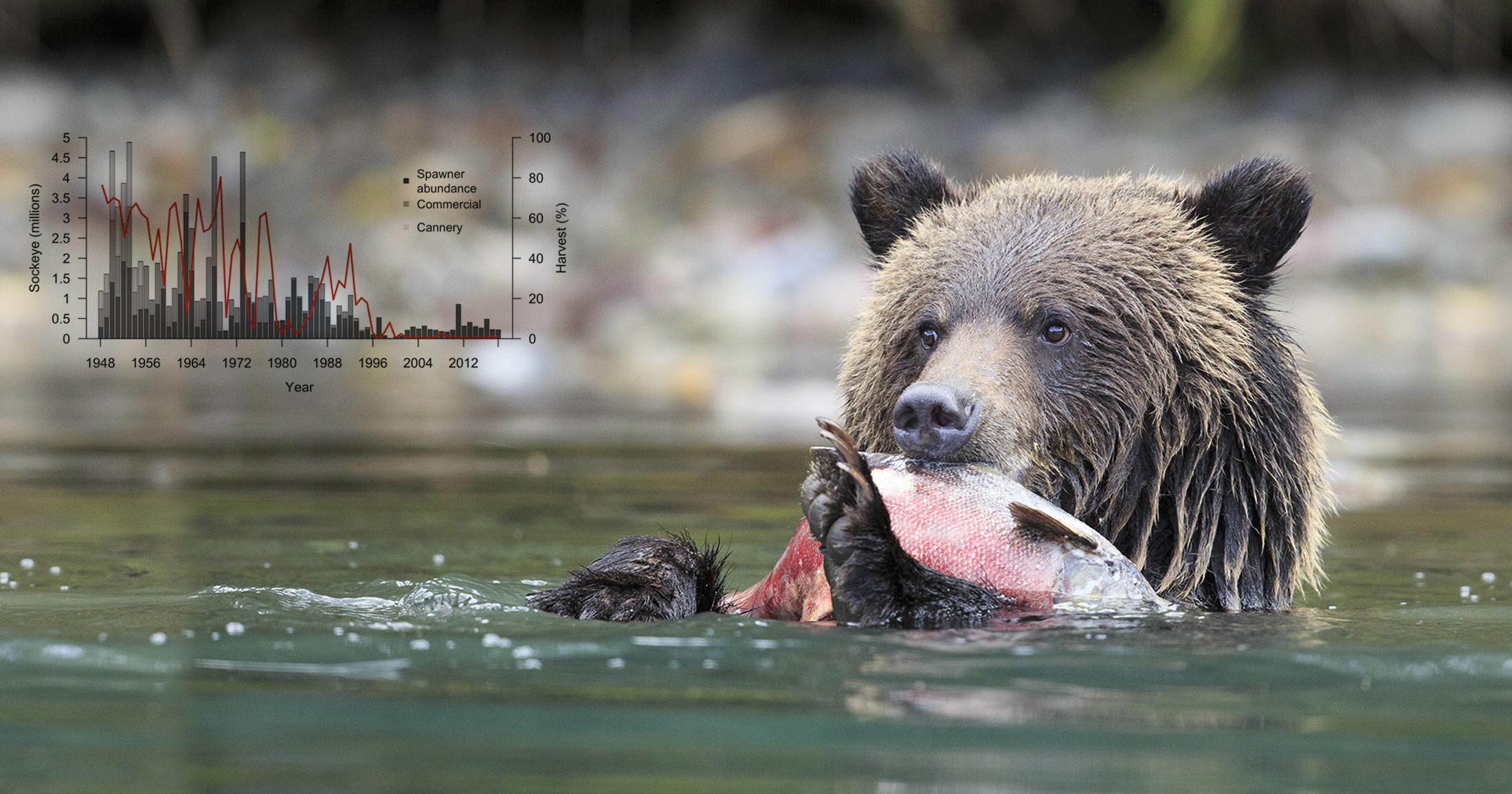
Research: Fisheries management of the Wuikinuxv bear-salmon-human system guided by n̓àn̓akila and data
Guided by the Wuikinuxv principle of n̓àn̓akila (to keep an eye on something or someone; a protector or guardian), a new study shows how fisheries managers can allocate salmon for wildlife, while balancing the needs of local communities.

Spatial alignment between grizzly bear genetic groups and Indigenous language families in coastal BC
In the landscape on the central coast of what is now known as British Columbia, genetic analyses have identified three distinct genetic groups of grizzly bears. The spatial areas of these groups align strikingly well with the geographies of three Indigenous language families (Tsimshian, Northern Wakashan, Salishan Nuxalk). The explanation the research partnership favours is…

Dr. Peter S. Ross to lead a new water contaminants program
There is an urgent need for a more comprehensive approach to monitoring water pollution in British Columbia. For these reasons, and more, we are excited to announce that Dr. Ross is leading the new Healthy Waters Program at Raincoast. He will bring new focus, and new reach, to our efforts to safeguard salmon, whales, and people.

Meet Lauren, Raincoast’s new development coordinator
A Q&A to help you get acquainted with our newest team member.