Living Economies

Raincoast’s Living Economies Program explores how healthy ecosystems can support thriving local economies. We quantify the economic value of ecosystem services, habitat restoration, and conservation initiatives, while developing innovative approaches to finance and the delivery of conservation in salmon-bearing watersheds. By integrating economics, western science, conservation finance, and policy, we work to create solutions that generate employment, strengthen local economies, and support resilient communities across British Columbia. 

Building on a decade years of habitat restoration and job creation

The Living Economies Program builds on the success of Raincoast’s decade-long habitat restoration and conservation work in the Lower Fraser River. Over the past 10 years, our projects have removed barriers to fish passage, controlled invasive species, and restored critical habitat for wild Pacific salmon.

This work created employment for 50 people, with more than $885,576.48 in grant funding directly supporting local jobs. The projects brought together a diverse range of expertise, including biologists, Indigenous Knowledge Keepers, First Nations youth, environmental monitors, engineers,  heavy machinery operators, construction consultants, archaeologists, and graduate students. 

By investing in habitat restoration, this initiative has contributed to the recovery of endangered Pacific salmon while demonstrating that conservation can create meaningful employment opportunities – even within one of the most urbanized and highly modified landscapes in British Columbia.

Aerial photo of tiny, distant workers with hard hats walking around the Fraser River Estuary, surrounded by grasses and water.
Misty MacDuffee, Noah Kussin-Bordo, David Scott, and Peter Kidd in the Fraser River estuary.
Photo by Alex Harris.

Conservation Economy Pilot  

In 2026, we are launching a Conservation Economy Pilot that pairs innovative conservation finance mechanisms with habitat restoration to create a scalable model for nature-positive economic development in rural communities. The pilot will demonstrate how investments in ecosystem recovery can generate long-term employment, attract private and public capital, strengthen local economies, and improve outcomes for fish, wildlife, and people.

By bringing together diverse skill sets – from restoration practitioners and foresters to economists, Indigenous partners, engineers, and community organizations – the pilot aims to test a new model for delivering shared environmental and economic benefits that can be replicated across British Columbia.

Recent, from Raincoast

A salmon in a stream, with four partner logos, Watershed Watch, David Suzuki Foundation, SkeenaWild Conservation Trust, and Raincoast.

Backgrounder on Canada’s Pacific salmon fishery losing its Marine Stewardship Council certification

What is the Marine Stewardship Council? The Marine Stewardship Council, or “MSC”, is an international, independent non-profit organization which sets a standard for sustainable fishing. Fisheries that wish to demonstrate they are well-managed and sustainable compared to the science-based MSC standards are assessed by a team of experts who are independent of both the fishery…
A salmon splashes in a shallow stream, surrounding by the vibrant colours of autumn.

Finding communities in salmon conservation

As I crouch on the riverbank taking measurements of the salmon carcass, the ever-telling sensation of being watched creeps up my neck. I look up to see a mother black bear and her two cubs across the river, staring right at me. Our eyes meet, and time slows. In this moment of connected eyes and…
Dave Scott, Misty MacDuffee, Lia Chalifour, and Charlie Clark work in the Fraser River Estuary.

How new research on habitats within the Fraser River estuary implicates conservation strategy
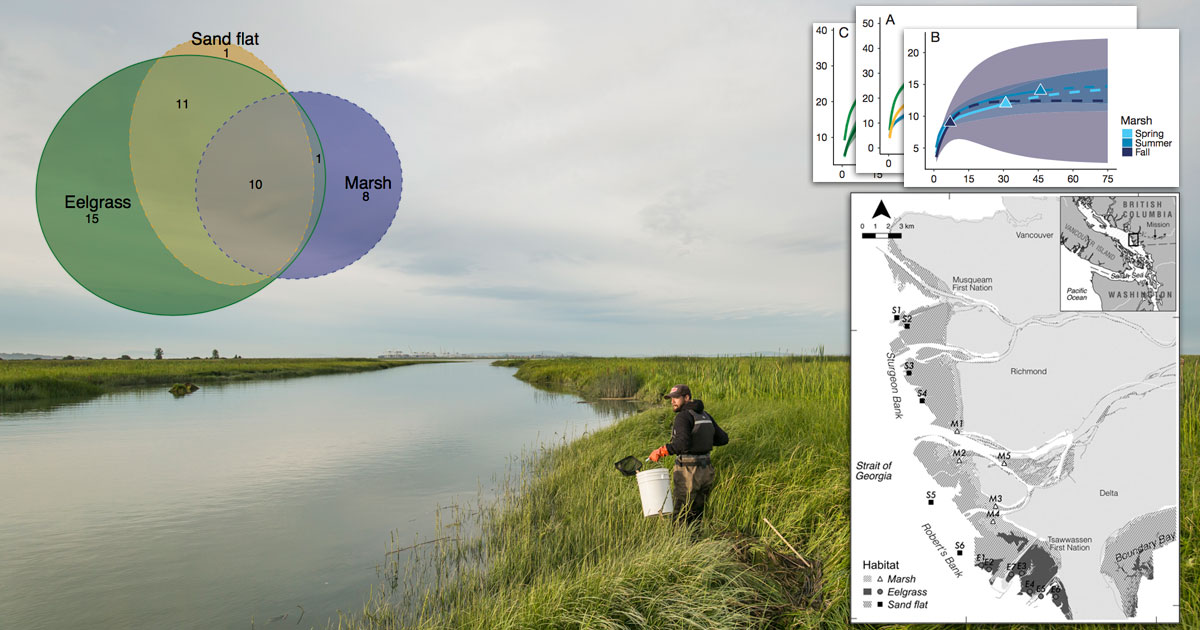
Raincoast biologist Misty MacDuffee joined Mark Brennae on CFAX 1070 to talk about the Fraser River and the fish that rely on its distinct and interconnected habitat. The Fraser Estuary supports more than 100 species that are recognized as “at-risk” (threatened, endangered or of concern) either provincially or federally.1 Misty MacDuffee is part of a…
An expansive view of a Raincoast scientist working in the field in the Fraser River estuary.

Habitat use by juvenile salmon, other migratory fish, and resident fish species underscores the importance of estuarine habitat mosaics

Pacific salmon, especially Chinook and Chum, reside and feed in estuaries during downstream migrations. But the extent to which they rely on estuaries, and which habitats within estuaries, is not well understood. We need to understand this complexity if we are going to enact effective conservation policies. This is especially important in urban systems where habitat loss is ongoing, and at different rates across the estuarine mosaic. The Fraser River estuary, for example, supports a multitude of fish species…
A killer whale chases a chinook salmon in the Salish Sea.

Increasing salmon hatcheries could do more harm than good for Chinook and Southern Resident killer whales

Hatcheries have failed to protect or restore the old ages, big sizes, range of migration times and diversity of wild Chinook salmon. For Southern Residents to recover, the age structure and run timing of wild Chinook runs, along with abundance, need to be restored. This is not the objective of hatcheries…
Close up of a map of streams and lost stream in the Fraser river watershed.

In search of the Lower Fraser’s lost streams

There is currently renewed interest in locating historical streams that have long been paved over and lost in Vancouver and the Lower Mainland. Mapping these historical landscape features offers a connection to the land that has been lost through urbanization and highlights opportunities for restoration…
Salmon circle on the rocky bottom of the Fraser River.

Approval of Trans Mountain expansion puts Fraser River salmon and Salish Sea estuaries at risk
The Fraser River in British Columbia remains one of the world’s most productive salmon rivers. Equally significant is the Fraser River’s estuary, which serves as vital habitat for fish, bird, and mammal species that are linked across thousands of kilometers of the Northeast Pacific Ocean. All Fraser River populations of salmon…
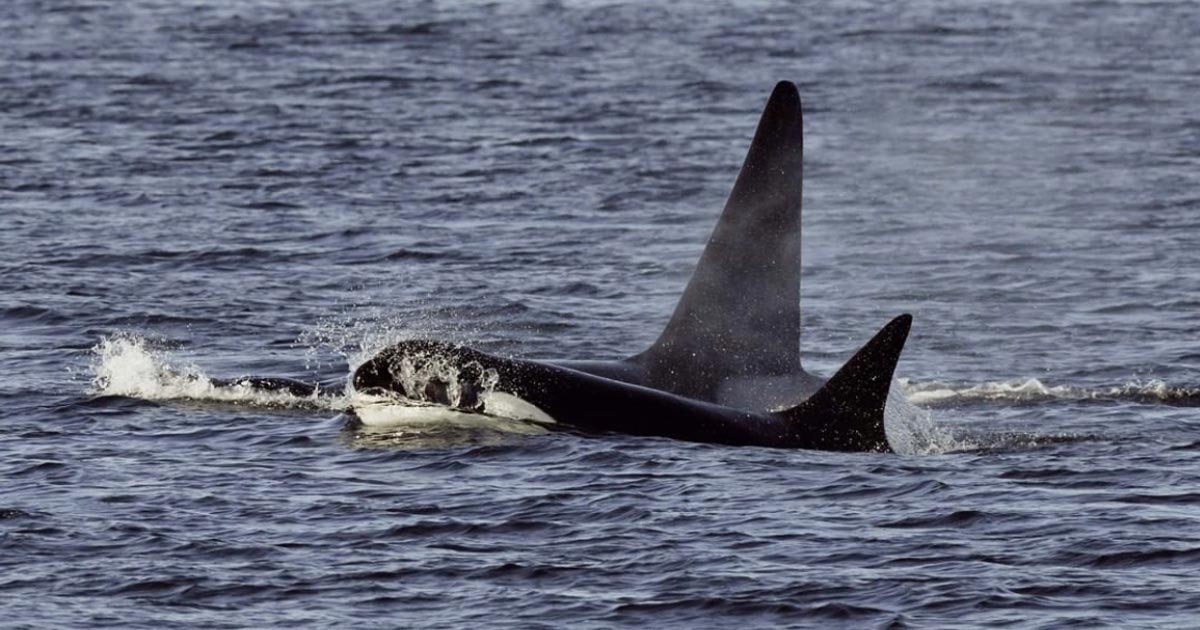
Two killer whales come to the surface of the Salish Sea.

Misty MacDuffee on CFAX 1070 talking about the approval of the Trans Mountain Pipeline

The day after the federal government approved the Trans Mountain Pipeline yet again, Raincoast’s Wild Salmon Program Director, Misty MacDuffee spoke with Mark Brennae on CFAX 1070 to talk pipelines, whales, and how humans are implicated in the disappearance of species. There is, of course, the risk of an oil spill or a vessel strike, but the noise and disturbance on both inbound and outbound tankers is always a certainty. And that noise can reduce the whales ability to echolocate and communicate…