

Coastal wolves
Shaped by life along the Pacific Coast.
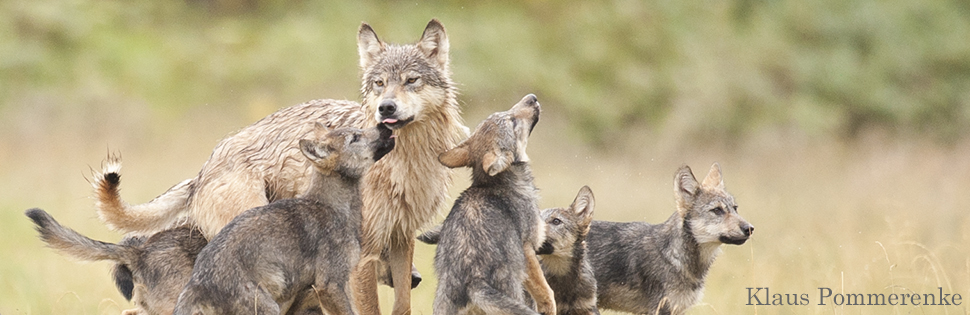
Photo by Klaus Pommerenke.


Shaped by life along the Pacific Coast
Coastal wolves are found in southeast Alaska and to the west of the Coast Mountains, which separate British Columbia’s coastal and interior regions. In BC, this includes what is often referred to as the ‘Great Bear Rainforest’, many islands and archipelagos in the Salish Sea — including Vancouver Island — and along the coast of the mainland.
Coastal wolves are part of the grey wolf species (Canis lupus) and were once recognized as separate subspecies based on where they lived along the Pacific Coast, including Canis lupus ligoni in southeast Alaska, C. l. fuscus in coastal British Columbia, and C. l. crassodon on Vancouver Island. While this classification has been debated, and many scientists now group them within a broader gray wolf subspecies (C. l. nubilus), others continue to recognize coastal wolves as a distinct coastal population shaped by their environment. Our genetics research, published in 2009, recognized them as an Evolutionarily Significant Unit (ESU) and among the most unique wolves in North America.
As wolf populations continue to recover in parts of southern BC, genetic analyses that we contributed to indicate that some of these wolves carry unique genetic markers that are linked to the distinct coastal wolves from British Columbia and southeast Alaska. While most returning wolves originate from interior populations historically spread across the Canadian Rockies, a modest contribution from coastal lineages has also been documented. Research published in 2019 confirms coastal wolves of BC origin are admixed with re-establishing wolves in Washington, and evidence suggests this mixing of lineages may help wolves adapt and thrive in changing environments.
Coastal wolves’ biology and ecology includes a unique diet heavily influenced by marine resources, distinct behaviours such as swimming in the open ocean between landmasses, and morphological differences compared to interior wolves, such as darker pelage, smaller size, and distinct cranial and dental morphology. Coastal wolves are fast, powerful swimmers who often paddle kilometres between islands in search of food. Along the vast coastlines of the rainforest, their diet consists of many marine-derived sources, and have been observed efficiently foraging in salmon streams, scavenging for shellfish and herring eggs, and feasting on seals and washed-up whale carcasses.
Our partnerships
Our partnerships with local communities, such as the Haíɫzaqv (Heiltsuk) Nation of Bella Bella, have granted us unique insight into the lives of coastal wolves. In 2014, a long-term scientific study by Raincoast and Haíɫzaqv partners revealed what First Nations have always known – wolves of the islands are distinct from their cousins of the coastal mainland. Although living nearby, island wolves show modest genetic divergence from those on the mainland, aligning with the divergence in diet between adjacent wolves; island wolves consume much more seafood.
Along the south coast of British Columbia, we have built partnerships with səlilwətaɬ (Tsleil-Waututh) and other First Nation communities, which have been instrumental in deepening our understanding of recent wolf recovery across local watersheds. Through Indigenous-led efforts to restore salmon habitat and monitor reintroduced elk herds, wolves are returning to landscapes that once again offer abundant food sources. These recovering populations were likely founded by two distinct wolf ecotypes, each with unique physical traits and genetic backgrounds: larger wolves that prey on large ungulates (e.g., moose, caribou, and elk) and inhabit the Rockies and interior plateaus, and smaller wolves that prey on salmon and marine-derived sources and occupy the Pacific coast and island ecosystems.
Our scientific publications related to coastal wolves
Hendricks SA, Schweizer RM, Harrigan RJ, Pollinger JP, Paquet PC, Darimont CT, Adams JR, Waits LP, vonHoldt BM, Hohenlohe PA, Wayne RK. 2019. Natural re-colonization and admixture of wolves (Canis lupus) in the US Pacific Northwest: challenges for the protection and management of rare and endangered taxa. Heredity. 122(2):133–149. https://doi.org/10.1038/s41437-018-0094-x.
Stronen AV, Navid EL, Quinn MS, Paquet PC, Bryan HM, Darimont CT. 2014. Population genetic structure of gray wolves (Canis lupus) in a marine archipelago suggests island-mainland differentiation consistent with dietary niche. BMC Ecol. 14:11. https://doi.org/10.1186/1472-6785-14-11/. Science update.
Bryan HM, Darimont CT, Paquet PC, Ellis JA, Goji N, Gouix M, Smits JE. 2011. Exposure to infectious agents in dogs in remote coastal British Columbia: possible sentinels of diseases in wildlife and humans. Can J Vet Res. 75(1):11–17. https://pmc.ncbi.nlm.nih.gov/articles/PMC3003557/. Science update.
Muñoz-Fuentes V, Darimont CT, Wayne RK, Paquet PC, Leonard JA. 2009. Ecological factors drive differentiation in wolves from British Columbia. J Biogeogr. 36(8):1516–1531. https://doi.org/10.1111/j.1365-2699.2008.02067.x. Science update.
Darimont CT, Paquet PC, Reimchen TE. 2008. Spawning salmon disrupt trophic coupling between wolves and ungulate prey in coastal British Columbia. BMC Ecol. 8:14. https://doi.org/10.1186/1472-6785-8-14. Science update.
Darimont CT, Reimchen TE, Bryan HM, Paquet PC. 2008. Faecal-centric approaches to wildlife ecology and conservation: methods, data and ethics. Wildl Biol Pract. 4(2):73–87. Science update.
Darimont CT, Paquet PC, Reimchen TE. 2007. Stable isotopic niche predicts fitness of prey in a wolf–deer system. Biol J Linn Soc. 90(1):125–137. https://doi.org/10.1111/j.1095-8312.2007.00716.x. Science update.
Paquet PC, Alexander SM, Swan PL, Darimont CT. 2006. Influence of natural landscape fragmentation and resource availability on distribution and connectivity of gray wolves (Canis lupus) in the archipelago of coastal British Columbia, Canada. In: Crooks KR, Sanjayan MA, editors. Connectivity conservation. Cambridge (UK): Cambridge University Press. p. 130–156. https://doi.org/10.1017/CBO9780511754821.007. Science update.
Bryan HM, Darimont CT, Reimchen TE, Paquet PC. 2006. Early ontogenetic diet in Gray Wolves, Canis lupus, of coastal British Columbia. Can Field-Nat. 120(1):61–66. https://doi.org/10.22621/cfn.v120i1.247. Science update.
Paquet PC, Darimont CT, Moola FM, Genovali C. 2005. Connectivity where the land meets the sea – preserving the last of the best. Wild Earth. 14:21–25. Science update.
Price MHH, Darimont CT, Winchester NN, Paquet PC. 2005. Facts from faeces: prey remains in wolf, Canis lupus, faeces revise occurrence records for mammals of British Columbia’s coastal archipelago. Can Field-Nat. 119(2):192–196. https://doi.org/10.22621/cfn.v119i2.105. Science update.
Darimont CT, Price MHH, Winchester NN, Gordon-Walker J, Paquet PC. 2004. Predators in natural fragments: foraging ecology of wolves in British Columbia’s central and north coast archipelago. J Biogeogr. 31(11):1867–1877. https://doi.org/10.1111/j.1365-2699.2004.01141.x. Science update.
Darimont CT, Reimchen TE, Paquet PC. 2003. Foraging behaviour by gray wolves on salmon streams in coastal British Columbia. Can J Zool. 81(2):349–353. https://doi.org/10.1139/z02-246. Science update.
Darimont CT, Paquet PC. 2002. The Gray Wolves, Canis lupus, of British Columbia’s Central and North Coast: distribution and conservation assessment. Can Field-Nat. 116(3):416–422. https://doi.org/10.5962/p.363480. Science update.
Darimont CT, Paquet PC. 2000. The Gray Wolves (Canis lupus) of British Columbia’s Coastal Rainforests: findings from Year 2000 pilot study and conservation assessment. Victoria (BC): Raincoast Conservation Society. 62 p. Science update.
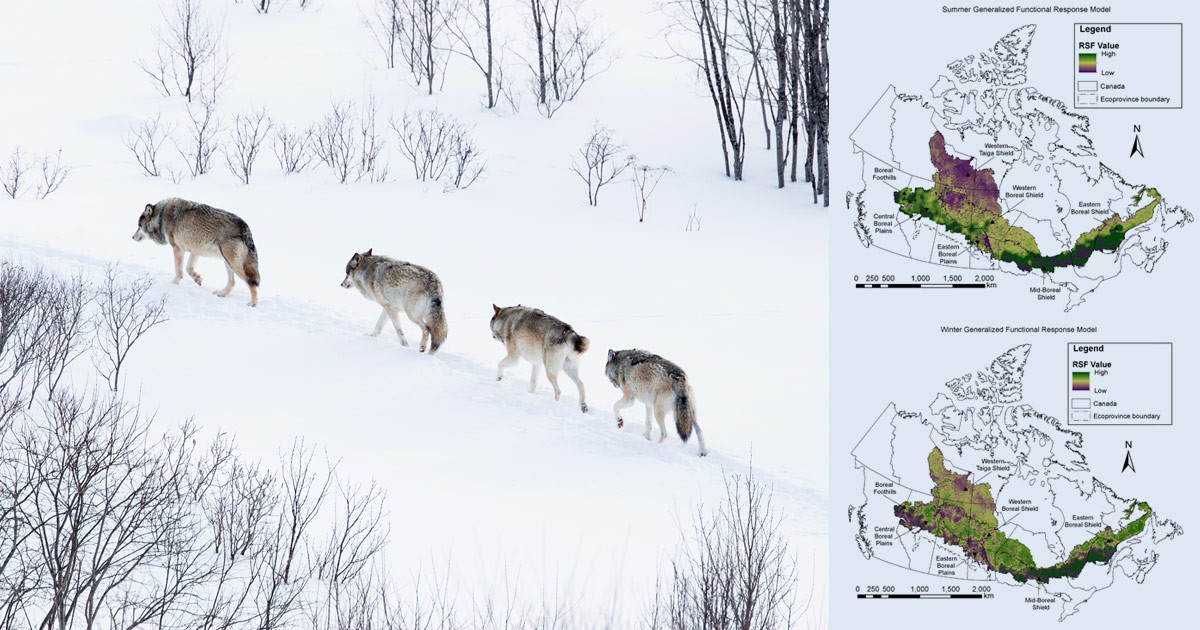
Ecology and Evolution: Functional response of wolves to human development across boreal North America

Poisoning Canada’s wolves with strychnine is unacceptable: journal comment

Maintaining Ethical Standards during Conservation Crises

Population genetic structure of gray wolves in a marine archipelago…
Animal welfare papers presented at conference: abstracts

Seasonal and biogeographical patterns of gastrointestinal parasites in large carnivores: wolves in a coastal archipelago

Genetic differentiation in wolves
