
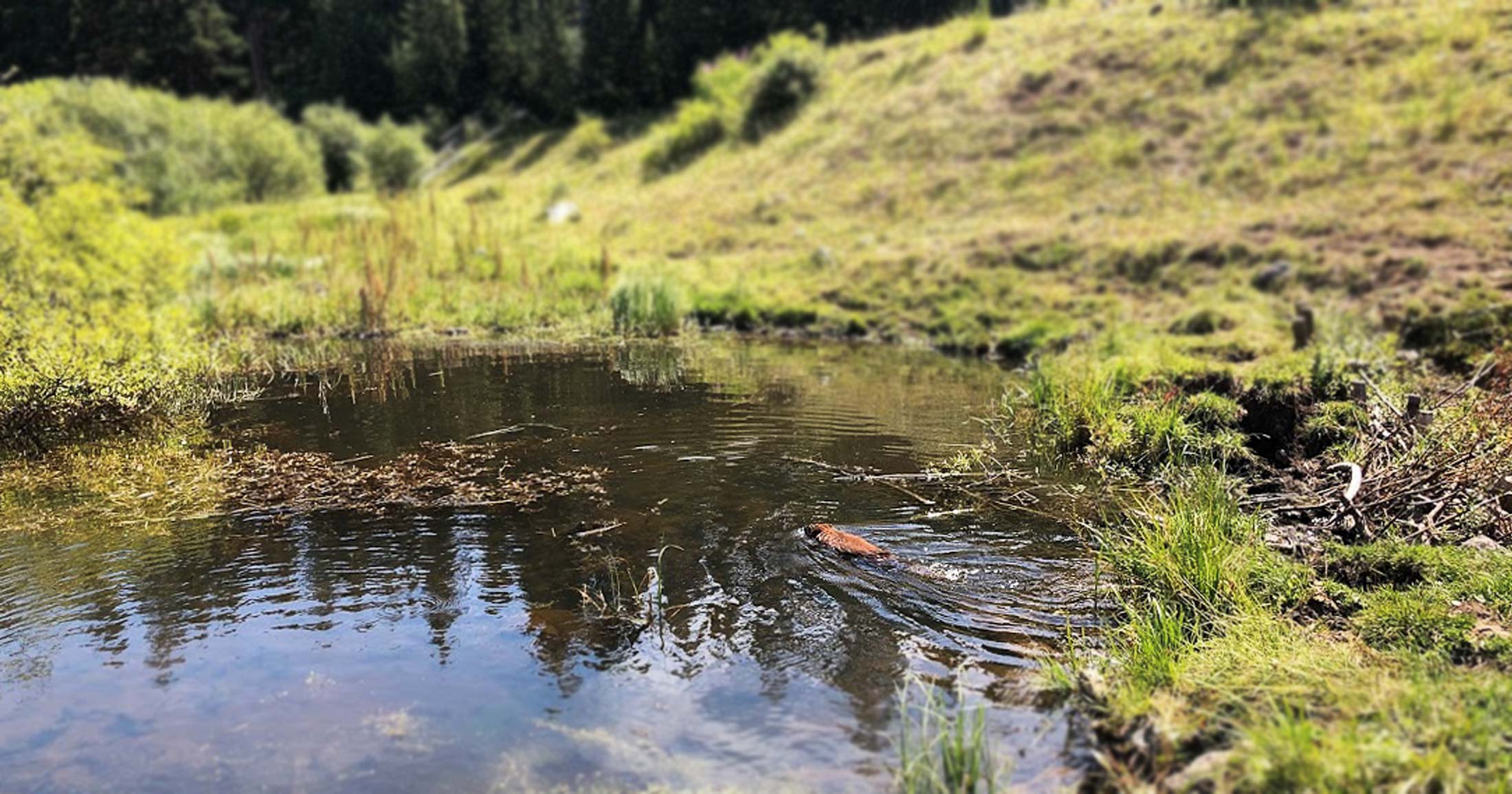
Beaver-based restoration
In a time when catastrophic conflagrations are becoming a new normal, an unlikely character is being welcomed back onto the landscape after generations of trapping and removal.
Decade after decade, forested regions across North America have become increasingly susceptible to wildfire as precipitation patterns dramatically fluctuate, droughts intensify, and every extreme weather event seems to set a new precedent. These climatic shifts have exacerbated legacies of industrial-scale logging, land conversion, fire suppression, and other anthropogenic pressures, making the potential occurrence of a landscape-altering conflagration less a question of if but when. While programs like FireSmart have raised public awareness and made progress toward protecting built infrastructure, there is still much work to do in developing proactive, site-specific approaches that seek to restore ecological functionality. Such approaches not only reduce wildfire risk in the long-term, but also result in myriad co-benefits such as wildlife habitat provision, reinvigoration of cultural value and use, enhancement of biodiversity, and increased carbon storage, just to name a few.
Beaver-based restoration has been gaining popularity as a strategy for responding to growing wildfire risk in an ecologically-informed way. Raincoast connected with Jennifer Rogers from the British Columbia Wildlife Federation to learn more about their 10,000 Wetlands Project and how it might inform better fire response throughout British Columbia. This article outlines how beaver-based restoration is an effective, ecologically-informed tool in the arsenal of approaches to reduce wildfire risk.

Beaver-settler conflict: A brief history
Some historians call beavers the architects of the country we recognize today as Canada because colonial hunters and trappers followed the fur trade from the east coast to the west. The pursuit of beavers and other prized fur-bearing animals drove the movement of settlers across North America, ultimately resulting in the mass removal of beavers from the landscape and almost completely extirpating most beaver populations across the continent.
But this loss was not just the result of hunting. As settlers began establishing themselves in these new (to them) areas, they endeavoured to reshape the land to better suit the European lifestyle. This meant felling forests, clearing brush, removing beaver dams and lodges, rerouting waterways, and draining wetlands. These once diverse habitats were replaced with homes, agricultural fields, and an overall more pastoral aesthetic.

What these early settlers did not foresee were the centuries-long impacts large-scale beaver removal would have on natural hydrology and other processes. The absence of ecosystem regulating services provided by beavers is still seen on the landscape today. Yet, strained relationships between humans and beavers have continued into modern times.
Despite historic hunting efforts and continuous habitat destruction, some beavers survived, and their populations are growing. Unfortunately, they do not understand the settlement patterns that now dominate their home habitats. Floodplains, many of which once supported flowing waterways, have beenーand continue to beーfragmented, infilled, and replaced by impermeable infrastructure, like homes and roadways. Significant habitat loss means that beavers have been forced to adapt and compromise, sometimes building dams that cause flooding or block culverts. Beavers are also commonly caught gnawing on trees or eating expensive ornamental vegetation, like rose bushes, on private property.
Though this is normal and instinctual beaver behaviour (behaviour that is increasingly understood by the scientific community to be essential to ecological functionality), many people feel justified in removing “nuisance beavers” from the landscape either by relocation or lethal trapping. However, the chance of another beaver colony (aka beaver family) moving into the area within the next few years is fairly high. As such, there is a much higher benefit to learn to live with and work alongside beavers, rather than fighting against them. After all, humans and beavers have more in common than most people might initially realize.
Mature beavers are monogamous and have an average of two to four offspring per year, called kits. Beavers live in family units (i.e., colonies) consisting of the breeding pair and their offspring from both the current and previous year. Between the ages of 20-24 months, young beavers leave to establish their own territories. A beaver family unit tends to be territorial, occupying areas of anywhere between 0.5 to 20km², with their territorial range depending on food availability and the density of the surrounding beaver population. Perhaps more than any similarity, the trait that may be most definitive of both beaver and human behaviour is the shared ability to reshape habitats to better suit their needs.
The relationship between beavers and climate risks like wildfire
Beavers live in rivers, lakes, and wetlands, and in more modern times, ditches and stormwater ponds. They prefer slow-moving water, and the modulation of faster-moving streams is often the impetus for dam construction. Beavers also build dams to create better conditions for siting lodges, which are used for shelter, protection from predators, overwintering, rearing offspring, and food storage.
Though dams and lodges are their best-known constructions, beavers are also known to develop canal systems to:
- more easily transport food and building materials throughout their territories, and
- expand food availability by creating better growing conditions for the herbaceous, aquatic, and woody plants they depend on for their food supply and other needs.
Taken together, beaver-built infrastructure is designed to slow the flow of water, hold it on the landscape, and foster the growth of the types of plants that beavers depend on for survival. Some of these species include alder and cottonwoods (Alnus spp.), aspen and other poplars (Populus spp.), birches (Betula spp.), maples (Acer spp.), willows (Salix spp.), dogwoods (Cornys spp.), cattails (Typha spp.), water lilies (Nymphaea spp.), sedges (Salix spp.), and rushes (Juncus spp.). Many of these species are also early successional species, that is, they establish early and quickly after a disturbance. This means that beavers not only mitigate the impacts of disturbances, but can also help recover recently disturbed sites. This is explored in more detail later in this article.


Maples, water lilies, alders, and cattails are some species in the diverse array that might comprise a beaver habitat.
Incidentally, the conditions that suit the needs of beavers are the same conditions that reduce fire, flood, and drought risk, ultimately enhancing climate change resilience at the landscape level.
It may seem counterintuitive to imagine that beaver constructions reduce flooding, because so often, flooding on private property is what causes human-beaver conflict. However, a rise in water level causing increased pooling and standing water is different from the sorts of flash floods that beaver activity can actually prevent. When water is in excess and being slowed by dams, it is able to spread and sink into the groundwater table, not only preventing the damage that can be caused by more powerful floods, like washed out roads, but also creating water storage for future use. In other words, beavers are not causing catastrophic floods; they are preventing them by encouraging the presence of water in natural floodplains.
Further, beaver dams create surface water storage and boost groundwater storage in peripheral floodplains. This means that as the flow of water is slowed, it is able to spread across and seep into the landscape. This increase in moisture mitigates the effects of drought and helps boost vegetation establishment and health throughout the riparian zone. Rich groundwater stores mean there are more resources available for fish and other wildlife, and a moisture-rich landscape occupied by lush, green riparian vegetation is simply less likely to burn than a water-starved, dry system.
These benefits continue even after a beaver has moved away from an area. Like wildfire scars on the landscape, old beaver wetlands leave a physical mark and an ecological legacy. As noted above, when beaver activity slows the flow of water and stores it higher in the watershed, this water supplements or augments flow later into the season. Rich groundwater stores are able to contribute to flowing waterways, even when temperatures climb and precipitation levels drop. That means more water on the landscape is available for fish and wildlife deeper into the summer season.

Post-fire recovery in beaver-occupied habitats
Beaver-occupied habitats do not just reduce climate-related risks like wildfire; they can also aid in ecosystem recovery post-fire and build flood and drought resilience.
In the years following a fire, it is common to see frequent and severe run-off events. This is especially true in the spring during snow melt, also known as freshet. Depending on how hot a fire burns, soils can become hydrophobic, meaning little to no infiltration and thus no replenishment of groundwater stores. As the water flows over the surface of the landscape, its erosive force can create contours on the ground known as rills, which can disrupt the flows of natural waterways and wash out soils.
Intense peak runoff and flow events, which are typically elevated up to 3 years after a fire, can be very destructive. One example is downcutting, which deepens the channel of a stream by washing away material from the streambed. This channel deepening results in a disconnection of a stream from its floodplain, which means there is no opportunity for overbank flow and therefore limited groundwater recharge. To better illustrate this process, a schematic of flow types has been provided in Figure 1. These sorts of disconnections and disruptions can result in a cascade of impacts, not the least of which is the system’s reduced ability to absorb influxes of water. This can lead to catastrophic flooding and intensified periods of drought, which are especially detrimental for communities located at the bottom of watersheds.

Increased sedimentation is also a risk because as run-off moves unhindered across the landscape, it catches and mobilizes sediment that then washes into waterways. When such a high influx of sediment is introduced to a waterbody, it often remains suspended in the water column, which can negatively impact water quality and, in turn, impact the health of aquatic organisms like fish.
Beavers or replication of beaver behaviour through human-led restoration activities can help reduce these post-fire impacts. Beaver dam analogues (BDAs) are structures designed to mimic beaver behaviour when beaver reintroduction is not safe or feasible. That is, post-fire, when few of the resources required to support beaver survival are present on the landscape, BDAs can be installed to slow water flow, prevent downcutting, and act as filters to improve downstream water quality by capturing sediment and other pollutants that tend to build up on the landscape post-fire, like nitrates. Eventually, BDAs help to restore habitat conditions that would allow beavers to return to landscapes that would have otherwise been too degraded to support them.

Not every habitat is beaver habitat
In recent years, beaver-based restoration has rapidly grown in popularity, but some researchers warn that beaver reintroductions should not be considered a panacea for reducing fire risk. Despite all the benefits of beavers, beaver-based restoration must be considered in a site-specific context. Even when beaver populations were abundant across North America, they were not present in every stream of every watershed. Looking through the lens of how watersheds may have functioned in the past, and identifying natural drivers or disturbance types can inform effective restoration strategies. Much like fire and windthrow, beavers do act as a disturbance and disturbance is a healthy part of ecological regulation.
Just as beavers are meant to be in some watersheds, fire is meant to burn in others (and of course, the two are not mutually exclusive). The trick for restoration practitioners is to read the landscape and employ proxies of these disturbances without risking built infrastructure or community safety. In some cases, beaver introductions are the best option, while in others, selective harvest or prescribed burns (to reduce fuel loads) might be more applicable. Ensuring the right solution is chosen for the right problem is key.
However, even if beavers are seemingly the best choice, they are living creatures with habitat requirements, free will, and the right to safety. For a beaver to make their home in a new place, they need an adequate food supply within reasonable proximity to a waterbody with at least 1 metre depth, to support the construction of a lodge which will keep them safe from predators. The terrain cannot be too steep, otherwise there is a risk of their dams or lodges blowing out. There must be safe access to a floodplain that can be shaped to the beaver’s liking. Importantly, there must also be a low risk of interference with human infrastructure.
Even if all habitat requirements are met, some places may still be unconducive to beaver presence. Too much built infrastructure in what was formerly a functional floodplain is often a primary limiting factor. To bring beavers back onto human-dominated landscapes requires a deep investment of time to encourage the cultural shift necessary to make people comfortable with, and excited about beavers’ return to the landscape. Approaches designed to foster the human/beaver relationship are sometimes referred to as “Living with Beaver Strategies.”
Meantime, to reduce the risk of conflict, key questions that must be asked prior to beaver introduction include: Are there roads that could be flooded? Are there culverts that could be clogged? Are there privately held lands that could be adversely impacted?
Finally, it is also necessary to identify existing pathways to alternative habitats that could potentially be attractive to a newly introduced beaver. Some recognized strategies that are known to prevent a newly introduced beaver from wandering away from the target introduction area include:
- avoiding the territory of an existing beaver (i.e., no introductions within 2 km of an established beaver colony);
- constructing temporary lodges as immediate forms of shelter and protection from predators; and
- introducing an opposite sex pair of beavers together rather than a solo beaver who might immigrate in search of a mate.
Beavers can be perceived as a solution or a problem. But, the root of the latter is all the ways humans have modified and inserted themselves onto landscapes. Until such a time that people accept the good and potential bad of beaver presence, it is generally safer for beavers to be reintroduced at the top of watersheds, where there is less privately-held land and limited built infrastructure.
The 10,000 Wetlands Project
In early 2023, the British Columbia Wildlife Federation (BCWF) launched a beaver-based restoration project called 10,000 Wetlands (“the Project”). It has been designed to nudge ecosystems toward recovery and resilience by listening to and mimicking natural processes. Its mode of action is using BDAs and, in some cases, beaver reintroduction to reduce climate change-driven fire, drought, and flood risk.
The first year of the Project focused on identifying potential sites for restorative action and building partnerships with aligned non-profits, First Nations, and other governments. With those relational foundations in place, the next step was to start building BDAs to foster the creation of ideal beaver habitat with the hope that beavers would return independently to the landscape once all their basic life requirements have been met. During this phase, the BCWF team, along with project partners, constructed 71 BDAs at 6 sites across BC.
Once restored landscapes have sufficiently healed and are ready to support beavers, the BCWF will consider bringing beavers back (if they have not already found their way to these newly enhanced habitats independently).
Early in the 2025 field season, the team revisited the installation sites to conduct initial monitoring of hydrologic responses like flow rate and groundwater impacts. They also assessed how the BDA structures themselves withstood seasonal cycles like spring freshet. Fortunately, they found that only minor repairs were needed because unlike natural dams, there were no busy beavers present (yet!) to do maintenance work every night.
A key goal of this work is to, over time, determine whether the restored sites can support a beaver colony. Though it would be ideal for beavers to naturally colonize these areas, this may be unlikely due to insufficient local populations. As such, if sites are deemed ready for beaver occupation by the BCWF team, reintroduction plans will be made.
Usually, when a beaver is introduced to a restored area, they are considered a “nuisance beaver” that has been removed from a different location. This happens when efforts to reduce human-beaver conflict are unsuccessful. In other cases, beavers are removed from an area that is not conducive to the fulfilment of all life history requirements, like an irrigation ditch. Though the BCWF is not currently directly involved with beaver trapping, they work together with local biologists and organizations like the Interior Wildlife Rehabilitation Society (IWRS) based in Summerland, BC which specializes in beaver care and provides a safe place until a captured beaver is ready for release. Sometimes, the IWRS will care for an individual beaver until their whole family is captured so the colony can be released together. In other cases, sick or injured beavers are nursed back to health before release. The partnership between the BCWF and IWRS acts as a symbiotic relationship as the former creates new habitats for beavers in need of relocation by the latter.


Indigenous Knowledge and cultural teachings
The reintroduction of beavers has roots in Indigenous Knowledge and cultural teachings. In the case of the work done by the BCWF, decisions are often guided by partnering First Nations who know potential beaver reintroduction sites better than anyone. With millennia-long relationships with the land, Indigenous communities know how these places looked and functioned in the past, how the land has changed, where beavers have been, where beavers should be encouraged to go now, and what other creatures live on the landscape and need consideration. In other words, there is a long-term vision of what a watershed once was and what it can be again. Integrating this level of longevity into projects that require ecological (i.e., centuries-long) time-scales is something that is often missing from most human endeavours. But this gap can be disastrous for restoration, which seeks to learn from ecological processes of the past to safeguard functional ecosystems into the future.
The BCWF is not the first organization in North America to do this work, but they are among the first to do so in BC. This means they are often navigating logistics and project design for the first time in the BC context. Though this can be challenging, it also provides an opportunity to work together with Indigenous partners and design projects collaboratively from the beginning.
It is essential when pursuing beaver-based restoration (and truly any land-based restoration work) to uphold the critical guidance provided by Indigenous voices. This not only means inviting Indigenous people to participate in projects that are planned or already in progress, but also being open and available to work under Indigenous-leadership on projects that are designed and needed by Indigenous communities and First Nations. Meeting people where they are at in a reciprocal relationship is essential to building trust-based partnerships.
How you can help
We need beavers. Education is essential to combating beaver-human conflict and expanding the scope and efficacy of beaver-based restoration work. There are things people can do to discourage beavers from damming in areas where their activities may cause damage. Tree wrapping and exclusion fencing are examples. However, in target restoration areas, we must learn to live with beavers better. Looking up local wildlife rehabilitation centres in your area may be helpful to learn more about beavers and living more harmoniously alongside them.

It is also essential that each of us hold ourselves accountable to being responsible community members and protecting the ecosystems around us as best we can. This includes paying attention to drought levels and using water sustainably when conditions are dry. It also includes being aware of burn restrictions and being fire safe when recreating
To put it simply, rather than implementing drastic interventions that might force the system one way or another, the beaver-based restoration work done by the BCWF promotes natural ecological processes to steer a place toward restoration. This sort of gentle intervention is something that can be emulated on small and large scales. Whether someone is interested in something more substantive, like building a wetland on their property to support beavers, or would rather just plant more native species in their yard, the world needs more stewardship at every scale. Every bit contributes!