

Marie-Ana Mikus
Cetacean Conservation Research Program Technician
Marie-Ana is a research technician for the Raincoast Cetacean Conservation Research program. She holds a MSc Degree in Animal behavior from the University of Rennes (France) where she studied small-clawed otter acoustic communication. She has extensive experience in behavioral and acoustic field data collection and acoustic analysis of animal sounds, particularly cetaceans. Since 2016, she has assisted with the collection and acoustic analysis of field recordings of beluga whales from Cunningham Inlet (Canadian High Arctic), the Churchill River Estuary and the St. Lawrence River Estuary, and has been involved on studies of killer whale acoustics and underwater noise impacts on cetaceans.
As a field technician, Marie-Ana is experienced with the deployment and troubleshooting of digital hydrophones, a competent small-boat handler, and a certified drone pilot.

Peer reviewed publications
Aubin, J. A., Mikus, M.-A., Michaud, R., Mennill, D., & Vergara, V. (2023). Fly with care: belugas show evasive responses to low altitude drone flights. Marine Mammal Science, 1– 22. https://doi.org/10.1111/mms.12997
Vergara, V., Wood, J., Lesage, V., Ames, A., Mikus, M.A. and Michaud, R., 2021. Can you hear me? Impacts of underwater noise on communication space of adult, sub-adult and calf contact calls of endangered St. Lawrence belugas (Delphinapterus leucas). Polar Research, 40, 5521. https://doi.org/10.33265/polar.v40.5521
Vergara, V. and Mikus, M.A., 2019. Contact call diversity in natural beluga entrapments in an Arctic estuary: Preliminary evidence of vocal signatures in wild belugas. Marine Mammal Science, 35(2), pp.434-465. https://doi.org/10.1111/mms.12538
Lemasson, A., Mikus, M.A., Blois-Heulin, C. and Lodé, T., 2014. Vocal repertoire, individual acoustic distinctiveness, and social networks in a group of captive Asian small-clawed otters (Aonyx cinerea). Journal of Mammalogy, 95(1), pp.128-139
Lemasson, A., Mikus, M.A., Blois-Heulin, C. and Lodé, T., 2013. Social partner discrimination based on sounds and scents in Asian small-clawed otters (Aonyx cinereus). Naturwissenschaften, 100(3), pp.275-279
Recent articles

We must end Alberta’s persecution of wolves
Chris Genovali and Sadie Parr/Huffington Post Grey wolves in Alberta…

The time has come for a different way of ‘managing’ Canada’s wildlife
Chris Genovali and Paul Paquet/Huffington Post The senseless killing of…
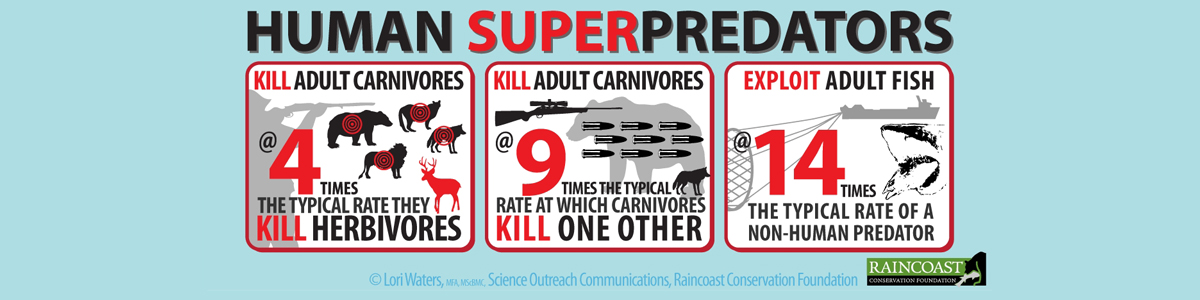
Humans are a “unique Super-Predator” claims new research
Marc Bekoff/Psychology Today This morning my email inbox was brimming…
Humans are ‘superpredators’ like no other species
Emily Chung/CBC News Humans are predators so unique and extreme…
The human ‘superpredator’ is unique — and unsustainable, study says
Amina Khan/Los Angeles Times If you’re looking for the world’s…
Humans are unsustainable super-predators
Randy Shore/Vancouver Sun Humans have emerged as a unique class…