
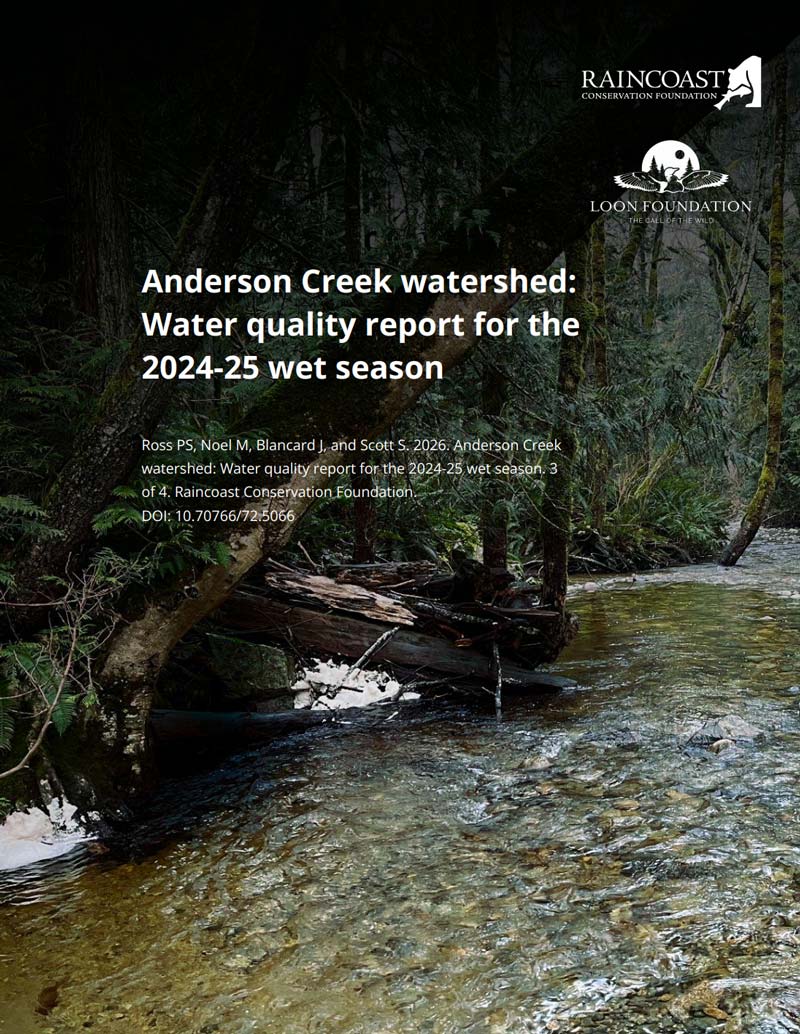
Photo by Sam Scott.
Anderson Creek watershed: Water quality report for the 2024-25 wet season
A total of 12 water samples were collected from field locations within the Anderson Creek watershed on December 12, 2024 by the Raincoast Healthy Waters team alongside representatives of the Pender Harbour Ocean Discovery Station. An additional 10 samples of tap water were obtained from homes and businesses in the surrounding community on the same day.
Team
Raincoast Healthy Waters: Peter S. Ross, Sam Scott, Ziggy Sveinson, and Marie Noel
Pacific Ocean Discovery Station: Jenn Blancard and Sidney-Rae Flumerfelt

A watershed based approach to sampling
Published on 2026 September 16.
Ross PS, Noel M, Blancard J, and Scott S. 2026. Anderson Creek watershed: Water quality report for the 2024-25 wet season. 3 of 4. Raincoast Conservation Foundation. https://doi.org/10.70766/72.5066
Acknowledgements
We acknowledge the financial support of the estate of Mrs. Mary Gordon. We acknowledge the assistance of Mark Tindle. We acknowledge the participation of the Pacific Ocean Ocean Discovery Station (PODS), and the enthusiastic support of Michael Jackson and Sidney-Rae Flumerfelt. We acknowledge the expert analytical support of Pam MacKenzie and Richard Grace at SGS-AXYS. We thank Xiangjun Liao, Andrew Ross and Neil Dangerfield at Fisheries and Oceans Canada for the provision of 6PPD-Q analysis. We thank Nicole Van Zutphen, Sherwin Arnott, and Brooke Gerle for report design. Photo credits: Sam Scott and Peter Ross.
Executive summary
Water is essential for life, and steps are needed to understand, protect and restore its health in fish habitat throughout British Columbia. The Raincoast Healthy Waters program was launched in 2023 to establish community-oriented water pollution monitoring in select BC watersheds. Two Healthy Waters sampling events take place every year in each watershed – the first in the dry season (summer), and the second being in the wet season (winter). This report highlights results from the first wet (winter) season sampling carried out with the support and participation of the Pacific Ocean Discovery Station (PODS).
Briefly, the Healthy Waters team collected water samples on December 12, 2024, from five water categories, including source water (3 samples), river water (3 samples), road runoff (3 samples), tap water (10 samples) and marine water (3 samples). The samples were pooled into composites by category and then analysed for coliform, nutrients (6), physical parameters, metals (37), pesticides (62), polycyclic aromatic hydrocarbons (PAHs; 76), pharmaceuticals and personal care products (PPCPs; 141), polychlorinated biphenyls (PCBs; 209), alkylphenol ethoxylates (APEs; 4), bisphenols (BPs; 6), per- and poly-fluoroalkyl substances (PFAS; 40), sucralose and 6PPD-Quinone.
We detected 102 contaminants out of 577 measured in the stream and river sample collected within the Anderson Creek watershed, excluding nutrients, fecal coliform and physical parameters. Overall, the Anderson Creek watershed had relatively good water quality in the wet season, but additional sampling and analysis will provide further insight into contamination impacts from forest fires, domestic wastewater, industrial chemicals and road runoff on the health of this valued watershed.
Anderson Creek watershed

Key findings
- This assessment of water quality in the Anderson Creek watershed reflects the third of several site visits; our understanding of water quality in these watersheds will grow with additional sampling.
- We collected and analysed water in the Anderson Creek watershed during the wet season (December 12, 2024).
- The marine water and road runoff water samples were the most contaminated water categories in the wet season; they had the highest concentrations of E. coli, metals, PAHs, and PPCPs, and PCBs, PFAS, nitrate, 6PPD-q and sucralose, respectively.
- The tap water sample had the highest concentrations of pesticides and bisphenols.
- The source and stream and river samples were the least contaminated categories in the wet season.
- Overall, the Anderson Creek watershed had relatively good water quality in the wet season:
- There were four exceedances of Canadian Environmental Quality Guidelines.
- Exceedances included:
- Aluminum in the stream and river sample.
- Dissolved oxygen and aluminum in the road runoff water.
- Boron in the marine water.
- There were no exceedances of Health Canada Drinking Water Quality Guidelines.
Background
Raincoast’s Healthy Waters Program (www.raincoast.org/waters/) delivers high-resolution, community-oriented water quality analysis to watersheds across southern British Columbia. The goal of Healthy Waters is to empower communities with the understanding of the status of water quality in their watersheds, to allow for local stewardship regarding both point and nonpoint source pollution.
Pacific Ocean Discovery Station (PODS) is an initiative of the Loon Foundation. The Loon Foundation is a registered charity that was founded in 2002 (as the Ruby Lake Lagoon Nature Reserve Society). Their mission is to ignite connections between people and the natural world, encourage responsible stewardship of natural resources for future generations, and to provide facilities and programs for environmental education, arts and cultural exploration, scientific research, and ecological monitoring.

A watershed based approach to sampling
We collect samples from five different categories of water in each of our partner watersheds: from source water, upstream of human impacts, down to the marine environment.
Source water serves as an upstream reference sample, allowing us to determine which contaminants are being introduced as water traces its path down through the watershed.
Stream and river samples allow us to investigate the quality of fish habitat directly, by collecting samples from streams, creeks, and rivers used by salmon and other fish species (either currently or historically).
Road runoff serves as an impacted sample category of current concern, as many contaminants, including PAHs, metals, surfactants and chemicals such as 6-PPD quinone can be washed off roadways and into fish habitat during rain events.
We include tap water samples in our analysis as a way to bring our homes into the conversation – we borrow water from the environment in the form of municipal or well water, and generally return it to aquatic habitats in a more-degraded state in the form of storm and sewage effluent (treated or untreated).
Marine water samples provide insight into those contaminants that may degrade fish and whale habitat in the ocean, and enable an understanding of the contribution of land-based pollutants from the adjacent watershed to the marine environment.
Collectively, the lessons learned from our partnering watersheds will contribute to a greater understanding of threats to water quality across British Columbia, and ultimately what policy changes can be implemented to preserve the quality of water for the future of salmon, whales, and people.
References
Barzen-Hanson KA, Roberts SC, Choyke S, Oetjen K, McAlees A, Riddell N, McCrindle R, Ferguson PL, Higgins CP, Field JA. 2017. Discovery of 40 classes of per- and polyfluoroalkyl substances in historical aqueous film-forming foams (AFFFs) and AFFF-impacted groundwater. Environmental Science & Technology. 51(4):2047–2057. DOI: https://doi.org/10.1021/acs.est.6b05843.
Berthiaume A, Galarneau E, Marson G. 2021. Polycyclic aromatic compounds (PACs) in the Canadian environment: sources and emissions. Environmental Pollution. DOI: https://doi.org/10.1016/j.envpol.2020.116008.
Canadian Council of Ministers of the Environment (CCME). 1999. Canadian sediment quality guidelines for the protection of aquatic life: endrin [Internet]. Winnipeg (MB): CCME. Available from: https://www.ccme.ca/en/res/endrin-canadian-sediment-quality-guidelines-for-the-protection-of-aquatic-life-en.pdf
Canadian Council of Ministers of the Environment (CCME). 1999. Canadian water quality guidelines for the protection of aquatic life—dissolved oxygen (freshwater) [Internet]. Winnipeg (MB): CCME. Available from: https://ccme.ca/en/res/dissolved-oxygen-freshwater-en-canadian-water-quality-guidelines-for-the-protection-of-aquatic-life.pdf
Canadian Council of Ministers of the Environment (CCME). 2010. Canadian water quality guidelines for the protection of aquatic life: ammonia. In: Canadian environmental quality guidelines, 1999. Winnipeg (MB): CCME. Available from: https://ccme.ca/en/res/ammonia-en-canadian-water-quality-guidelines-for-the-protection-of-aquatic-life.pdf
Canadian Council of Ministers of the Environment (CCME). 2016. Guidance manual for developing nutrient guidelines for rivers and streams [Internet]. Winnipeg (MB): CCME. Available from: https://ccme.ca/en/res/guidancemanualfordevelopingnutrientguidelinesforriversandstreams.pdf
Davis J. 1975. Minimal dissolved oxygen requirements of aquatic life with emphasis on Canadian species: a review. Journal of the Fisheries Board of Canada. [Volume and page range not provided]. doi: https://doi.org/10.1139/f75-268.
Ding Y, Hayward SJ, Westgate JN, Brown TN, Lei YD, Wania F. 2023. Legacy and current-use pesticides in Western Canadian mountain air: influence of pesticide sales, source proximity, and altitude. Atmospheric Environment. 308:119882. doi: https://doi.org/10.1016/j.atmosenv.2023.119882.
Lee D, Choi K. 2019. Comparison of regulatory frameworks of environmental risk assessments for human pharmaceuticals in EU, USA, and Canada. Science of the Total Environment. 671:1026–1035. doi: https://doi.org/10.1016/j.scitotenv.2019.03.372.
Environment and Climate Change Canada (ECCC). 2023. Update on Canada’s national implementation plan under the Stockholm Convention on persistent organic pollutants [Internet]. Ottawa (ON): Environment and Climate Change Canada. [cited 2024 May]. Available from: https://www.canada.ca/content/dam/eccc/documents/pdf/cepa/En14-517-2023-eng.pdf
Environment and Climate Change Canada (ECCC), Health Canada. 2023. Draft state of per- and polyfluoroalkyl substances (PFAS) [Internet]. Ottawa (ON): Government of Canada. [cited 2024 May]. Available from: https://www.canada.ca/en/environment-climate-change/services/evaluating-existing-substances/draft-state-per-polyfluoroalkyl-substances-report.html
Giardina A, Larson SE, Wisner B, Wheeler J, Chao M. 2009. Long-term and acute effects of zinc contamination of a stream on fish mortality and physiology. Environmental Toxicology and Chemistry. 28(2):287–295. doi: https://doi.org/10.1897/07-461.1.
Government of Canada, Environment and Climate Change Canada, Health Canada. 1994. Canadian Environmental Protection Act—priority substances list assessment report: polycyclic aromatic hydrocarbons [Internet]. Ottawa (ON): Government of Canada. [cited 2024 May]. Available from: https://www.canada.ca/content/dam/hc-sc/migration/hc-sc/ewh-semt/alt_formats/hecs-sesc/pdf/pubs/contaminants/psl1-lsp1/hydrocarb_aromat_polycycl/hydrocarbons-hydrocarbures-eng.pdf
Government of Canada. 2017. Toxic substances list—hexachlorobenzene (HCB) [Internet]. Ottawa (ON): Government of Canada. [cited 2024 May]. Available from: https://www.canada.ca/en/environment-climate-change/services/management-toxic-substances/list-canadian-environmental-protection-act/hexachlorobenzene.html
Health Canada. 2007. Pesticides and health [Internet]. Ottawa (ON): Health Canada. [cited 2024 May]. Available from: https://www.canada.ca/content/dam/hc-sc/migration/hc-sc/ewh-semt/alt_formats/hecs-sesc/pdf/pubs/contaminants/pesticides-eng.pdf
Health Canada. 2010. Polychlorinated biphenyls [Internet]. Ottawa (ON): Health Canada. [cited 2024 May]. Available from: https://www.canada.ca/en/health-canada/services/chemical-substances/fact-sheets/chemicals-glance/polychlorinated-biphenyls.html
Health Canada. 2011. Discontinuation of endosulfan [Internet]. Ottawa (ON): Health Canada. [cited 2024 May]. Available from: https://publications.gc.ca/collections/collection_2011/sc-hc/H113-5-2011-1-eng.pdf
Health Canada. 2016. Special review of simazine: proposed decision for consultation [Internet]. Ottawa (ON): Health Canada. [cited 2024 May]. Available from: https://publications.gc.ca/collections/collection_2016/sc-hc/H113-5-2016-9-eng.pdf
Jadaa W, Mohammed HK. 2023. Heavy metals—definition, natural and anthropogenic sources of releasing into ecosystems, toxicity, and removal methods—an overview study. Journal of Ecological Engineering. 24(6):249–27 [page range appears incomplete]. DOI: https://doi.org/10.12911/22998993/162955.
La VT, Cooke SJ. 2011. Advancing the science and practice of fish kill investigations. Reviews in Fisheries Science. 19(1):21–33. Doi: https://doi.org/10.1080/10641262.2010.531793.
La Guardia MJ, Hale RC, Harvey E, Mainor TM. 1999. Alkylphenol ethoxylate degradation products in land-applied sewage sludge (biosolids). Environmental Science & Technology. 33(9):1366–1372. doi: https://doi.org/10.1021/es980966z.
Lalonde B, Garron C. 2021. Nonylphenol, octylphenol, and nonylphenol ethoxylates dissemination in the Canadian freshwater environment. Archives of Environmental Contamination and Toxicology. 80:319–330. doi: https://doi.org/10.1007/s00244-020-00807-x.
Li E, Saleem F, Edge TA, Schellhorn HE. 2021. Biological indicators for fecal pollution detection and source tracking: a review. Processes. 9(11):2058. doi: https://doi.org/10.3390/pr9112058.
Lo BP, Marlatt VM, Liao X, Reger S, Gallilee C, Ross ARS, Brown TM. 2023. Acute toxicity of 6PPD-quinone to early life stage juvenile Chinook (Oncorhynchus tshawytscha) and Coho (Oncorhynchus kisutch) salmon. Environmental Toxicology and Chemistry. 42(4):741–947. DOI: https://doi.org/10.1002/etc.5568.
Longpré D, Lorusso L, Levicki C, Carrier R, Cureton P. 2020. PFOS, PFOA, LC-PFCAs, and certain other PFAS: a focus on Canadian guidelines and guidance for contaminated sites management. Environmental Technology & Innovation. 18:100752. doi: https://doi.org/10.1016/j.eti.2020.100752.
Malhotra N, Ger TR, Uapipatanakul B, Huang JC, Chen KHC, Hsiao CD. 2020. Review of copper and copper nanoparticle toxicity in fish. Nanomaterials. 10(6):1126. doi: https://doi.org/10.3390/nano10061126.
Marvin CH, Berthiaume A, Burniston DA, Chibwe L, Dove A, Evans M, et al. 2021. Polycyclic aromatic compounds in the Canadian environment: aquatic and terrestrial environments. Environmental Pollution. 285:117442. DOI: https://doi.org/10.1016/j.envpol.2021.117442.
Faheem M, Bhandari RK. 2021. Detrimental effects of bisphenol compounds on physiology and reproduction in fish: a literature review. Environmental Toxicology and Pharmacology. 81:103497. doi: https://doi.org/10.1016/j.etap.2020.103497.
Metcalfe C, Miao XS, Hua W, Letcher R, Servos M. 2004. Pharmaceuticals in the Canadian environment. In: Kümmerer K, editor. Pharmaceuticals in the environment. Berlin (DE): Springer. doi: https://doi.org/10.1007/978-3-662-09259-0_6.
Möller A, Ahrens L, Surm R, Westerveld J, van der Wielen F, Ebinghaus R, de Voogt P. 2010. Distribution and sources of polyfluoroalkyl substances (PFAS) in the River Rhine watershed. Environmental Pollution. 158:3243–3250. doi: https://doi.org/10.1016/j.envpol.2010.07.019.
Noël M, Dangerfield N, Hourston RA, Belzer W, Shaw P, Yunker MB, Ross PS. 2009. Do trans-Pacific air masses deliver PBDEs to coastal British Columbia, Canada? Environmental Pollution. 157(12):3404–3412. DOI: https://doi.org/10.1016/j.envpol.2009.06.025
Oppenheimer J, Eaton A, Badruzzaman M, Haghani AW, Jacangelo JG. 2011. Occurrence and suitability of sucralose as an indicator compound of wastewater loading to surface waters in urbanized regions. Water Research. 45:4019–4027. doi: https://doi.org/10.1016/j.watres.2011.05.014.
Othman N, Ismail Z, Selamat MI, Sheikh Abdul Kadir SH, Shibraumalisi NA. 2022. A review of polychlorinated biphenyls (PCBs) pollution in the air: where and how much are we exposed to? International Journal of Environmental Research and Public Health. 19(21):13923. DOI: https://doi.org/10.3390/ijerph192113923.
Putt AE, MacIsaac EA, Herunter HE, Cooper AB, Selbie DT. 2019. Eutrophication forcings on a peri-urban lake ecosystem: context for integrated watershed to airshed management. PLoS One. 14(7). doi: https://doi.org/10.1371/journal.pone.0219241.
Ribeiro de Sousa DN, Mozeto AA, Carneiro RL, Fadini PS. 2014. Electrical conductivity and emerging contaminant as markers of surface freshwater contamination by wastewater. Science of the Total Environment. 484:19–26. doi: https://doi.org/10.1016/j.scitotenv.2014.02.135.
Rochester JR. 2013. Bisphenol A and human health: a review of the literature. Reproductive Toxicology. 42:132–155. doi: https://doi.org/10.1016/j.reprotox.2013.08.008.
Ross PS, Ellis GM, Ikonomou MG, Barrett-Lennard LG, Addison RF. 2000. High PCB concentrations in free-ranging Pacific killer whales, Orcinus orca: effects of age, sex and dietary preference. Marine Pollution Bulletin. 40(6):504–515. DOI: https://doi.org/10.1016/S0025-326X(99)00233-7.
Ross PS, Noël M, Lambourn DM, Dangerfield N, Calambokidis JC, Jeffries SJ. 2013. Declining concentrations of PCBs, PBDEs, PCDEs and PCNs in harbor seals from the Salish Sea. Progress in Oceanography. 115:160–170. DOI: https://doi.org/10.1016/j.pocean.2013.05.027.
Rügner H, Schwientek M, Beckingham B, et al. 2013. Turbidity as a proxy for total suspended solids (TSS) and particle facilitated pollutant transport in catchments. Environmental Earth Sciences. 69:373–380. doi: https://doi.org/10.1007/s12665-013-2307-1.
Rusydi AF. 2018. Correlation between conductivity and total dissolved solid in various type of water: A review. IOP Conference Series: Earth and Environmental Science. 118:012019. Doi: https://doi.org/10.1088/1755-1315/118/1/012019.
Schulz R. 2004. Field studies on exposure, effects, and risk mitigation of aquatic nonpoint-source insecticide pollution: a review. Journal of Environmental Quality. 33(2):419–448. DOI: https://doi.org/10.2134/jeq2004.0419.
Schwartz H, Marushka L, Chan HM, et al. 2021. Pharmaceuticals in source waters of 95 First Nations in Canada. Canadian Journal of Public Health. 112(Suppl 1):133–153. doi: https://doi.org/10.17269/s41997-021-00499-3.
Shang D, Macdonald RW, Ikonomou MG. 1999. Persistence of nonylphenol ethoxylate surfactants and their primary degradation products in sediments from near a municipal outfall in the Strait of Georgia, British Columbia, Canada. Environmental Science & Technology. 33(9):1366–1372. doi: https://doi.org/10.1021/es980966z.
Tian Z, Zhao H, Peter KT, Gonzalez M, Wetzel J, Wu C, Hu X, Prat J, Mudrock E, Hettinger RA, et al. 2021. A ubiquitous tire rubber–derived chemical induces acute mortality in coho salmon. Science. 371:185–189. doi: https://doi.org/10.1126/science.abd6951.
United Nations Environment Programme (UNEP). 2025. United Nations Environment Programme: Stockholm Convention on persistent organic pollutants [Internet]. [cited 2025 Jun]. Available from: https://www.pops.int/partners/unep/overview/tabid/255/default.aspx
van Elsas JD, Semenov AV, Costa R, Trevors JT. 2011. Survival of Escherichia coli in the environment: fundamental and public health aspects. The ISME Journal. 5(2):173–183. doi: https://doi.org/10.1038/ismej.2010.80.
van Stempvoort DL, Brown SJ, Spoelstra J, Garda D, Robertson WD, Smyth SA. 2020. Variable persistence of artificial sweeteners during wastewater treatment: implications for future use as tracers. Water Research. 184:116124. doi: https://doi.org/10.1016/j.watres.2020.06.020.