

Big Tree Registry
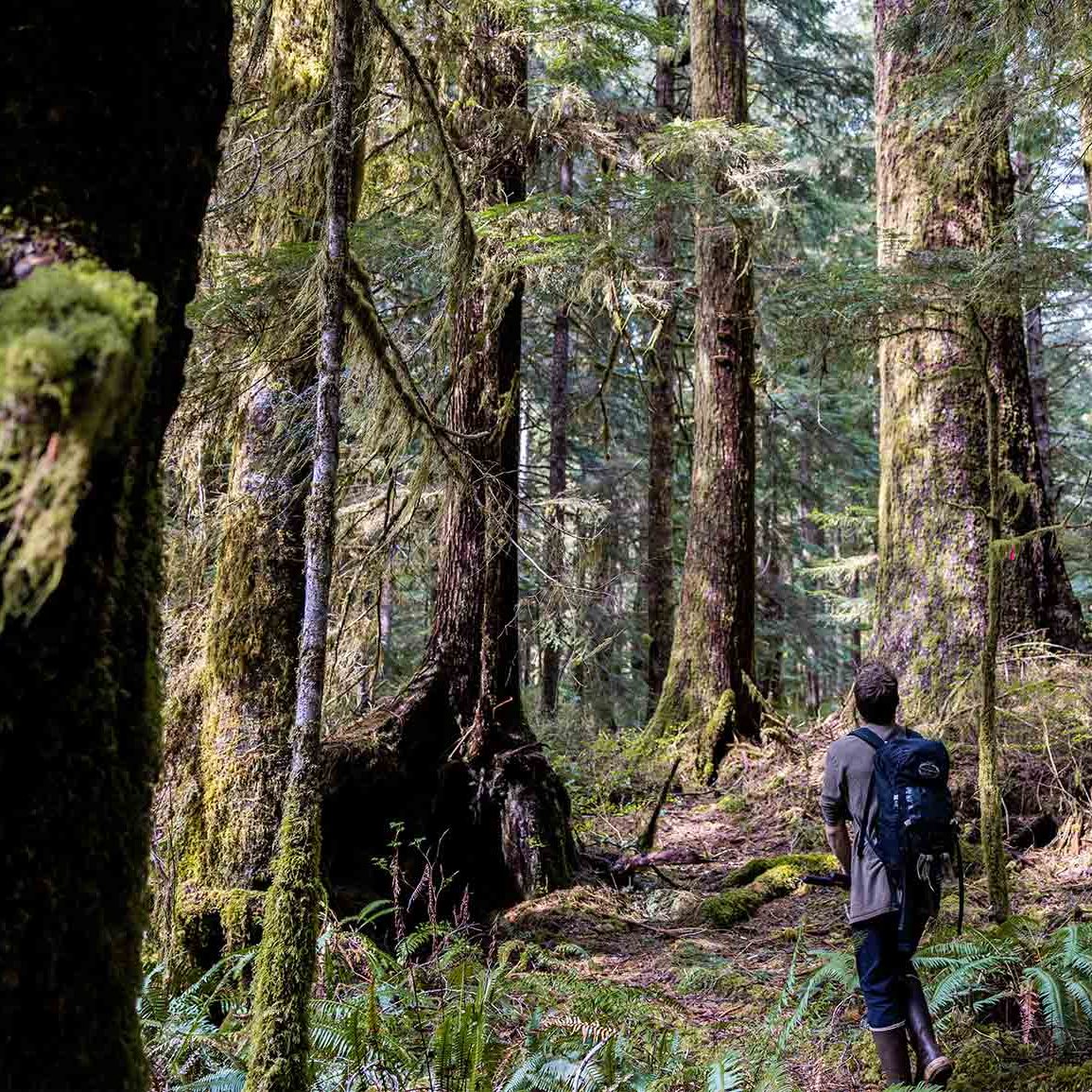
Photo by Alex Harris /
Raincoast Conservation Foundation.
Big Tree Registries are community-science driven initiatives that not only raise awareness about the importance of healthy trees and forests but also help identify areas of high conservation priority, providing valuable information to encourage the protection of iconic trees.
Pender Islands Big Tree Registry
The Pender Islands Big Tree Registry, launched in September 2019, aims to raise awareness about the rare and endangered status of Coastal Douglas-fir (CDF) forests and associated ecosystems characteristic to the Gulf Islands. It is a growing database of the big trees found around North and South Pender Islands, with plans to expand to additional southern Gulf Islands in late 2021. The registry has been modelled, with permission, after the University of British Columbia’s (UBC) big tree registry.
The CDF biogeoclimatic zone is among the most biodiverse zones in the province. It is also the most degraded. It is the least-protected zone in BC with less than 1% of its forests remaining as old growth and less than 10% older than 120 years.
Contribute to the Pender Islands Big Tree Registry
Like other big tree registries, trees are nominated by community members who collect species information along with a few simple measurements including trunk diameter at breast height (DBH), height, and crown spread. Nominations are made using the iNaturalist smartphone app, a Google Form submission, or manually using a prepared datasheet (PDF) depending on the nominator’s preference. These nominations are then verified by a qualified professional working with Raincoast Conservation Foundation to ensure measurements and location information have been accurately recorded. Findings will be used to document the biodiversity on Pender Islands and data may be useful for a number of potential projects.
Measurement guidelines
For more information on how to measure big trees, including tools you will need, photography tips, safety information, and how to measure irregular trees use Raincoast’s big tree measurement guidelines.
Other registries
Find out about other registries from other regions.
Thank you

Recent articles

So long, and thanks for all the fish

Persistent Organic Pollutants in British Columbia’s Grizzly Bears: Consequence of Divergent Diets
Wayward Course: British Columbia’s Failure to Meet Protected Areas Standards for Grizzlies