
Plastic pollution

Photo by April Benze.

Plastic pollution is choking our waterways and threatening the health of fish and wildlife. We are collecting plastic and microplastic data as part of our community-oriented water pollution monitoring program. We are collaborating on research projects with universities, governments and experts in the field. We are providing advice to local, regional and federal governments on plastic science, policies, and regulations. We are working with Ocean Diagnostics to support a strong science-based foundation for solutions.


Lots of garbage on a beach.
Photo by Simon Ager.
People working together to take samples of water in jars.
Photo by Alex Harris / Raincoast Conservation Foundation.

Our approach

  • Design a source identification toolbox for plastic pollution; 
  • Working with Indigenous and coastal communities to document plastic pollution and track this back to its source;
  • Conduct research on the source, transport and fate of micro and macroplastics in the environment;
  • Engage in outside-the-box dialogue with industry and governments to support more sustainable design, manufacturing and processes that stem the release of plastics during the life cycle of a product;
  • Support community-oriented outreach and training to support solution-oriented actions and capacity building.

Plastics are everywhere

Plastics from just about every sector can now be found all over the world – from mountain tops to the seafloor, from the Arctic to the Antarctic, and from our homes to the ocean. A modern-day scourge that is blighting remote beaches and shorelines, getting mistaken for food by wildlife, and getting into the foods that nourish us. Whether it’s the structural features of plastic products that suffocate, entangle, or create intestinal blockages – or the endocrine disrupting-contaminants that serve as ingredients of the product (e.g. Bisphenol A or phthalate esters) or as hitchhikers soaked up by plastics in the environment (e.g. PCBs or metals) – plastics are harmful.

Underwater photo of plastic floating near the top of the water.
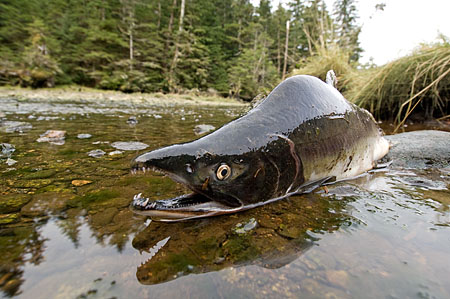
Chinook salmon swim in a river as seen from head on; epic.
Photo by Fernando Lessa.

The impact on the environment

Without a dramatic re-think, the plastic crisis is here to stay. Despite the best intentions of governments, industry, and consumers to reduce, recycle or re-use, global plastic production continues to enjoy exponential growth. And the unintentional loss to the environment of plastic products and byproducts will continue – plastic bags, bottles, and fishing gear, as well as the discharge of microplastics through domestic and industrial waste. With that will come a constant stream of items that will be mistaken for food but offer zero nutrition, that will entangle wildlife, and will deliver endocrine disruptors to our aquatic food webs. We will document impacts, share findings, and work for change through science, community engagement, and expert advice.

Recent articles

dummy-img

British Columbia wolves have taste for salmon, new study finds
Financial Post Canwest News Service Published: Tuesday, September 02, 2008 A team of biologists has discovered “Canada’s newest marine mammal” — the wolf. A new Canadian study of the feeding patterns of British Columbia wolf packs found that they would rather fish than hunt. The study found that wolves routinely turn up their noses at…
Dead animal in spawning stream

Venison’s fine, but wolves prefer salmon

Wolves are not quite the red-blooded hunters we thought they were. It appears they prefer to dine on a nice piece of salmon rather than …
dummy-img

Oil Futures: We’re in for a whale of a time, one way or another

BY: CHRIS GENOVALI MONDAY MAGAZINE August 27, 2008 The International Union for Conservation of Nature (IUCN) recently released its 2008 list of threatened species of cetaceans (whales, dolphins and porpoises). While this news was reasonably encouraging for the global recovery of populations of humpback whales, these assessments have far-reaching impacts on their conservation management.
Poster image: Applications of Paleolimnology to Sockey Salmon Nursery Lakes and Ecosystems in the Pacific Northwest and Alaska.

Paleolimnology workshop

Institute of Ocean Sciences October 8 and 9th, 2008Hosted by the Raincoast Conservation FoundationWorkshop of the Salmon Nutrient Research Community View the Poster (PDF) Leading scientists in the salmon nutrient and paleolimnology fields reviewed sediment core studies conducted in BC and Alaskan sockeye lakes. The goal of the workshop was to better understand what paleolimnological…
dummy-img

Raincoast examines cougar conservation

View the poster In May 2008, Raincoast presented a conference poster at the Mountain Lion Workshop in Sun Valley, Idaho. The poster, entitled “Cougars in British Columbia: conservation assessment and science-based management recommendations”, includes highlights from a forthcoming report that examines opportunities for cougar conservation.
dummy-img

Migrations

by Ian Jansma, Field Station Coordinator Denny Island, July 2008 A new season has begun at our field research station on remote Denny Island in the Great Bear Rainforest. This part of the world gets up late from its misty winter slumber and rolls slowly over through spring rain toward the summer sun. The days…
dummy-img

Grizzly bears need protection

Vancouver Sun, Thursday, July 31, 2008 Letter: by Chris Genovali Re: B.C. grizzly population at ‘great risk’, July 29 I’d like to clarify an important point in the article. I did not state that the 430 grizzly bears killed in 2007 were all from sport hunting. What I did say is that a record number…
dummy-img

Scale of B.C. grizzly bear hunt, population disputed

The Prince Rupert Daily News Thursday, July 31, 2008 George T. Baker In a Vancouver Sun article published on Tuesday, it was reported that 430 grizzly bears were killed in the province last year. But the Environment Minister Barry Penner shot back that the number was not accurately portrayed by the coalition of scientists, conservationists…