

Section 1. What is sound?
Sound is a mechanical wave created when something vibrates. These vibrations travel through a medium (such as air or water) as pressure waves that carry energy.
Sound pressure wave

When we hear something, pressure changes in the air make our eardrum vibrate. These vibrations travel into the inner ear, where tiny hair cells detect the movement and convert them into electrical signals that travel along the auditory nerve to the brain.
Many animals detect sound in a similar way, even if the sound reaches their inner ear differently. For example, whales don’t use an external ear like we do – sound travels through fats and bones before reaching the inner ear.
Other animals sense sound differently. Many fish and invertebrates are most sensitive to the particle-motion component of a sound wave – the tiny back-and-forth movement of water particles as the wave passes – rather than to pressure changes.
How sound travels
There are two types of mechanical waves: transverse and longitudinal. A simple slinky can be used to demonstrate both. If you move the slinky up and down, the coils move at right angles to the direction of travel (a transverse wave). If you push and pull along its length, the coils bunch up and spread out in the same direction the wave travels (a longitudinal wave).
Slinky illustration of a transverse and longitudinal wave

Sound travels as a longitudinal wave. The particles in the medium don’t travel with the sound – they vibrate back and forth around their resting positions. This motion transfers the sound’s energy along the medium.
As the wave travels, it creates alternating regions of higher pressure where the particles are pressed together (compressions) and areas of low pressure where the particles are spread apart (rarefactions).
Sound wave propagation: compression and rarefaction

The medium matters: sound in water vs. air
Sound travels very differently depending on the medium it moves through. In water, sound travels roughly 4.5 times faster than in air – about 1,500 metres per second compared to 340 metres per second in air. Water is much denser and less compressible than air, which means pressure waves transmit more efficiently and travel farther before fading. This is why the ocean is such an effective acoustic environment: a sound produced by a whale can travel hundreds or even thousands of kilometres underwater.
One important consequence of this difference is that the way we measure sound intensity is not the same in air and water. Decibel values in water use a different reference point than those in air, which means that a sound measured at, say, 120 dB underwater and 120 dB in air do not represent the same physical intensity – underwater decibels and in-air decibels are not directly comparable. This is explained in more detail in Section 5.
Noise vs. sound
In physics, sound refers to any mechanical wave that travels through a medium and can be detected by a hearing organ or instrument.
The difference between sound and noise depends on the listener’s perspective and the acoustic signal of interest.
- Sound: any acoustic signal – the term itself is neutral. Examples: music, whale calls, waves on the shore
- Noise: sound that is unwanted, disruptive, or interferes with another signal of interest. Examples: an ambulance passing by, loud music you don’t want to listen to, construction noise.
A ‘sound’ becomes ‘noise’ when it interferes with the reception or transmission of an acoustic signal of interest or when it disturbs a listener. For example, a humpback whale’s song may be a beautiful sound to us – but for another marine animal relying on sound to navigate, find food, or communicate, that same song might act as noise because it masks a critical signal.
Anatomy of sound waves
To visualize the properties of sound waves, we often use a waveform – a graph that shows how pressure changes over time or space. In this representation, peaks show regions where particles are pushed closer together, creating higher pressure (compressions) and troughs indicate regions where particles are spread farther apart, creating lower pressure (rarefactions). This makes it easier to identify key features of sound such as wavelength, frequency and amplitude.
Although a waveform looks like a transverse wave, sound actually travels as a longitudinal pressure wave. The graph below does not show how particles move, only how pressure varies within the medium.
Basic anatomy of a sound wave
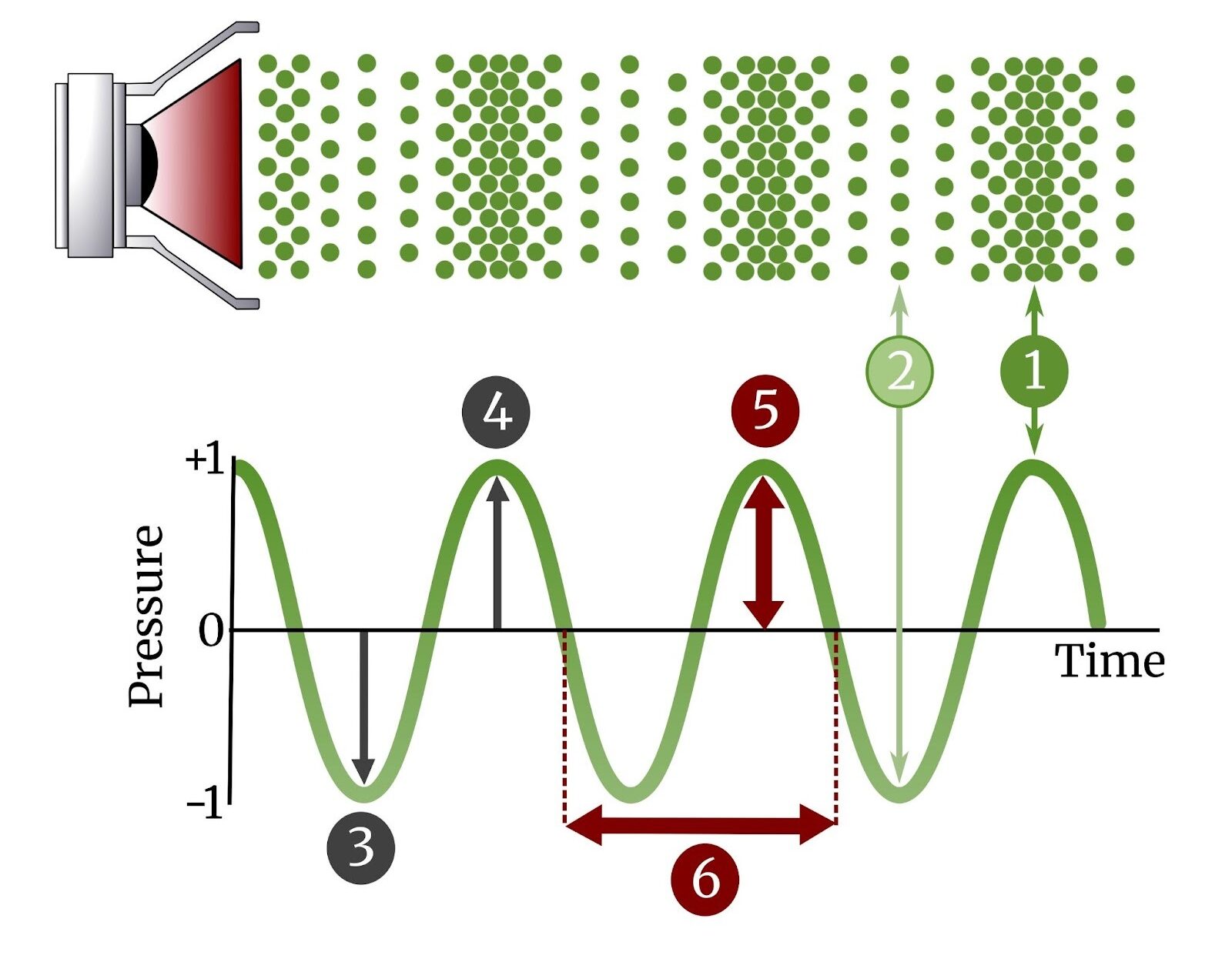
Wavelength is the distance between two identical points in a repeating sound wave, typically from one region of highest pressure (a compression, shown as a peak on the waveform) to the next, or from one region of lowest pressure (a rarefaction, shown as a trough) to the next.
It is related to the speed at which sound travels and the frequency of the wave (wavelength (λ) = speed of sound (v) ÷ frequency (f)). In other words, the higher the frequency, the shorter the wavelength, and vice versa.
Frequency is the number of wave cycles passing a specific point each second. It is measured in Hertz (Hz), where 1Hz = 1 cycle per second.
Frequency is commonly referred to as the ‘pitch’ of a sound:
- High-frequency = high pitch (e.g., bird song, dolphin whistles)
- Low-frequency = low pitch (e.g., drum beats, whale rumbles)
Low and high frequency sounds

Amplitude relates to changes in pressure and the amount of energy a sound wave carries at a specific location. It is the maximum variation in pressure caused by the wave as it travels through the medium.
Amplitude is commonly associated with how loud or soft a sound is perceived. As amplitude increases, a sound is perceived as getting louder; as amplitude decreases, it is perceived as getting quieter.
Low and high amplitude sounds

The amount of pressure variation a sound wave causes is measured in decibels – you’ll find a full explanation of how this scale works in Section 5.