
Fraser River Estuary fish habitat: Contaminant concentrations, profiles and risks in water and sediment
Scott S, Roper P, Scott DC, Noel M, Ross PS. 2026. Fraser River Estuary fish habitat: Contaminant concentrations, profiles and risks in water and sediment. Raincoast Conservation Foundation. DOI: 10.70766/9.66067.
Contributions by SGS Axys: Pam Mackenzie and Richard Grace.
Financial support by the Fisheries and Oceans Canada Aquatic Ecosystems Restoration Fund (AERF) and Raincoast Conservation Foundation.
Executive summary
Water is essential for life, and steps are needed to understand, protect and restore its health in fish habitat throughout British Columbia. The Raincoast Healthy Waters program was launched in 2023 to establish community-oriented water pollution monitoring in select BC watersheds. In this study, we conducted a risk-based assessment of a suite of contaminants of concern in the Fraser River Estuary, an important feeding, rearing and migratory habitat for Pacific salmon.
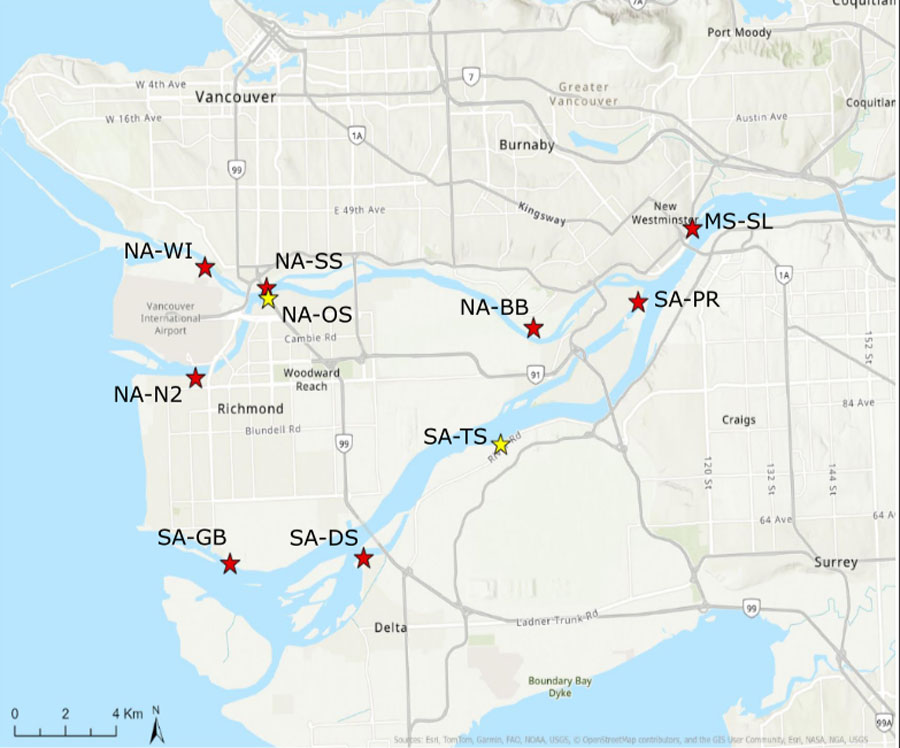
Our team determined basic water properties (temperature, conductivity, pH, dissolved oxygen and turbidity) in situ at sampling sites on March 19, 2025. Water and intertidal sediment samples were then collected from 10 sites within the Fraser River Estuary, including five sites in the North Arm of the river, four sites in the South Arm of the river, and one site upstream in the Fraser River main stem. Two water samples (NA-OS and SA-TS) were submitted to both ALS and SGS-Axys for a comprehensive contaminant analysis including: coliform, nutrients (6), physical parameters, metals (37), pesticides (62), polycyclic aromatic hydrocarbons (PAHs; 76), pharmaceuticals and personal care products (PPCPs; 141), polychlorinated biphenyls (PCBs; 209), alkylphenol ethoxylates (APEs; 4), bisphenols (BPs; 6), per- and poly-fluoroalkyl substances (PFAS; 40), and sucralose. Analysis of 6PPD-quinone is pending. The remaining eight water samples were submitted to ALS Environmental for determination of coliform, nutrients (6), physical parameters, and metals (37). Sediment samples from all 10 sites were submitted to SGS Axys for comprehensive contaminant analyses: polycyclic aromatic hydrocarbons (PAHs; 76), polychlorinated biphenyls (PCBs; 209), polybrominated diphenyl ethers (PBDEs; 209), dioxins and furans (DFs; 19), alkylphenol ethoxylates (APEs; 4), bisphenols (BPs; 6), and per- and poly-fluoroalkyl substances (PFAS; 40).
Key findings
- We collected 10 water and 10 sediment samples in the Fraser River Estuary (March 19, 2025), and analysed these for water properties and a suite of inorganic and organic contaminants of concern.
- North Arm water samples had 1.4 times higher concentrations of most contaminants, with the exception of PPCPs, sucralose, and APEs that were 1.9 times higher in the South Arm water.
- The number of contaminants detected in the North Arm water sample was 237 out of 587 measured, compared to the 213 contaminants that were measured in the South Arm (this does not include water quality parameters, physical contaminants, nutrients, or coliform bacteria).
- Average total sediment contaminant concentrations were 6.5 times higher in the North Arm than in the South Arm.
- The average number of contaminants detected in the North Arm sediment samples was 298 out of 420, compared to the 281 contaminants that were measured in the South Arm and the 269 that were measured in the upstream Main Stem site.
- Average sediment contaminant concentrations in both the North and South Arm were generally higher than the concentrations detected in the upstream MS-SL (Sapperton Landing) sample.
- In sediments, the NA-SS (Shaughnessy Street) sample had the greatest number of Environmental Quality Guideline exceedances, followed by the NA-OS (Oak Street):
- There were 40 exceedances of Canadian Environmental Quality Guidelines in sediment, with 37 of these in the North Arm samples, and three in the South Arm samples. There were no exceedances in the sediment sample from the upstream MS-SL (Sapperton Landing) sample.
- These sediment exceedances were dominated by Polycyclic Aromatic Hydrocarbons (PAH; 29), followed by Dioxins and Furans (DFs; 6), pesticides (n=3), Polychlorinated Biphenyls (PCBs; 1), and Polybrominated Diphenyl Ethers (PBDEs; 1).
- There were 32 exceedances of Canadian Environmental Quality Guidelines in water. These were observed in both the North Arm (16) and South Arm (16), and 4 exceedances in the upstream MS-SL (Sapperton Landing) sample.
- These water exceedances included Aluminum (Al; 10), Iron (Fe; 10), Silver (Ag; 2) and Ammonia (NH3 ; 4).
- There were 6 exceedances of Health Canada Recreational Use Guidelines for E. coli.
- Results suggest that the Fraser River Estuary is influenced by metals of upstream geological or glacial origin, coupled with anthropogenic activities in and above the North Arm.
- PAHs from industrial activities, road runoff and smoke are degrading North Arm fish habitat, while municipal wastewater, road runoff and industrial activities are degrading South Arm fish habitat.
- The consequences for fish health in this salmon rearing area are troubling and merit further investigation.
Figure 1: The Fraser River Estuary
Background
Raincoast’s Healthy Waters Program (https://www.raincoast.org/waters/) delivers high-resolution, community-oriented water quality analysis to watersheds across southern British Columbia. The goal of Healthy Waters is to empower communities with the understanding of the status of water quality in their watersheds, to allow for local advocacy regarding both point and nonpoint source pollution.
Raincoast’s Wild Salmon Program (https://www.raincoast.org/salmon/) is focused on ensuring that wild salmon thrive across their historic range at abundance levels that sustain wildlife and communities. The Wild Salmon Program addresses threats facing the survival of wild salmon. We offer solutions to the systemic problems that drive short-sighted and commodity-based decisions on the land, in the water, and over resources, by all levels of government.
Raincoast’s Wild Salmon Program has been working in the Lower Fraser River to conduct research and restoration projects focused on juvenile salmon and their habitats. The Fraser River is home to an amazing diversity of salmon populations which spawn throughout the watershed each year. As juveniles, all Fraser salmon must migrate through the Lower Fraser and estuary, and some species and populations such as Harrison River Chinook use the area extensively for important feeding and growth opportunities prior to entering the ocean. Juvenile salmon growth is thought to be an important determinant of marine survival, therefore protecting and restoring these estuary habitats is important to salmon conservation.
As part of our research, we wanted to better understand potential contaminant exposure for juvenile salmon in the Lower Fraser and estuary, a potential stressor for which until just recently there had been little study. We know that the vast majority of estuary habitats have been lost or disconnected, with few remaining intact marshes to support salmon. Therefore we have been working to restore marsh habitats across the Lower Fraser and estuary, with funding from the BC Salmon Restoration and Innovation Fund and the Aquatic Ecosystem Restoration Fund. As part of this work, we partnered with our Healthy Waters program to investigate potential contaminant exposure at our restoration sites as well as other reference sites across the area.

A watershed based approach to sampling
Healthy Waters
The Raincoast Healthy Waters program is a community-oriented water pollution monitoring initiative. We collect samples from five different categories of water in each of our partner watersheds: from source water, upstream of human impacts, down to the marine environment. We work with top service laboratories to analyse samples for 587 contaminant analytes. This high resolution approach to analysis generates data with low Detection Limits and enables an invaluable opportunity to identify activities within watersheds that are contributing to the degradation of fish habitat. Results help to inform opportunities for best practices within the watersheds and the restoration of healthy fish habitats.
The lessons learned from our partnering watersheds will contribute to a greater understanding of threats to water quality across British Columbia, and ultimately what policy changes can be implemented to preserve the quality of water for the future of salmon, whales, and people.
Lower Fraser Research and Restoration – Wild Salmon Program
Raincoast has been conducting long-term monitoring of Fraser River juvenile salmon in partnership with xʷməθkʷəy̓əm (Musqueam) Environmental Stewardship Program, Ducks Unlimited, and three enlisted field crews. This builds on our understanding of juvenile salmon in one of Canada’s most important estuaries, while helping us develop and answer questions about the juvenile life stages of salmon.
Raincoast has been busy with restoration projects in the Fraser River Estuary, an initiative that benefits from an assessment of the contaminants present in fish habitat in the area. This year, we completed construction on a previous restoration project at Woods Island, a conservation area that had lost its ability to function as salmon habitat after its initial restoration. Since increasing connectivity and deepening its channels, lowering elevation, and planting native species, we have improved marsh habitat and have already observed more salmon and native fish passage at this site.