

Ottawa’s designation of RBT2 as a project of national interest is designed to circumvent Canada’s Species at Risk Act and avoid protecting endangered killer whales
This designation is evidence that the federal government cannot fast-track projects and protect endangered wildlife at the same time.
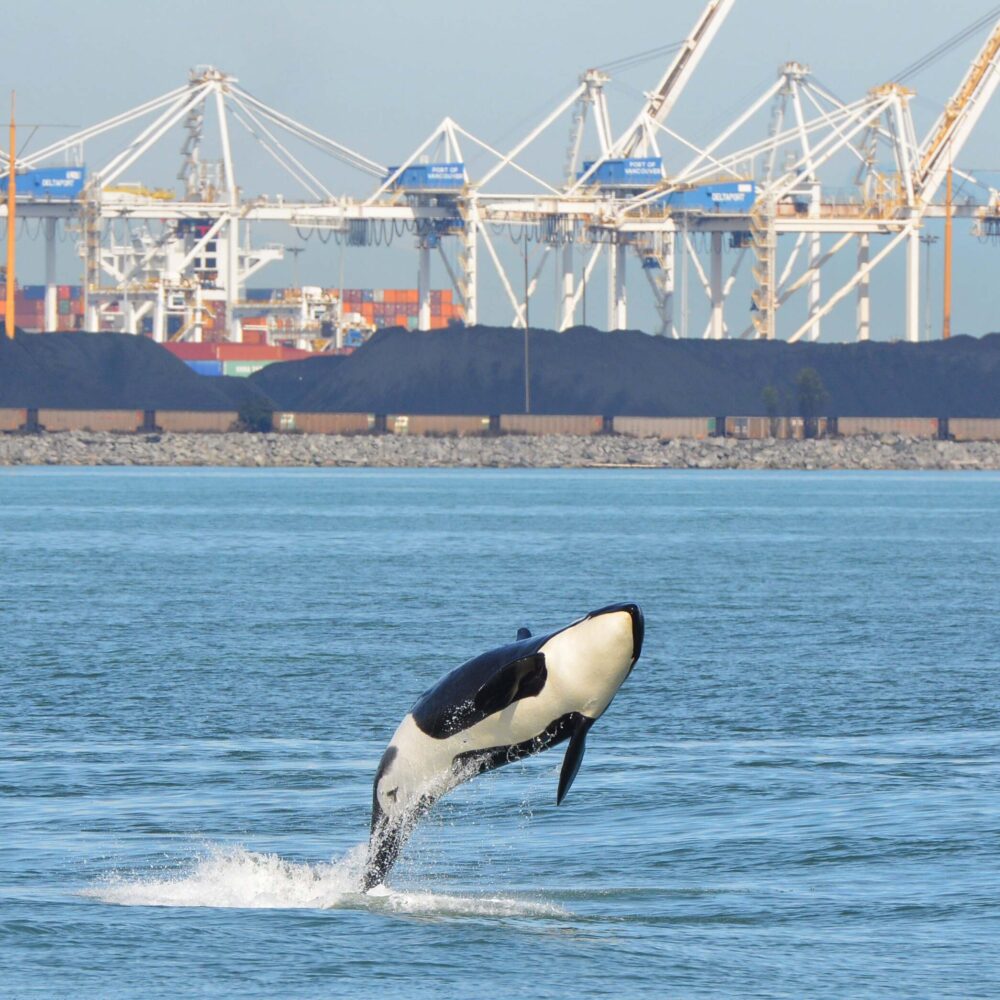
SIDNEY, BC, October 26, 2026: The Government of Canada announced its second of two referrals to the Major Projects Office today by designating the Roberts Bank Terminal 2 expansion as a Project of National Interest (PONI). This announcement will negate years of review and upend the internal Species at Risk Act (SARA) deliberations on the permits required for this project.
The Port of Vancouver was required to obtain a SARA permit issued by Fisheries and Oceans Canada (DFO) that would allow them to ‘destroy’ the Critical Habitat of endangered Southern Resident killer whales. Today’s announcement overrides the need for the permit and any assurance that RBT2 won’t push Southern Resident killer whales closer to extinction.
Section 73 of SARA is known as the ‘jeopardy clause’. It has a strict legal requirement that states a project must not jeopardize the survival or recovery of a species. The jeopardy test looks at harm remaining after considering offsetting and mitigation.
“We believe that RBT2 could not meet SARA’s jeopardy test and this PONI designation lies behind Ottawa’s desire to circumvent the need for a SARA permit. The project would not have received DFO approval because it increases the extinction likelihood for Southern Resident killer whales.”
Misty MacDuffee, Director, Wild Salmon Program
This sidestepping of the no-jeopardy requirement under SARA took place as the review was in its final stages by Fisheries and Oceans Canada. It sets a troubling precedent for endangered species in Canada.
The federal government has previously made two imminent threat decisions, finding in 2018 and again in 2024 that SRKW face imminent threats to their survival and that intervention is required to allow for survival and eventual recovery.
“Killer whales live in a world of sound. They use calls and echolocation to find salmon, coordinate as families, and stay together. Every additional ship adds noise that masks those signals. Adding container traffic to their critical habitat moves them in the wrong direction at a time when recovery requires measurable reductions in noise.”
Dr. Valeria Vergara, Program Director, Cetacean Conservation Research Program
RBT2 would add new pressures to Southern Residents in a vitally important feeding area – the Fraser River estuary. More vessel traffic and underwater noise would make it harder for the whales to find and catch salmon, while further impacting the habitat of their key prey, Fraser River Chinook salmon.
The Federal Review Panel was clear: there is no adequate plan to mitigate the underwater noise from RBT2’s added vessel traffic to Southern Resident killer whale critical habitat. Listing the project as a project of national interest doesn’t change that science. It only changes whether anyone has to act on it.
“Construction, industrial expansion, and more ships means more air and water pollution, and more risks of accidents and spills in the most diverse and productive estuary in Canada. This PONI designation risks degrading irreplaceable habitats for migrating salmon and birds, and threatens the quality and abundance of food for killer whales and for people.”
Dr. Peter S. Ross, Director of Raincoast’s Healthy Waters Program