Skip to content
Raincoast Conservation Foundation logo with bear and salmon icon.Raincoast Conservation Foundation icon.
  • Give killer whales a voice
  • What we doExpand
    • Wild Salmon
    • Healthy Waters
    • Wolf Conservation
    • Safeguard Coastal Carnivores
    • Cetacean Conservation
    • Forest Conservation
    • Youth Education
    • Research vessel
    • Southern Resident killer whales
  • ScienceExpand
    • Peer-reviewed publications
    • Reports and books
    • Mapping
    • Conservation Genetics Lab
    • Applied Conservation Science Lab
  • AboutExpand
    • Team
    • Raincoast Ocean Science Awards
    • Tracking Raincoast
    • FAQ
    • Events
    • Raincoast store
  • newsExpand
    • Latest
    • Videos
    • Raincoast Radio
    • Press releases
    • Media contacts
Donate
Raincoast Conservation Foundation logo with bear and salmon icon.Raincoast Conservation Foundation icon.

What's new // Paul Paquet

Paul Paquet

Notes from the field
Raincoast Radio
Conservation updates
Raincoast updates
Press releases
Science literature
Reports and books
Investigate and inform
Backgrounders
Map science
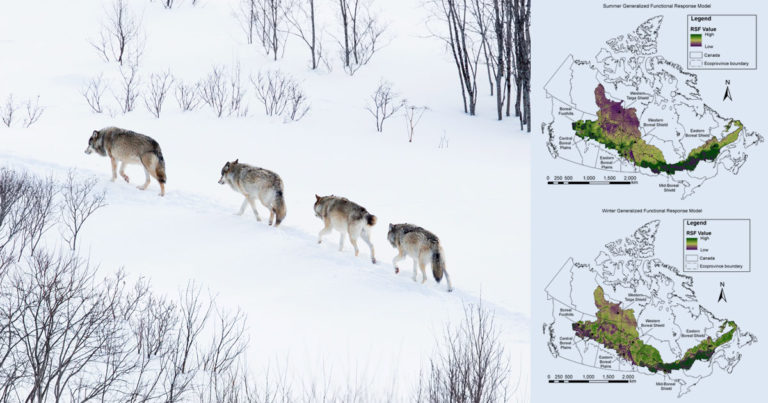
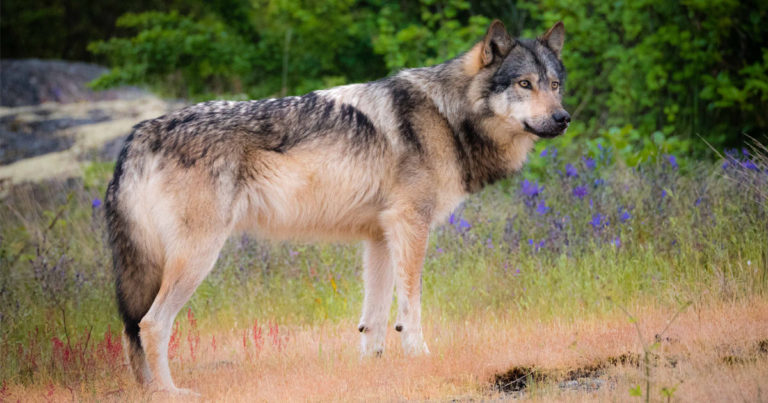
  • Four wolves walk up a hill following a narrow path, research maps superimposed on top.
    Scientific literature

    Ecology and Evolution: Functional response of wolves to human development across boreal North America

    2019 November 132024 July 8

    Previous research on how wolves are affected by human development have been limited in scope and location and the results were mixed. Wolves adapted in a range of ways depending on contextual factors like road or cutblock density. Research undertaken by a team of conservation scientists, including Paul Paquet of Raincoast Conservation Foundation, endeavoured to…

    Read More Ecology and Evolution: Functional response of wolves to human development across boreal North AmericaContinue

  • A rhinoceros and juvenile rhinoceros stand in the brown grass of the Botswana flats.
    Scientific literature

    Evidence, values, policy, and the advance of science

    2019 October 242024 July 8

    Last month, a group of scientists published a letter in the journal Science that advocated for trophy hunting, arguing that the practice can help safeguard biodiversity. In today’s issue of Science, there are six response letters, and Raincoast scientists (Drs. Kyle Artelle, Chris Darimont and Paul Paquet), contribute to three.  Our team argues that there…

    Read More Evidence, values, policy, and the advance of scienceContinue

  • Beam Reach Haro Strait Salish Sea, with a map of the Southern Resident killer whale critical habitat and the tanker route tot he Trans Mountain Expansion Burnaby terminal.
    Investigate and inform

    Raincoast’s evidence on Southern Resident killer whales for the National Energy Board’s reconsideration of the Trans Mountain Expansion

    2019 February 202024 July 8

    The National Energy Board is now preparing its recommendations to cabinet on the Trans Mountain Expansion. When we won our legal case in the federal court of appeal in August 2018, the courts quashed the Trans Mountain permits and required the National Energy Board to reconsider their recommendations…

    Read More Raincoast’s evidence on Southern Resident killer whales for the National Energy Board’s reconsideration of the Trans Mountain ExpansionContinue

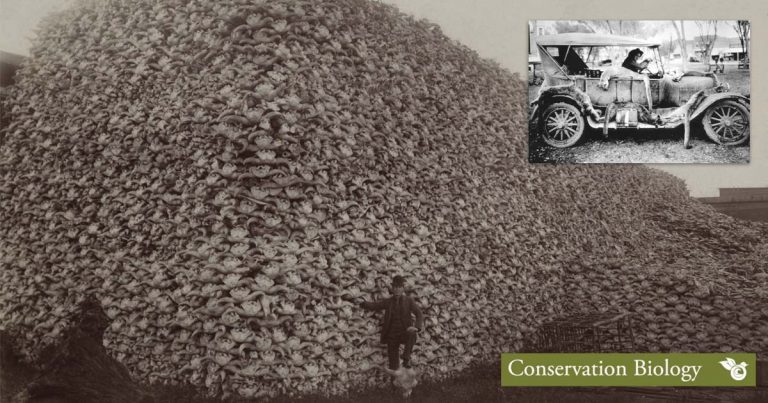
  • A giant pile of bison bones loom over a person standing beside it.
    Scientific literature

    Research: Differentiating between regulation and hunting as conservation interventions

    2019 February 112025 April 7

    Wildlife conservation literature and public discourse, too often gloss over the important difference between hunting and the regulation of hunting. This is so common that there is a persistent, misinformed idea that extinctions have been avoided through the act of hunting. Historically, the regulation of hunting, not hunting itself, has averted extinction…

    Read More Research: Differentiating between regulation and hunting as conservation interventionsContinue

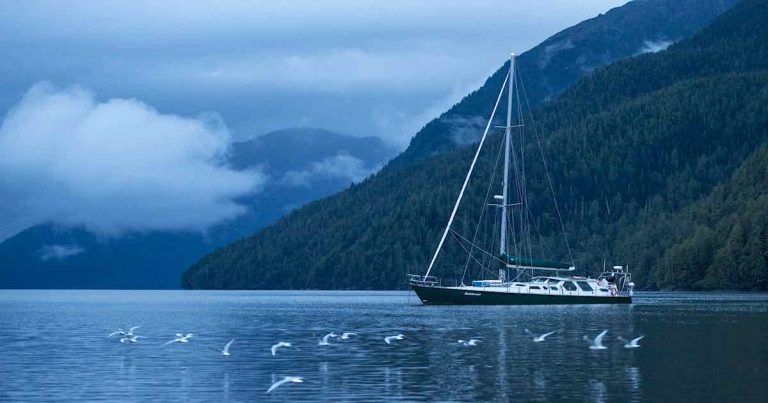
  • The Achiever with a misty mountain in the background.
    Raincoast updates

    April conservation expedition with Raincoast’s Dr. Paul Paquet

    2019 January 312024 July 8

    As Raincoast’s Senior Scientist, and a world renowned large carnivore expert, Paul’s input is key to guiding our research and conservation programs in both the Great Bear Rainforest and the Salish Sea. Paul will provide insight into key conservation issues on BC’s coast including…

    Read More April conservation expedition with Raincoast’s Dr. Paul PaquetContinue

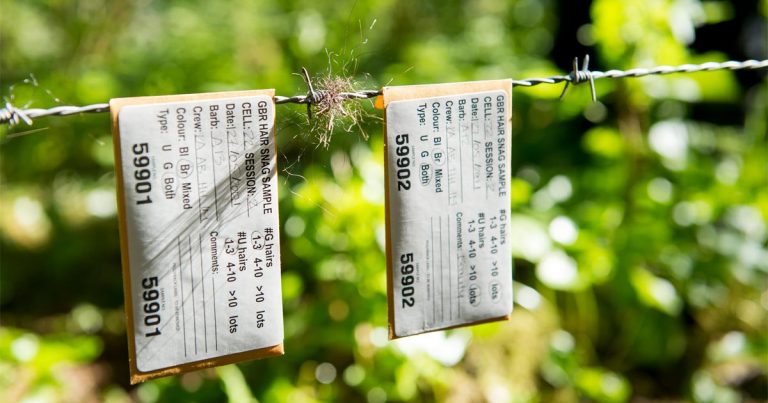
  • Hair samples in the field of bears.
    Notes from the field

    Advancing non-invasive approaches for monitoring wildlife: considering the ethics of developing new techniques

    2019 January 282024 July 8

    A theme that underlies our research in the Applied Conservation Lab is that we aim to apply methods that are minimally invasive to wildlife. This ethos emerges in large part from our partners in First Nations communities, who have taught us many important lessons about respecting the people, places, and animals where we work. Our…

    Read More Advancing non-invasive approaches for monitoring wildlife: considering the ethics of developing new techniquesContinue

  • A collage of images and graphs from a published peer reviewed article on salmonid species diversity and bear health: Hakai, Raincoast, University of Victoria, and Spirit Bear Foundation logos at the bottom.
    Scientific literature

    Salmon species diversity predicts salmon consumption by terrestrial wildlife

    2019 January 72024 October 8

    Research by scientists at Spirit Bear Research Foundation, Raincoast Conservation Foundation, and the University of Victoria, led by Christina Service, shows that salmon species diversity – the number of spawning salmon species available – is far more important and positively related to salmon consumption in coastal black bears than biomass abundance…

    Read More Salmon species diversity predicts salmon consumption by terrestrial wildlifeContinue

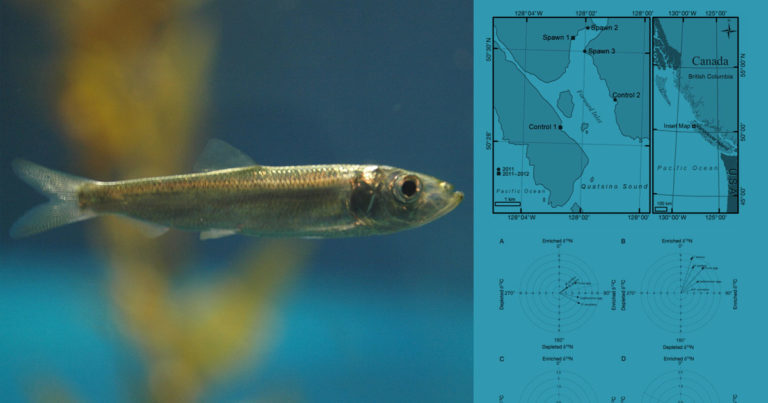
  • A Pacific herring stops moving for a moment; figures from the research about herring are on the right hand side.
    Scientific literature

    Pacific herring spawn events influence nearshore subtidal and intertidal species

    2018 May 182024 July 8

    Although we know that herring play a pivotal ecological role in nearshore ecosystems, from a scientific perspective little is known about the amount of energy and nutrients they transfer from the ocean to the land. Therefore, researchers at Raincoast Conservation Foundation, University of Victoria, and Dalhousie University, aimed to determine if the nutrients that herring…

    Read More Pacific herring spawn events influence nearshore subtidal and intertidal speciesContinue

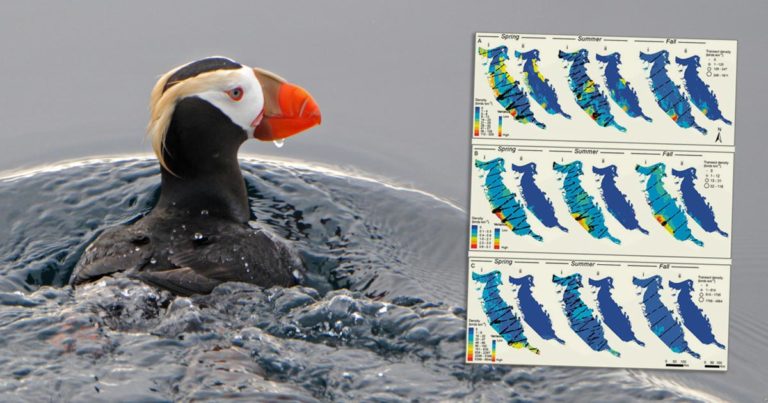
  • Maps of marine birds distributions and densities overlaid onto a tufted puffin.
    Scientific literature

    Predictions from machine learning ensembles: marine bird distribution and density on Canada’s Pacific coast

    2018 April 302024 July 8

    In February of 2017, a team of researchers, including Raincoast senior scientist Dr. Paul Paquet, from five research facilities published their findings in Marine Ecology Progress Series: “Predictions from machine learning ensembles: Marine bird distribution and density on Canada’s Pacific coast”…

    Read More Predictions from machine learning ensembles: marine bird distribution and density on Canada’s Pacific coastContinue

  • Chris Darimont close up with the CRFAX 1070 logo floating in the background.
    In the media

    Chris Darimont interviewed on CFAX 1070 about political populations

    2018 March 202024 July 8

    What is a political population? Did governments around the world try to exaggerate the size or resilience of carnivore populations? Have estimates of populations been skewed by systemic selection of data to suit political interests? Adam Stirling and Chris Darimont take on these questions and more…

    Read More Chris Darimont interviewed on CFAX 1070 about political populationsContinue

  • A map of North America and then in text it says, An assessment of 667 wildlife management systems across Canada and the USA found that key hallmarks of science were missing...
    Scientific literature

    Applied Ecology: Hallmarks of science missing from North American wildlife management

    2018 March 72024 October 23

    A new study, “Hallmarks of science missing from North American wildlife management”, published by Science Advances , challenges a widespread assumption that wildlife management in North America is science-based. Scientists from Raincoast Conservation Foundation, Simon Fraser University, University of Victoria, and the University of Wisconsin – Madison examined management documents relating to most hunted species across…

    Read More Applied Ecology: Hallmarks of science missing from North American wildlife managementContinue

  • Juvenile killer whale and mother off the coast of British Columbia.
    Investigate and inform

    National Energy Board’s failure haunts governments

    2018 February 222024 July 8

    The cries of condemnation emanating from the Alberta and Canadian federal governments are deafening. The burgeoning conflict began when BC announced the province would limit shipments of diluted bitumen from Alberta…

    Read More National Energy Board’s failure haunts governmentsContinue

Page navigation

Previous PagePrevious 1 2 3 4 5 6 Next PageNext

Registered Charity Number in Canada

#889643565 RR0001
More information

Facebook Twitter Instagram YouTube Vimeo Linkedin
  • About Raincoast
  • Events
  • Career
  • Volunteer
  • Privacy policy

.eco profile for raincoast.eco

  • Subscribe
  • Mail a cheque
  • Raincoast Ocean Science Awards
  • Contact Us
  • FAQ
  • Newsroom
  • Press releases
  • Press assets policy
  • Publications
  • Backgrounders
  • Conservation ethics
  • Photography ethics
  • Notes from the field
  • Scientific literature
  • Backgrounders

© 2026 Raincoast | W̱SÁNEĆ Territory
Site supported by Pink Sheep Media.

Scroll to top
Search
  • Raincoast Conservation Foundation
  • Give killer whales a voice
  • What we do
    • Wild Salmon Conservation
      • Managing Salmon for Wildlife
      • Climate
      • Fisheries Management
      • Trans Mountain Expansion
      • Policy and Governance
      • Habitat Restoration
      • Roberts Bank Terminal 2
    • Healthy Waters
      • Spill response
      • Plastic pollution
      • Mobile lab
    • Wolf Conservation
      • Protect wolves
      • Coastal wolves
      • Wolf School
    • Safeguarding Coastal Carnivores
      • A 25 year history
      • GBR map
    • Forest Conservation
      • Land Trust
      • S,DÁYES Flycatcher Forest
      • KELÁ_EKE Kingfisher Forest
      • Big Tree Registry
      • Project TEACH
    • Cetacean Conservation
      • Cetacean Conservation Research
    • Southern Resident killer whales
      • Ten years of work
      • Take action
    • Raincoast Education
      • Online education: Coastal Insights
      • Outdoor education
    • Achiever, research vessel
      • More about Marine Operations
      • Where are we?
      • Re-Power Achiever
  • Science
    • Publications
    • Reports and books
    • Mapping
    • Raincoast Lab
    • Genetics Lab
  • About Raincoast
    • Team members and staff
    • Tracking Raincoast
    • FAQ
    • Calendar of events
    • Raincoast Ocean Science Awards
  • News
    • Videos
    • Press releases
    • Media contacts
  • Donate
Facebook Twitter Instagram Linkedin
Search