

Twenty years in, Government of Canada still failing to implement Wild Salmon Policy, researchers warn
New study finds that twenty years later, the Wild Salmon Policy’s promise to safeguard Canada’s wild Pacific salmon remains largely unfulfilled.
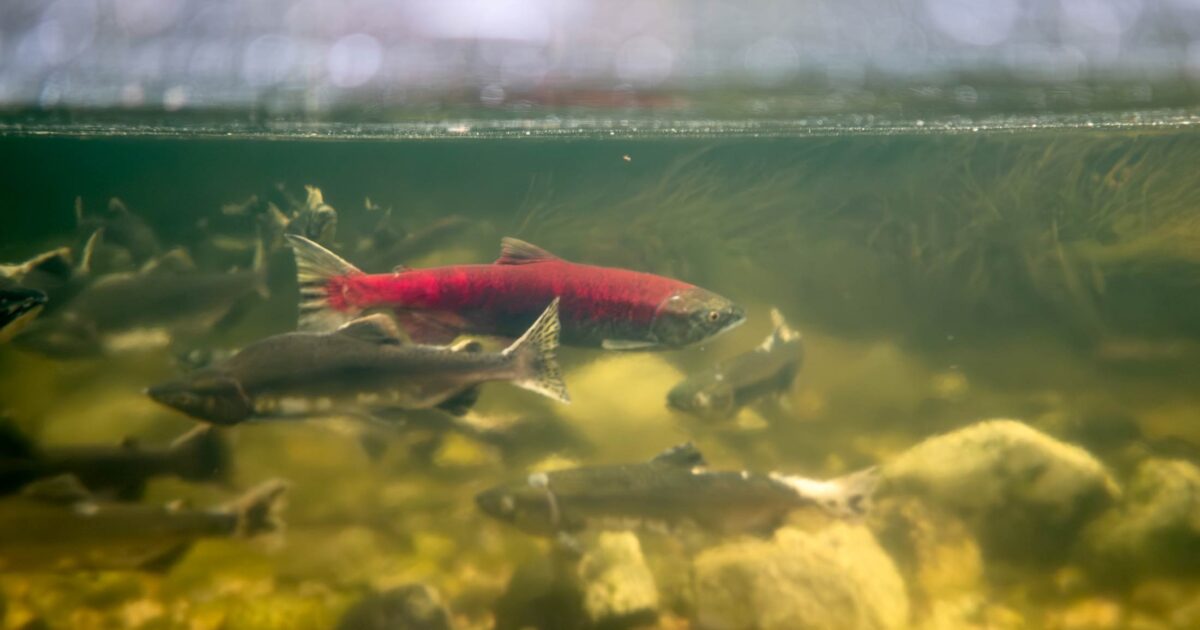
Twenty years after the inception of Canada’s Policy for the Conservation of Wild Pacific Salmon, researchers have found that, despite strong principles, the policy’s promise remains largely unrealized. In a new perspective published in the Canadian Journal of Fisheries and Aquatic Sciences, scientists and conservation practitioners from the Raincoast Conservation Foundation, Coastland Research, SkeenaWild Conservation Trust, and Watershed Watch Salmon Society examine the successes and shortcomings of the Wild Salmon Policy.
The authors conclude that persistent implementation gaps are undermining conservation outcomes for wild salmon populations across British Columbia.
The paper, titled “Gaps in policy implementation obscure conservation progress after two decades under Canada’s Wild Salmon Policy,” reviews twenty years of policy development and execution within Fisheries and Oceans Canada. While the Wild Salmon Policy established a groundbreaking framework prioritizing salmon diversity, abundance, habitat integrity, and sustainable management, its rollout has been slow, inconsistent, and incomplete, leaving critical conservation goals unmet.
“The Wild Salmon Policy remains one of Canada’s most ambitious conservation frameworks, but ambition isn’t enough”, said Aaron Hill, Executive Director of Watershed Watch Salmon Society. “Two decades on, the lack of comprehensive monitoring, coordinated leadership, and clear accountability for policy implementation mean we still lack a reliable understanding on the status of most salmon populations. Equally, we lack the tools to effectively protect habitat and rebuild populations.”
Drawing on case studies of Skeena sockeye, interior Fraser coho, and Cowichan Chinook, the authors highlight both local successes and widespread policy gaps. They find that fragmented governance, discretionary decision-making, and insufficient regulatory enforcement have weakened the Wild Salmon Policy’s intended outcomes. The authors recommend a renewed commitment to salmon population assessments, Indigenous and regional leadership in salmon watersheds, ecosystem-based management, and stronger legal authority to ensure the policy’s effectiveness in the decades ahead.
“Without meaningful reforms, the Wild Salmon Policy risks remaining an aspirational document rather than a functional conservation tool,” said study lead author Allison Dennert, Salmon Ecologist at the Raincoast Conservation Foundation. “Wild salmon populations are facing accelerating pressures from climate change, habitat degradation, unsustainable fishing practices, and other human activity. Implementing the policy in full is not optional, it’s essential.”
The study underscores that as the Wild Salmon Policy marks its 20th anniversary, its promise to safeguard Canada’s wild Pacific salmon remains largely unfulfilled. The authors argue that completing the actions laid out in the policy, closing implementation gaps, and establishing a clear national framework for action are vital to prevent further declines and secure the long-term survival and abundance of salmon ecosystems.
Dennert A, Rosenberger A, Knox G, MacDuffee M, Yehle K, Hill A. 2025 Nov 5. Gaps in policy implementation obscure conservation progress after two decades under Canada’s Wild Salmon Policy. Canadian Journal of Fisheries and Aquatic Sciences. doi:https://doi.org/10.1139/cjfas-2025-0111.