Step into a creek walker’s boots
A first-person account of monitoring the salmon run in Haíɫzaqv (Heiltsuk) Territory.
I wake to a crackle of static. A voice murmurs through our kitchen VHF radio, All stations. All stations. All stations. This is Prince Rupert Coast Guard Radio, Prince Rupert Coast Guard Radio, Prince Rupert Coast Guard Radio. Gale warning in effect for Central Coast McInnes to Pine Island. I’m grateful we are sticking to the inside.
As I swing my feet off the bed I hear the whirr of the coffee grinder telling me I’m running behind. In the kitchen my colleagues are already shuffling about, throwing turkey sandwiches together and shoving fruit gummies into their lunch bags. I look out the window and see the dim glow of the tugboat docked in front of our apartment. I can see its skipper, Jackson, sipping coffee illuminated by the cabin lights, and the glow of dawn about to break out across the water.

I wearily slather cream cheese on my over-toasted bagel and gratefully accept a strong black coffee that’s passed to me. There’s a swishing of nylon as we pull on our rain gear and stuff the waders into our giant lime-green drysack. Barely 20 minutes have passed since I left my bed and we’re hurrying out the door, down the ramp, into the boat, and pushing off the dock into another day.
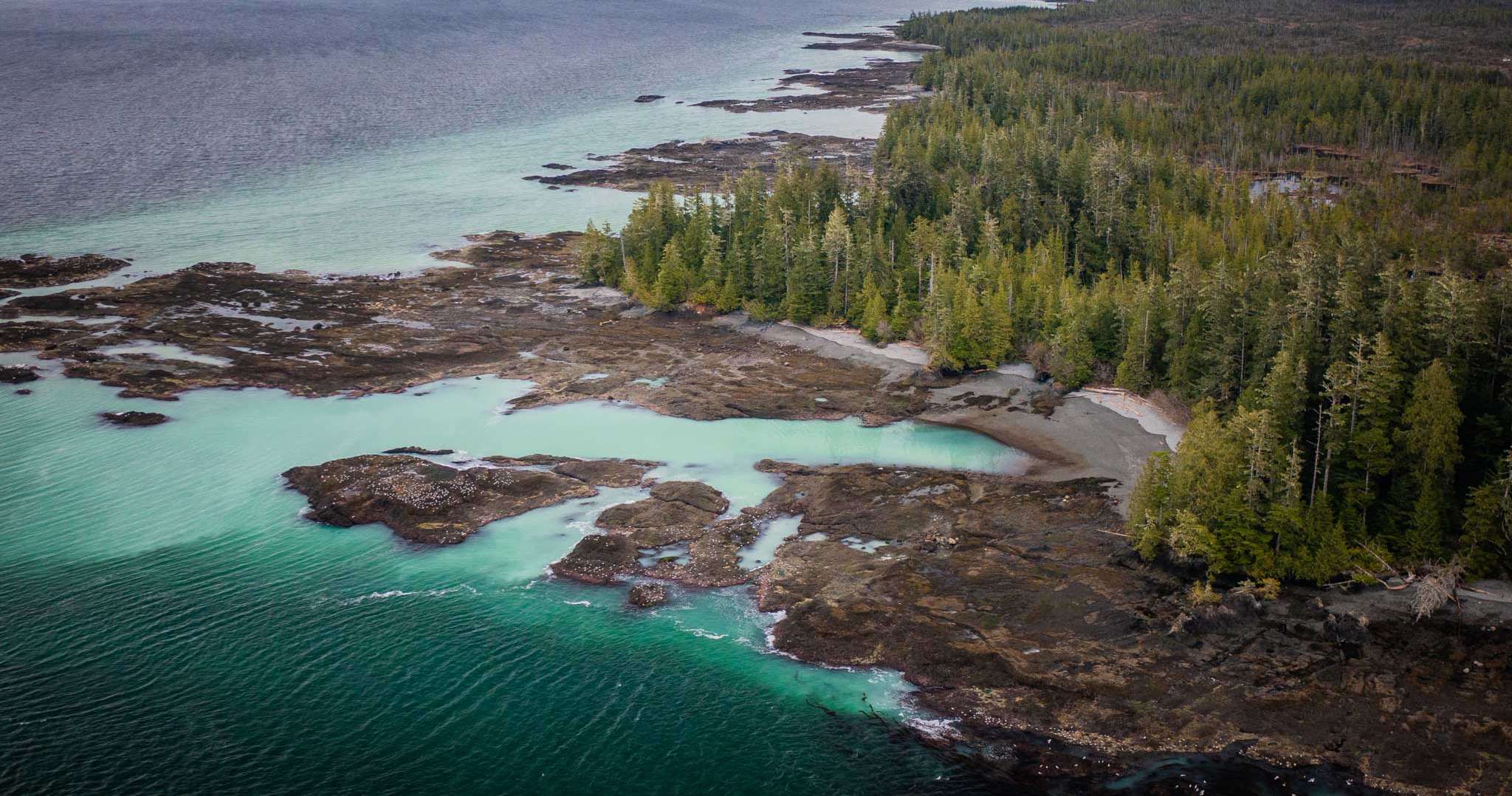
Looking at a map of British Columbia, the Central Coast is but a small strip of coastline somewhere between Prince Rupert and the northern tip of Vancouver Island. As you zoom in closer, the area kaleidoscopes into thousands of islands and inlets, a mosaic of land and sea. Deep fjords reach their fingers far inland, terminating at granite peaks that rise straight out of the water. It’s a place of unimaginable biodiversity and abundance.
We’re here in Bella Bella (Waglisla) to monitor the fall salmon runs, the organic fuel that powers the incredible ecological productivity across the coast. The data we collect will be used by government and First Nations fisheries managers for stock management and recovery planning. Unlike large watersheds like the Fraser, Skeena, and Nass, where the salmon return in the millions to a single river system, salmon watersheds in the Central Coast are made up of thousands of tiny creeks, some no wider than a kitchen table. Many are barely visible on a map, and often have an upstream terminus at a lake or waterfall less than three kilometers from the ocean.
The diverse geography of the Central Coast is a reason there is immense ecological diversity in its salmon populations. Each creek is home to its own unique population of fish. This makes it difficult to truly understand exactly how salmon in this region are doing year to year. Monitoring every creek across the coast would be impossible, so fisheries managers developed an approach to monitor a few “indicator” creeks that are supposed to reflect how salmon populations in the surrounding areas are doing. However, the number of indicator streams monitored every year has fallen over time as the government has continually cut funding for monitoring, leaving an ever growing knowledge void about the state of salmon on the Central Coast.
The work Raincoast supports here builds on over 20 years of monitoring conducted by the Reynolds Lab at Simon Fraser University, in partnership with the Haíɫzaqv Nation. It also brings Raincoast full circle as our Wild Salmon Program originated in the Great Bear Rainforest a quarter of a century ago. In fact, Raincoast’s seminal 2002 report Ghost Runs: The Future of Wild Salmon on BC’s North and Central Coasts (PDF), and subsequent 2008 peer reviewed journal paper Ghost Runs: Management and status assessment of Pacific salmon returning to British Columbia’s central and north coasts, were born out of our early field work 25 years ago.
Our aim is to fill in these data gaps by monitoring streams that have fallen off the federal government’s list of priorities, as well as streams that are prioritized by the Haíɫzaqv Nation. One of those streams is Lee Creek, which is the focus of our day.

We’re a team of five, including myself. Allison and Paige are part of Raincoast’s Wild Salmon team. Arianne is with the Reynolds Lab at SFU and is our project leader, having led the work for the past three years. We’re also joined by Royce, who’s from Waglisla and is our team’s newest member. Our boat, Keta, glides by towering sitka spruce and western red cedar whose branches are pasted with Usnea, – the lichens that hang from their boughs. Bearing the latin name for Chum Salmon, Keta is our simple 19-foot aluminum vessel, standing out among others with a bright orange kayak fastened to the deck. Most mornings we sit quietly staring out the cabin, watching the mountains pass by and watching for whales in the distance.
We round a rocky point and approach Troup Narrows, a tight navigable channel through two islands that allows us to take a direct path to Roscoe Inlet, and our target, Lee Creek. Navigating the tightest section of the pass at speed is a rite of passage for new boat drivers in the area. Keta shoots through the pass and makes an S turn around a rock reef as we enter Roscoe Inlet. The water is like glass here. Our wake is the only disturbance in an otherwise tranquil bay. Deeper into Roscoe, the low, forested domes transform into sheer granite walls rising straight out of the black water and into the clouds. We crane our necks and gawk at the spectacle, always inspiring no matter how many visits we make.
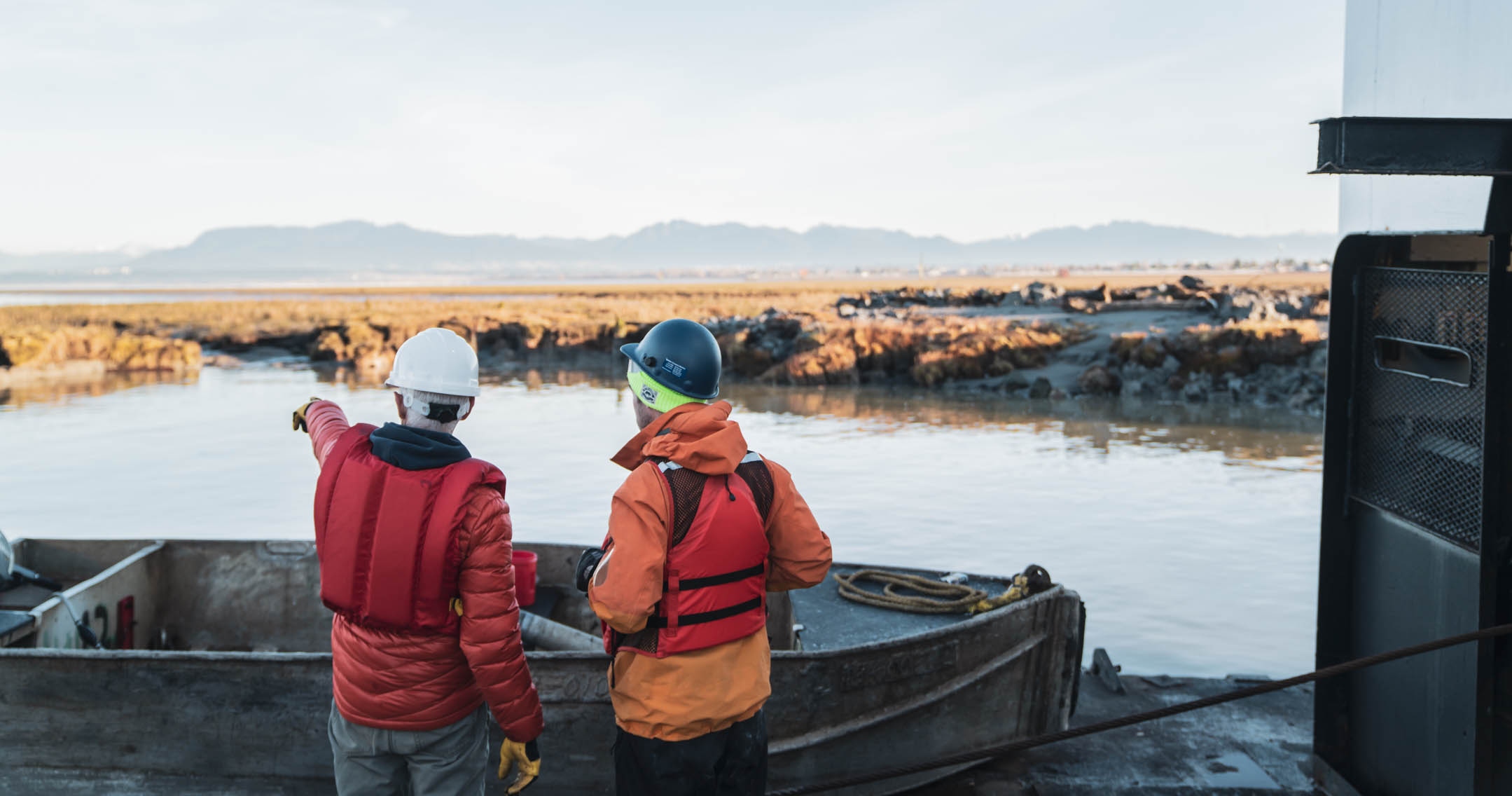
Before long Keta is nudging into the salt marsh and we’re kneeling at the bow, looking for a shallow spot to jump off. I spot a flat patch of grass beneath a foot of water and make the jump, feet sinking slightly into the organic mat, and turn to brace myself against the boat, slowing its drift. We wade onshore as Arianne maneuvers Keta into deeper water to set anchor, before sliding the kayak into the water and paddling to join us on shore. It’s a gentle quiet. An eagle chitters somewhere in the distance. Up ahead, Lee Creek flows silently into the sea. There’s a subtle scent of rotting fish.


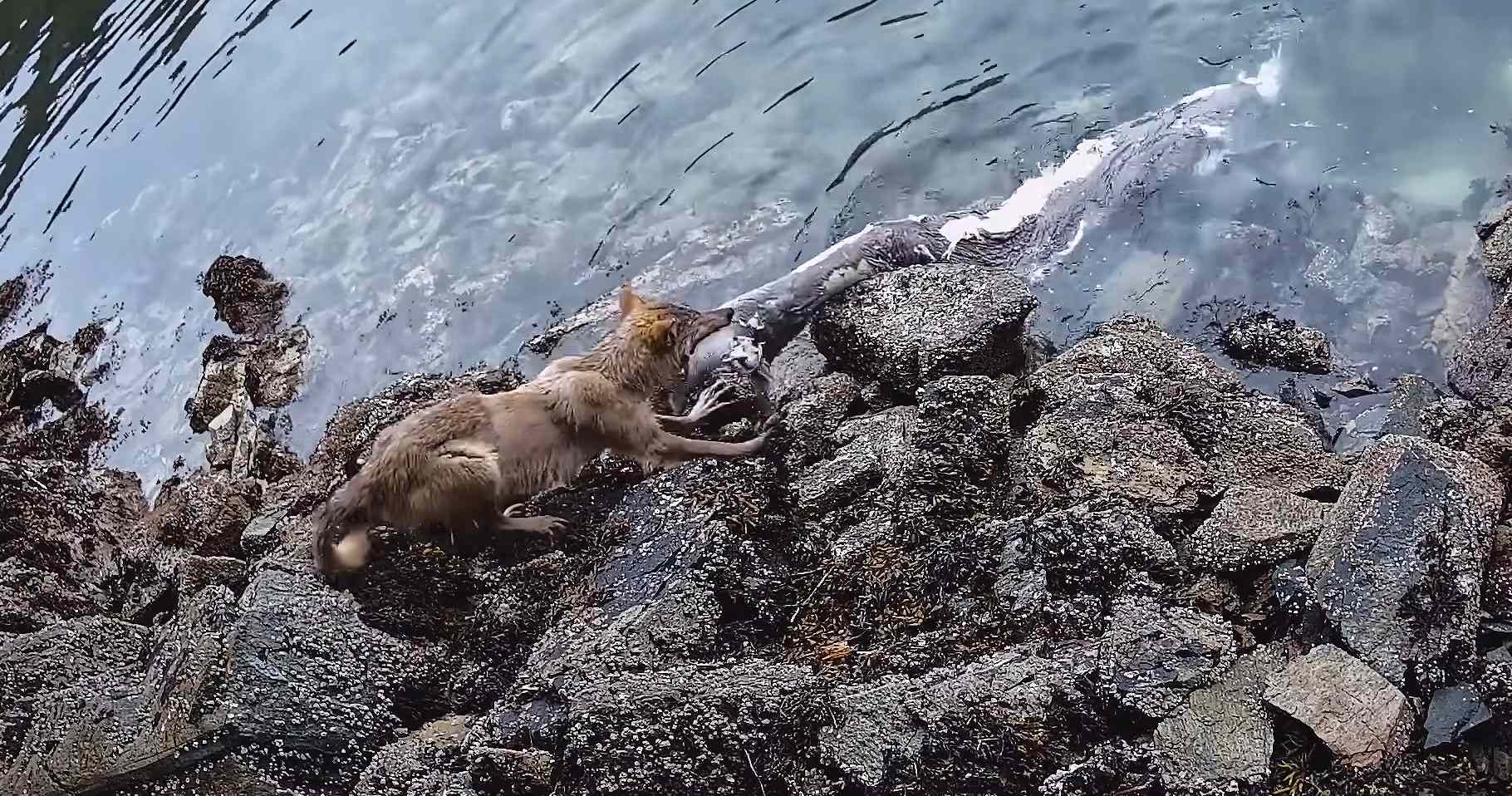
We split into two teams. Arianne and Allison count live fish, while Royce and I count the dead. We visit each stream several times over the course of the two month-long chum and pink salmon run, and the ratio of dead to live at each visit gives us a sense of how the run is progressing over time. The dead counts of each species are separated by manner of death: bear kill, wolf kill, or natural death. This data helps us understand predator-prey dynamics, and detect changes in predator abundance and behaviour over time.

At first this task seemed daunting. How were we supposed to identify what killed a salmon based on a mangled, half-rotted carcass? The secret lies in the eating habits of each predator. Wolves seem to specifically target the fatty brains of the fish, leaving perfect semi-circular holes in the fish’s head. The rest of the fish is untouched. Researchers hypothesize that over generations, wolves learned to avoid the flesh of salmon as they contain parasites that could weaken or kill a wolf. The brain of a salmon doesn’t contain parasites and is high in fat, making it an energy efficient meal. Bears on the other hand, aren’t as picky, especially at the start of the run when they eat all parts of the fish. As they satiate, they focus more on the eggs of the females. Both predators often drag fish far into the forest before eating them, helping move nutrients deeper inland.

We trudge up the stream as a unit, occasionally calling out to let bears know we are in the area. We’ve arrived at the peak of the pink run and there are thousands of spawning adults in the creek today. Their spotted yellow tails flash in the tannic water. Many are paired up already, I can see the females on their sides, expertly digging out the gravel with quick flicks of their tails, and the males, with their characteristic humped backs.


We reach a fork in the stream and split up. I take Royce on a small side channel densely grown over with salmonberry, devil’s club and stink currant. The brambles form a near-solid wall of vegetation at face-height, forcing us to crawl along the streambed. The channel is barely a meter across and less than knee deep, yet it is boiling with fish. My breath catches as I narrowly avoid sinking my palm into a pile of near-liquid salmon carcasses. I look back at Royce, who seems to be enjoying himself in this dense thicket.
We forge ahead, crawling under and vaulting over ancient trees which have toppled into the creek long ago, forming eddies and pools that salmon use to escape the current. We shimmy under one cedar that is wider than a school bus.
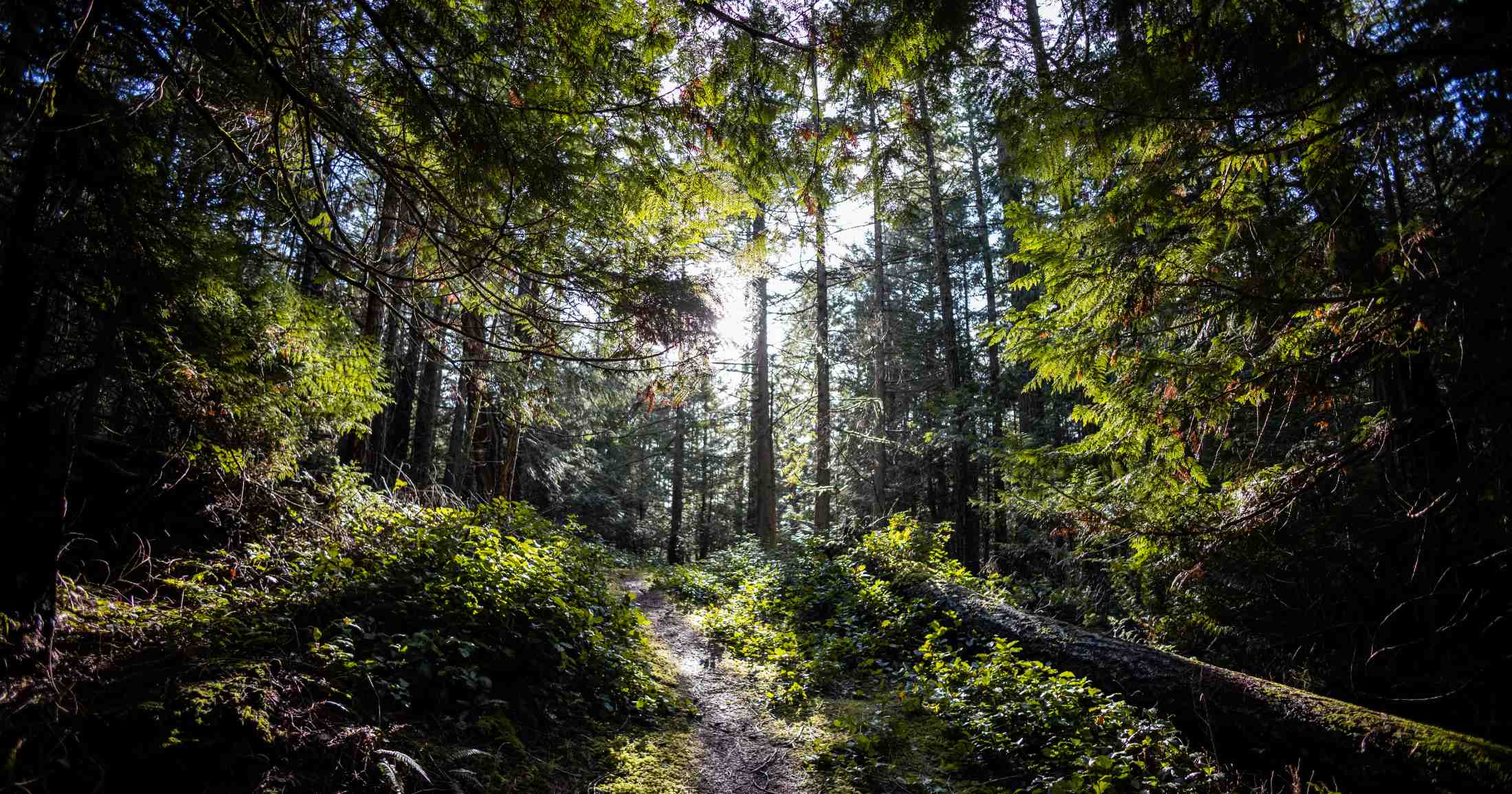
After half an hour we arrive under a large spruce and tear into our snacks, resting on the plush emerald moss that carpets the forest floor. There is life covering every surface in this forest. Mosses of innumerable diversity, liverworts with scales like snakeskin, pastel-green Lobaria lichen, licorice ferns fluttering in the breeze, neon-orange jelly fungus, bird’s nest fungus, brilliant red huckleberries, all of it woven together by a twisted net of roots and dripping with moisture. Taking a hand lens to any square centimeter of this place would reveal dozens, if not hundreds of different species. Salmon are the foundation for this productivity. Their arrival in the stream each year brings about a perfusion of marine nutrients into the freshwater environment.
Pacific salmon are semelparous, meaning they spawn once in their lifetime before dying. Between predation and natural senescence, the dead fish pile up in logjams and along the riverbank, their bodies picked apart by scavengers then further broken down by decomposers. The nutrients contained in each fish spread far throughout the forest, taken up by plants, fungi, and bacteria. My colleague Allison’s research has found that plants fertilized by salmon carcasses grow larger leaves and more showy flowers than their unfertilized counterparts. Multiply this effect over thousands of streams and thousands of years and one can appreciate how salmon are the biological glue that binds this ecosystem together.
A pink salmon thrashes next to my foot and jolts me from my daydream. I’ve finished my packet of fruit gummies.


There’s still another half hour upstream to go. We radio Allison and Arianne to check in and rise from our little alcove, leaving human-shaped imprints in the moss. Continuing onwards, we count hundreds more salmon until we reach a house-sized tangle of fallen trees that marks the rendezvous point, where Allison and Arianne are waiting.
Wood of every shape and size has piled up here over time to form a dam that slows the creek to a trickle. We exchange quips about whose channel was harder as we together clamber up the mess of wet wood to check the final pool where we often find coho salmon, which are renowned for their ability to swim up something akin to a wet rope. We pull over the lip and find the pool, which looks to be 20 feet deep and is situated at the base of a small waterfall. I can see the bottom; the pale pink bedrock laced with black striations looks like a scoop of vanilla ice cream with a chocolate swirl.

Together we peer into the depths of the pool and count a dozen coho salmon, characterized by their bullet shaped bodies and their propensity to streak off in every direction with the slightest disturbance. We take a moment to marvel at these fish, who have somehow entered the pool by way of its outlet, which looks like a waterslide. The audacity of these coho, to fight their way up a foaming torrent without knowing what lies ahead. It’s a trait that many people who study salmon deeply appreciate.

Our survey complete, we retrace our steps back towards the estuary, doing our best to avoid the masses of wriggling fish who seem hell bent on tripping us up. Over and under the fallen trees, through the tunnels of salmonberry, squeezing around boulders and across perched log-bridges, we finally arrive at the mouth of the creek, the scent of salt and a chorus of gulls greeting us. The tide has risen over a meter since we were last here.

Arianne unties the kayak from a tree and paddles it out to Keta. We wait on shore, the clanking of Arianne pulling the anchor onboard echoing across the still bay. She starts the engine and expertly negotiates the rocky shallow channel towards our pick up point. With some difficulty, we all get on board without flooding our waders in the high tide. Weary, we sit silently and watch as the sweeping granite cliffs pass us by, thankful for another day spent in one of the most incredible places on earth.